










A landmark investigation into Tyrannosaurus rex fossils has fundamentally altered scientific understanding of how long these apex predators took to mature.
Research conducted by three American scientists has established that T. rex did not achieve full adult proportions until approximately 40 years of age, rather than the 25 years previously accepted by palaeontologists.
The findings, published in the journal PeerJ, indicate these prehistoric giants experienced a gradual, steady maturation process spanning several decades.
Earlier estimates had suggested a far more rapid development, but the new analysis reveals that the oldest specimens likely survived well past their fourth decade.
TRENDING
Stories
Videos
Your Say
The extended growth period effectively gave the species a prolonged adolescence during which they continued increasing in both size and strength.
The research team employed a novel technique to uncover the true age of these dinosaurs, slicing through fossilised leg bones and polishing them until they became nearly transparent.
Scientists then examined these specimens using microscopes equipped with polarised light filters, which revealed growth rings previously invisible under standard illumination.
Much like the annual rings found in tree trunks, these markings recorded periods when growth either halted entirely or slowed considerably.
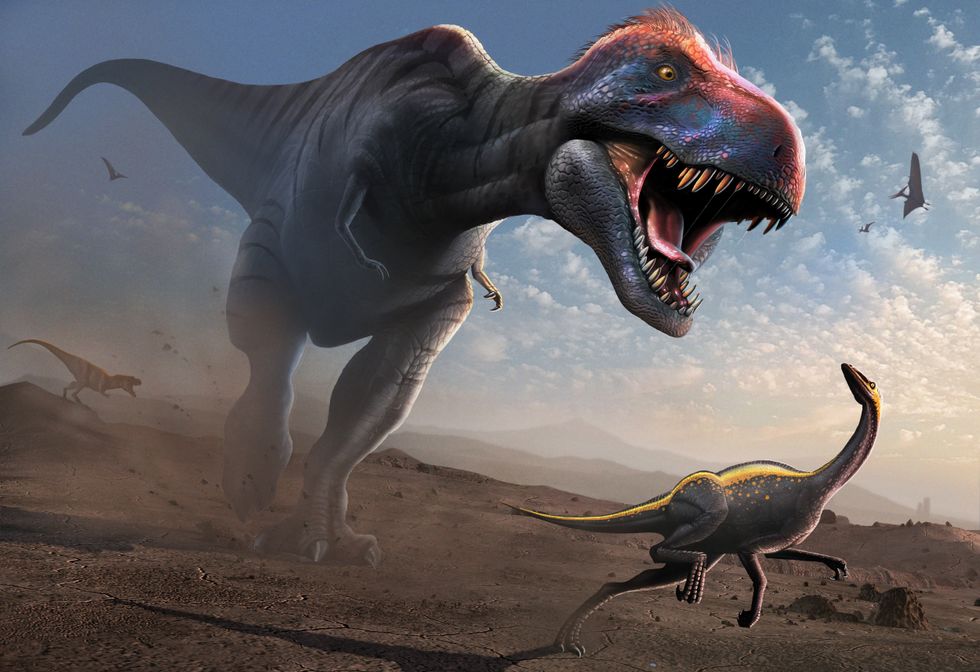
The T. rex did not achieve full adult proportions until approximately 40 years of age according to the new findings
|GETTY
The polarised light created vivid colours and sharp contrasts that made every ring visible in remarkable detail.
Bone samples were collected from 17 tyrannosaur specimens, primarily sourced from museum collections in Montana and North Dakota.
Among these were fossils from well-known individuals nicknamed 'Jane' and 'Petey', which displayed particularly distinctive growth characteristics.
The investigation revealed distinct phases in tyrannosaur development, with the most dramatic changes occurring during a teenage growth spurt.
Between the ages of 14 and 29, these predators packed on weight at an extraordinary rate, adding between 800 and 1,200 pounds annually.
However, this rapid expansion represented only one stage of a far longer journey to adulthood.
Following this intense period of growth, the dinosaurs entered what researchers describe as a 'subadult' phase lasting an additional 10 to 15 years.
During this extended stage, they continued accumulating mass and size at a slower pace before finally reaching full maturity.
MORE INCREDIBLE SCIENCE DISCOVERIES
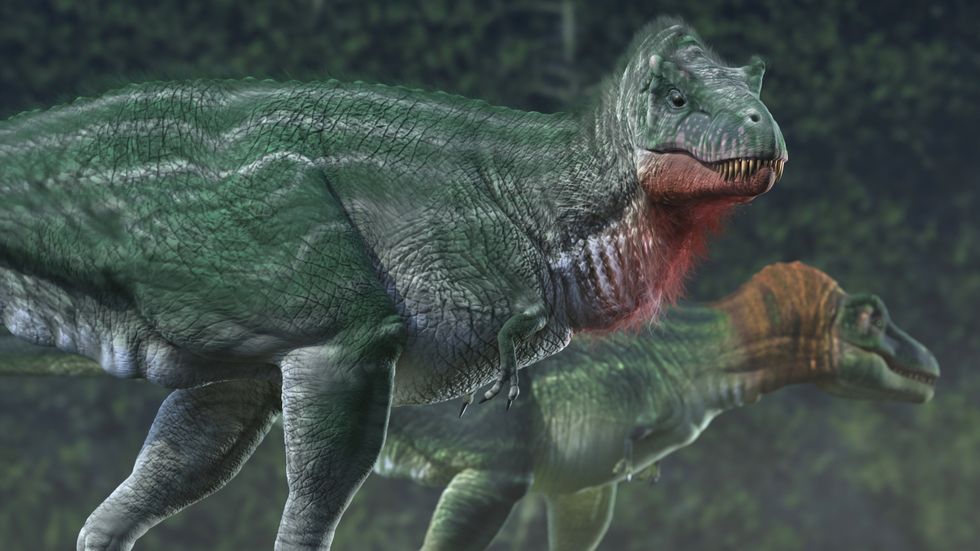
The investigation revealed distinct phases in tyrannosaur development, with the most dramatic changes occurring during a teenage growth spurt
|GETTY
The team developed four separate counting methods and utilised computer modelling to determine which approach produced the most consistent picture of the dinosaur lifespan.
Nathan Myhrvold, a mathematician from Oklahoma State University Center for Health Sciences, acknowledged the complexity of the analysis, stating: "Interpreting multiple closely spaced growth marks is tricky. We found strong evidence that the protocols typically used in growth studies may need to be revised."
The solid lines within the fossils indicated moments when growth ceased completely, whilst fuzzier bands marked periods of mere deceleration.
Sophisticated computer models combined data from multiple specimens to construct a more precise growth curve, accounting for variations caused by environmental stresses and food scarcity.
Jack Horner of Chapman University in California noted the ecological significance of these findings: "A four-decade growth phase may have allowed younger tyrannosaurs to fill a variety of ecological roles within their environments."
He suggested this protracted maturation enabled juvenile T. rex to hunt smaller prey, potentially contributing to their dominance during the Cretaceous Period.
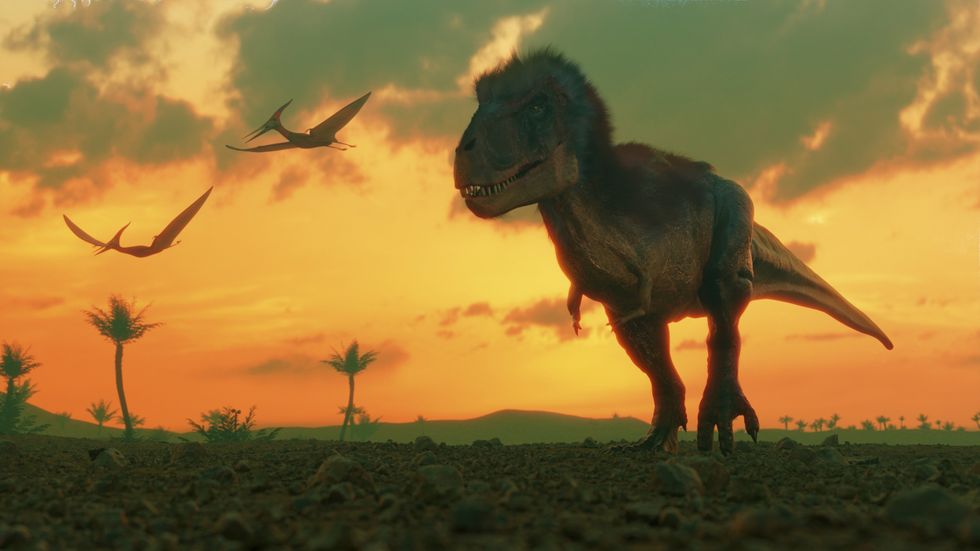
The study represents a significant advancement in understanding how these formidable creatures developed
|GETTY
The researchers acknowledged certain limitations in their conclusions, noting that the fossils examined belonged to a broader 'Tyrannosaurus rex species complex' that may have encompassed more than a single species or subspecies.
This taxonomic uncertainty could potentially have influenced the newly proposed growth timeline.
Particularly intriguing were the specimens known as Jane and Petey, whose growth patterns diverged significantly from the remainder of the fossil group.
These anomalies have prompted speculation that these smaller individuals might actually represent a distinct species altogether, possibly the proposed 'Nanotyrannus'.
Despite these caveats, the study represents a significant advancement in understanding how these formidable creatures developed, challenging decades of assumptions about dinosaur biology and suggesting that previous methodologies for ageing prehistoric specimens may require substantial revision.