










Archaeologists have uncovered the remains of a gigantic "sunken city" off the coast of western France.
The discovery, made near the Ile de Sein, points to an advanced coastal civilisation which existed more than 7,000 years ago.
The site includes a substantial granite wall resting on the seabed, along with at least twelve smaller constructions sitting below the waves.
Researchers say the findings demonstrate a level of sophistication previously unheard of for this era in France.
The buildings reveal that the ancient French possessed technical skills and social organisation far beyond what is commonly believed.
The largest structure stretches 120 metres across a submerged valley.
Divers explored the site between 2022 and 2024, finding stacked granite blocks supported by more than 60 standing monoliths.
Some stone slabs reach nearly two metres in height.
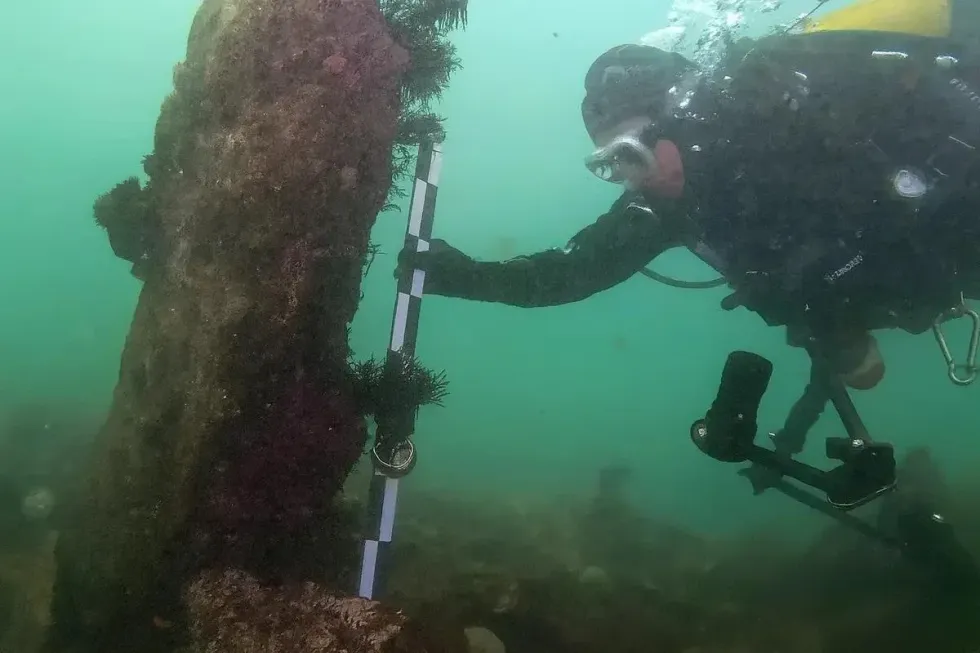
Divers explored the site between 2022 and 2024, finding stacked granite blocks supported by more than 60 standing monoliths
|INTERNATIONAL JOURNAL OF NAUTICAL ARCHAEOLOGY
Another group of constructions was identified during dives in 2024.
These feature narrower walls built from smaller stones, positioned to seal natural gaps in the terrain.
One notable find includes a 50-metre row of tightly arranged small monoliths.
Some of these stones stand in parallel lines.
The site first came to light in 2017 when laser-based seabed mapping revealed strange lines on the ocean floor.
ARCHAEOLOGICAL MARVELS - READ MORE:
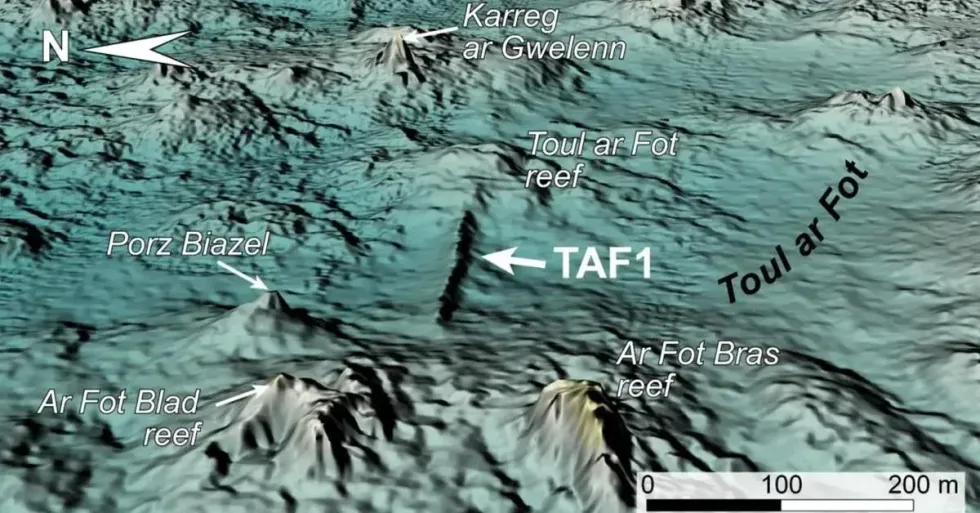
Scans of the sea floor revealed a mysterious line below the waves
|INTERNATIONAL JOURNAL OF NAUTICAL ARCHAEOLOGY
Follow-up Lidar surveys and underwater investigations confirmed these were man-made rather than natural formations.
Scientists estimate the structures were erected between 5800 and 5300 BC.
During this period, sea levels sat much lower than today.
The area would have formed part of the dry coastal landscape during the transition from the Late Mesolithic to Early Neolithic periods.
Researchers believe the smaller formations may have served as fish traps.
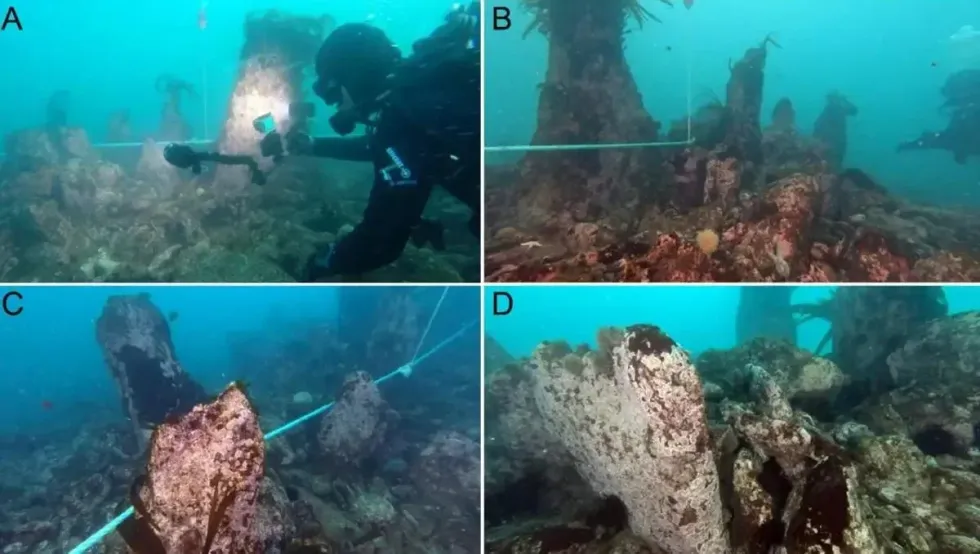
Scientists estimate the structures were erected between 5800 and 5300 BC
|INTERNATIONAL JOURNAL OF NAUTICAL ARCHAEOLOGY
The larger constructions likely had different purposes, perhaps functioning as coastal defences or territorial boundaries.
Curiously, in Britanny's folklore, local legends speak of a sunken city lying west of the Bay of Douarnenez, close to where the structures were found.
No evidence supports the existence of any truly lost city.
But researchers suggest that "collective memories" of an abandoned coastal landscape, later swallowed by rising waters, may have inspired such tales over thousands of years.
The findings contribute to growing evidence that sophisticated stone-building practices existed among coastal hunter-gatherer communities long before farming reached Europe.
Similar submerged structures have been documented in the Baltic, where ancient peoples constructed stone alignments to guide migrating animals.