








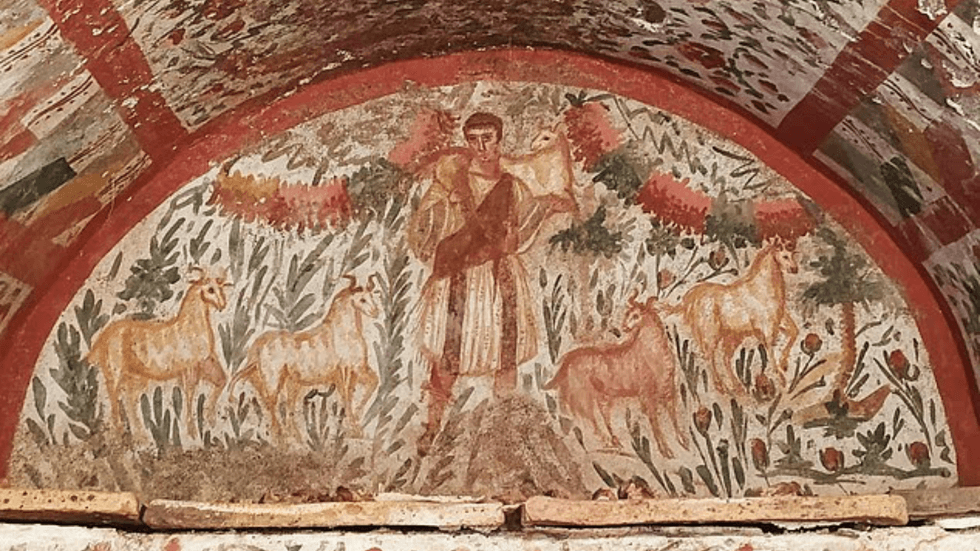
Archaeologists have unearthed a vibrant third-century mural in Turkey portraying Jesus as the "Good Shepherd", mirroring one of the Bible's most important verses.
Turkish authorities have described it as the sole early Christian-era example of its type discovered beyond Italian borders.
The remarkable painting emerged from the northern wall of a subterranean chamber tomb at the Hisardere Necropolis, situated in the Iznik district of Bursa province.
This extensive cemetery, dating between the second and fifth centuries AD, ranks among the largest ancient burial sites in the region, containing diverse interment styles from terracotta-roofed tombs to stone sarcophagi and deep underground burial chambers.
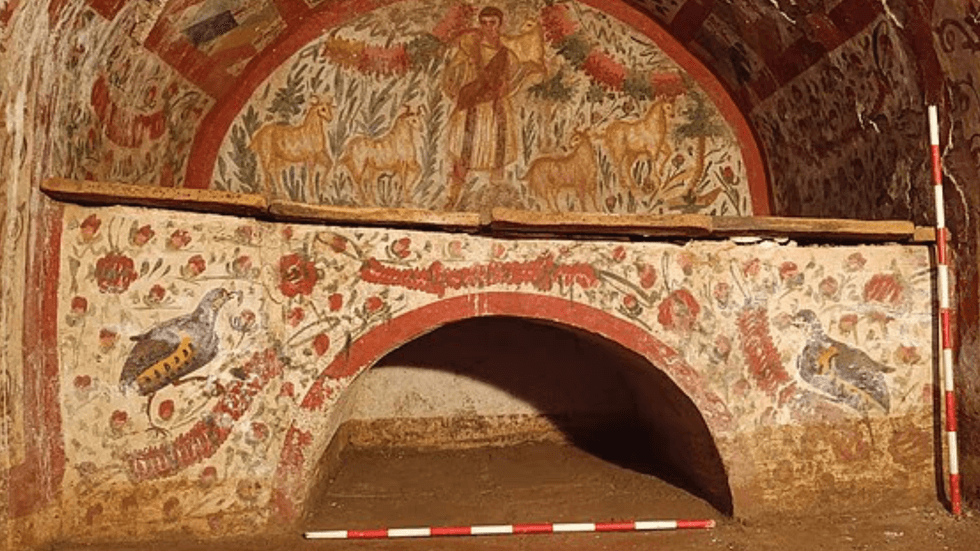
The artwork depicts Jesus as a youthful figure dressed in a simple tunic, carrying a goat across his shoulders
|FACEBOOK/ARKEOLOJIHABER
The artwork depicts Jesus as a youthful, clean-shaven figure dressed in a simple tunic, carrying a goat across his shoulders as he moves through a pastoral landscape populated by other goats.
This imagery directly corresponds with the biblical passage from John 10:11, where Jesus declares: "I am the good shepherd."
The discovery demonstrates that followers of the early Christian faith employed identical visual representations and terminology for Jesus as those recorded in the New Testament.
Beyond the shepherd scene, the tomb's three surviving walls and ceiling bear additional painted decorations, with the fresco positioned directly behind a raised burial platform lined with terracotta tiles.
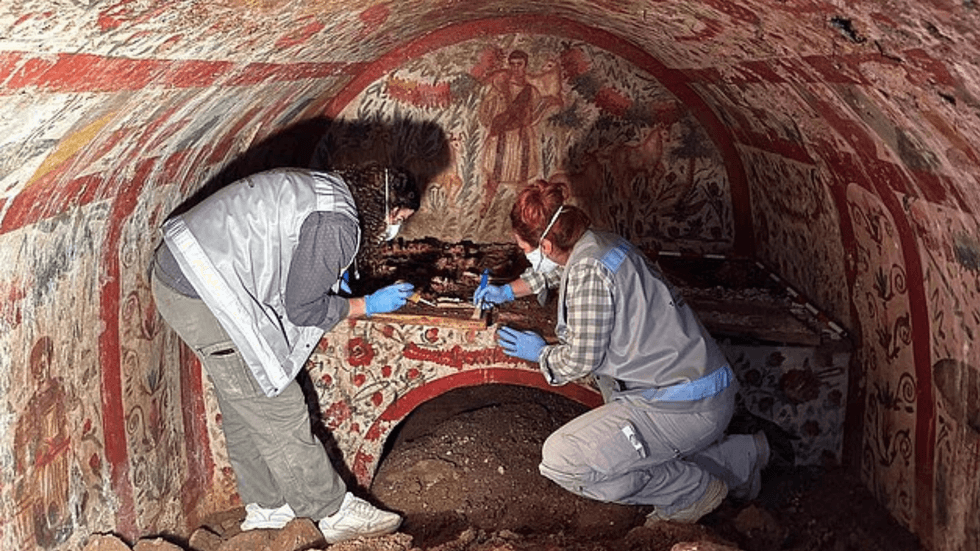
Turkish authorities have described it as the sole early Christian-era example of its type discovered beyond Italy.
|FACEBOOK/ARKEOLOJIHABER
According to experts who spoke to Middle East Eye, the painted image of Jesus within the tomb signifies a shift from pagan religious practices to Christian worship.
Prior to the cross becoming Christianity's primary emblem, believers frequently utilised the Good Shepherd imagery to convey their faith, with the figure carrying a sheep symbolising protection, salvation and divine guidance.
This allowed early Christians to express their beliefs discreetly during an era when explicit religious iconography remained unusual.
The tomb's western wall features portraits of a married couple, likely those interred there, depicted as wealthy aristocrats through their elegant clothing and ornaments.
ARCHAEOLOGY - READ THE LATEST:
Early Christians frequently utilised the Good Shepherd imagery to convey their faith
|FACEBOOK/ARKEOLOJIHABER
A symposium scene accompanying these figures maintains pagan traditions by representing the afterlife as an eternal banquet, despite the tomb's Christian elements.
The region now known as Turkey served as a vital crossroads between Asia and Europe, hosting numerous ancient civilisations before becoming part of the Roman and Byzantine empires.
Christianity took root in Anatolia during the first century following the crucifixion, with several Apostles establishing churches and ministering to local populations.
The ancient city of Antioch, present-day Antakya, witnessed both the founding of the first distinct Christian church and the earliest documented use of the term 'Christian'.
İznik already holds considerable religious significance as the location of the First Council of Nicaea in 325 AD, which established fundamental Christian doctrines.
Researchers anticipate that continued excavations at the necropolis may reveal further frescoes, inscriptions and artefacts illuminating ancient Nicaea's heritage.
The remarkable find comes just months after archaeologists unearthed a 1,700-year-old church in the Diyarbakır region, shedding light on early Byzantine Christian communities in eastern Anatolia.
The discovery offered a rare insight into how Christianity spread beyond the Roman heartlands.
Our Standards: The GB News Editorial Charter