









An Italian researcher has claimed a second Sphinx may lie buried beneath the sands of the Giza Plateau, with ancient carvings potentially offering a clue left behind more than three millennia ago.
Filippo Biondi announced his findings on Thursday during an appearance on the Matt Beall Limitless podcast.
The "Dream Stele", a stone monument between the Great Sphinx's front paws, shows what appears to be two sphinx figures rather than one.
Mr Biondi and his team suggest this imagery may represent an actual second monument rather than just symbolism.
Researchers used satellite radar technology to pick subtle vibrations in the ground.
From that, they found what they believe is a huge structure hidden beneath a mound of compacted sand.
"We are finding precise geometrical correlation, 100 percent of correlation, in this symmetry," Mr Biondi said, adding: "We are very confident to announce this we have a confidence about 80 per cent."
By drawing a line from the centre of the Khafre Pyramid to the existing Sphinx, the team established a geometric reference point across the plateau.
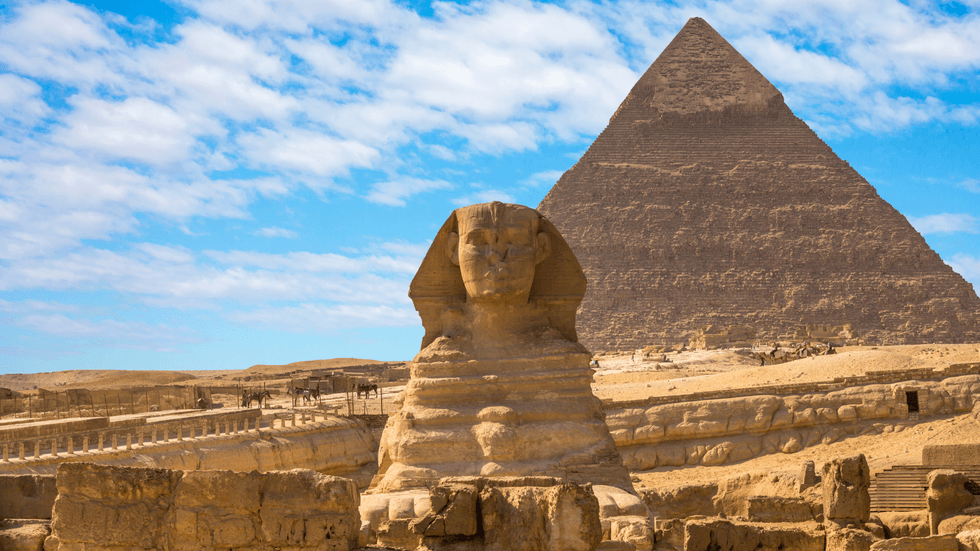
An Italian researcher believes a second Sphinx may lie buried beneath the sands of the Giza Plateau
|GETTY
Mirroring this alignment from the centre of the larger Great Pyramid indicated a location on the opposite side where scans suggest the second structure may lie.
"That small mountain has a height of approximately 108 feet," the Italian researcher explained, noting that the original Sphinx sits in a shallow depression below the plateau surface.
Initial scans reveal vertical shafts and passages bearing striking resemblance to those discovered beneath the known Sphinx.
"There is an incredible symmetry between the first and the second," Mr Biondi observed.
REMARKABLE FINDS - READ MORE:
Filippo Biondi announced his findings during an appearance on the Matt Beall Limitless podcast
|YOUTUBE/MATT BEALL PODCAST
The dense vertical lines detected are thought to represent solid shaft walls rather than hollow spaces.
Horizontal tunnels extending from deeper sections have also been identified in the preliminary data.
Last year, Mr Biondi's team claimed to have discovered massive underground structures beneath Giza.
He said: "Down underneath the Giza Plateau, there is something very huge that we are measuring.
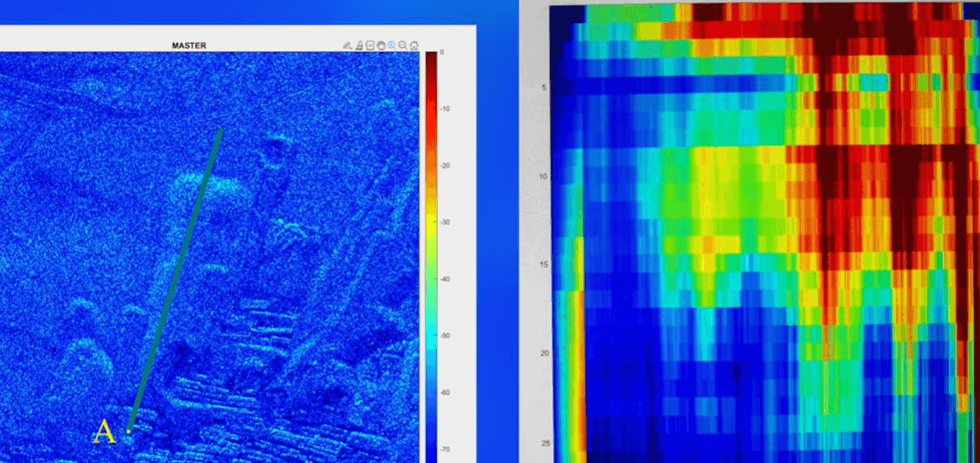
Researchers used satellite radar technology to identify what they believe is a large structure
|YOUTUBE/MATT BEALL PODCAST
"There is an underground megastructure."
The Dream Stele was erected by Pharaoh Thutmose IV around 1401 BC during the 18th Dynasty.
Egyptologist Bassam El Shammaa proposed a similar theory over a decade ago, citing ancient records describing lightning striking the Sphinx.
But Egypt's former Minister of Antiquities, Zahi Hawass, dismissed Mr El Shammaa's claims in 2017, insisting the area had been extensively excavated without yielding evidence.
Mr Biondi stressed that on-site investigation with geologists remains essential before reaching definitive conclusions.
His team has now prepared a formal project proposal for submission to Egyptian authorities.
Our Standards: The GB News Editorial Charter