









Archaeologists have discovered a "lost Pompeii" that once towered above the ancient Roman city, with structures reaching up to 40ft in height perched atop the grandest residences.
Research teams from Berlin's Humboldt University and the Archaeological Park of Pompeii have reconstructed these vanished upper storeys using sophisticated 3D modelling techniques.
Their findings, published in the E-journal Scavi di Pompei, suggest that the wealthiest inhabitants of Pompeii lived beneath impressive towers that served as symbols of status and influence.
These elevated structures, destroyed when Mount Vesuvius erupted in AD79, offered commanding views across the city and the Bay of Naples.
The investigation began with an architectural puzzle at the House of Thiasus, a villa celebrated for its fresco-adorned banquet hall.
A substantial stone staircase within the property appeared to terminate abruptly, connecting to nothing visible at ground level.
Rather than dismissing this anomaly, the research team chose to consider what might have existed overhead.
The collaboration between German and Italian scholars focused on this particular residence, questioning whether the imposing steps once provided access to something far grander than the preserved ruins suggested.
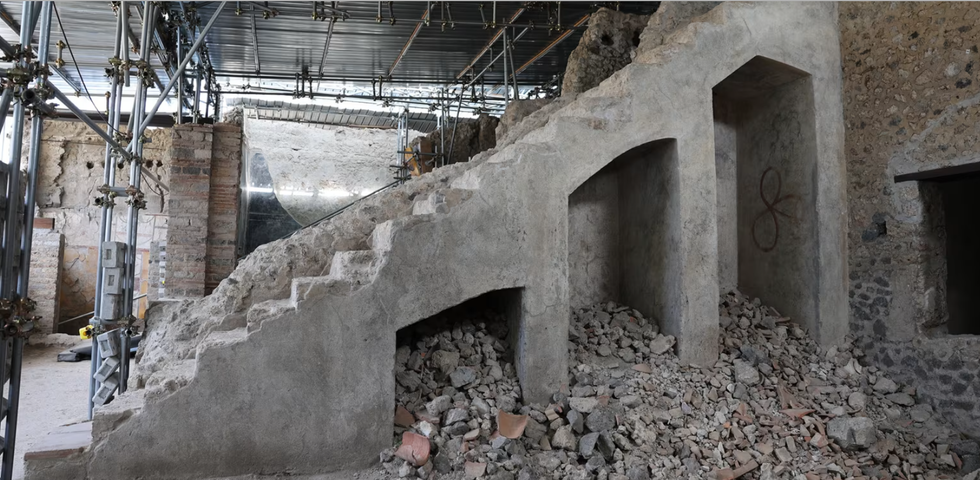
A substantial stone staircase within the property appeared to terminate abruptly
|HUMBOLDT UNIVERSITY OF BERLIN/POMPEII RESET PROJECT/SUSANNE MUTH/DIRK MARIASCHK/ELIS RUHEMANN
Their decision to look skyward rather than concentrate solely on surviving ground-floor remains proved transformative for understanding the site's original architecture.
By scanning the structures that survived, researchers created digital replicas and identified telltale signs of what once stood above—disconnected staircases and severed support beams pointing to vanished floors.
The team's analysis indicates the House of Thiasus likely featured a multi-storey tower, with modest furnishings at lower levels contrasting sharply with the grand external staircase leading upward.
Gabriel Zuchtriegal, director of the Archaeological Park of Pompeii, explained the significance: "Lost Pompeii consists of the upper floors of buildings which are essential to understanding life in the ancient city."
LATEST DEVELOPMENTS
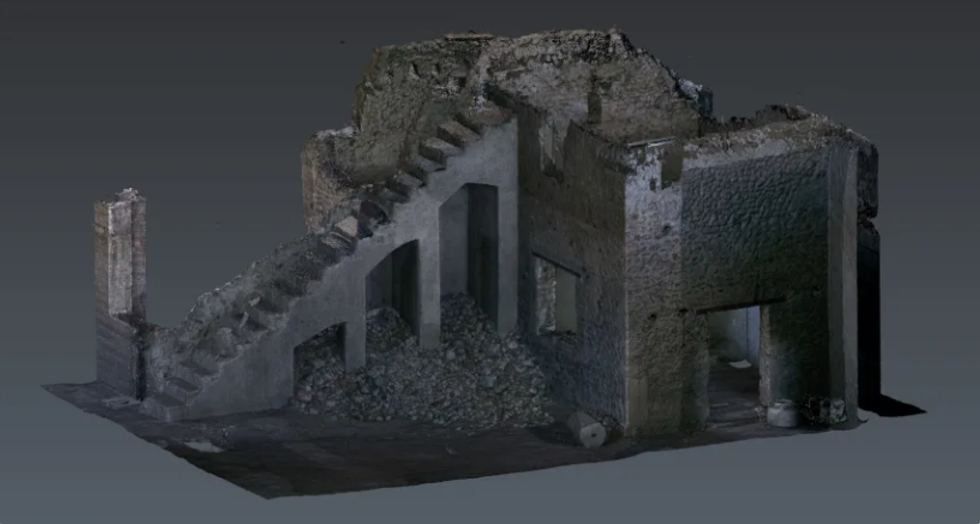
The 3D modelling approach enables scholars to develop hypothetical reconstructions
|HUMBOLDT UNIVERSITY OF BERLIN/POMPEII RESET PROJECT/SUSANNE MUTH/DIRK MARIASCHK/ELIS RUHEMANN
The 3D modelling approach enables scholars to develop hypothetical reconstructions illuminating ancient spaces and social hierarchies.
This methodology represents a shift in archaeological practice at Pompeii, focusing on what the volcanic catastrophe obliterated rather than what it preserved.
The devastating eruption buried and protected the city's lowest levels whilst simultaneously destroying everything above.
Zuchtriegal noted that alongside traditional excavation work, "another approach involves non-invasive research, based on studies and hypothetical reconstructions of what has not been preserved, but which adds to our knowledge of the site."
The digital reconstructions suggest Pompeii's elite once ascended their private towers to survey the cityscape, gaze across the Bay of Naples, and observe the night sky from privileged vantage points now lost to history.