









Long-held assumptions about Neanderthals' cognitive abilities have been challenged by new research from Indiana University, published in the Proceedings of the National Academy of Sciences.
The study suggests our ancient relatives possessed intelligence comparable to modern humans, contradicting decades of scientific thinking that portrayed them as mentally inferior.
For generations, the distinctive skull shape of Neanderthals led scientists to conclude they suffered from limited language capabilities, reduced mental capacity and weaker memory function.
The Indiana University team wrote in their paper: "The question of why Neanderthals no longer exist has long been of interest. Speculation on Neanderthal cognition based on archaeological and paleoneurological research has frequently concluded they were likely cognitively challenged. Putting estimated Neanderthal differences into the context of modern human variation does not support this view."
The researchers employed MRI scanning technology to examine brain anatomy across two distinct modern human populations.
Their sample comprised 200 individuals of European descent living in the United States alongside 200 ethnic Han Chinese participants.
When comparing specific brain regions between these groups, the scientists discovered something unexpected.
Volume differences in particular areas of the brain proved larger between the contemporary American and Chinese cohorts than those estimated between Neanderthals and early Homo sapiens.
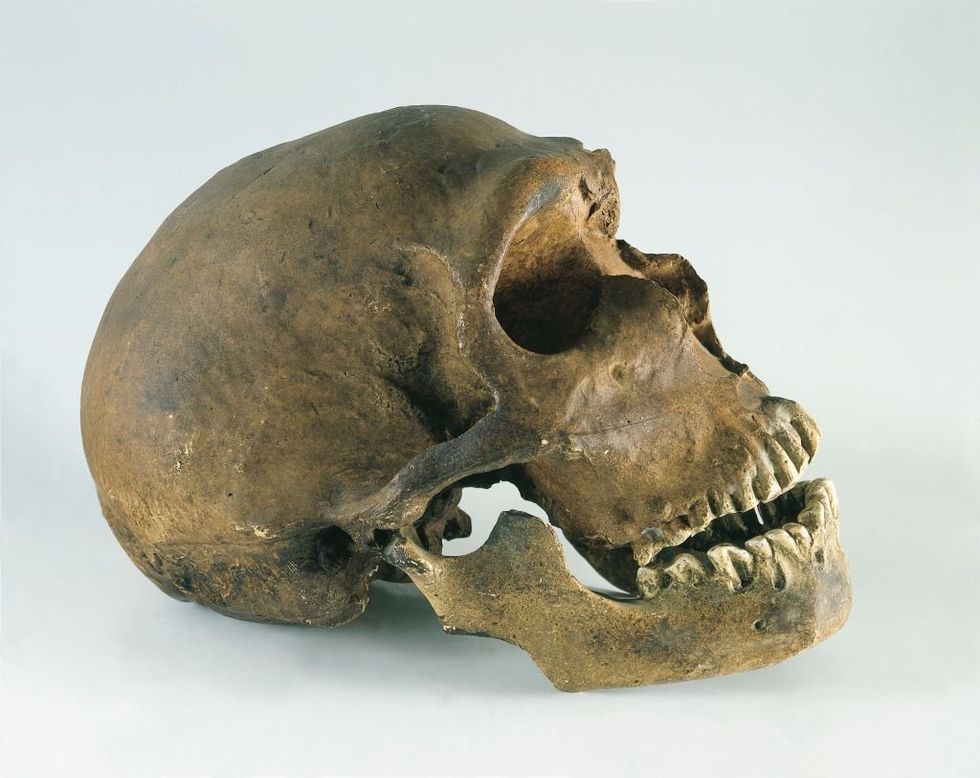
The distinctive skull shape of Neanderthals led scientists to conclude they suffered from limited language capabilities
|GETTY
The team examined 13 separate brain regions, finding greater variation between present-day populations in nine of them.
"It seems likely that any average cognitive differences that existed would have been very subtle, if detectable at all," the researchers concluded.
They also noted recent scientific literature indicates any connection between brain size and intelligence remains weak and unproven.
Rather than being outsmarted by Homo sapiens, Neanderthals likely disappeared through a process of genetic absorption, according to the researchers.
LATEST DEVELOPMENTS

Long-held assumptions about Neanderthals' cognitive abilities have been challenged by new research from Indiana University
|GETTY
Interbreeding between the two species over thousands of years gradually replaced Neanderthal genes with those of modern humans, a phenomenon scientists describe as genetic "swamping".
The study authors point out that Neanderthals occupied vast territories stretching from Portugal to central Asia's Altai Mountains before their extinction roughly 40,000 years ago.
Archaeological findings demonstrate these ancient humans mastered fire, cooked their food and gathered diverse resources from their environment.
Evidence of sophisticated behaviour continues to mount, with discoveries showing Neanderthals created cave paintings, fashioned tools, produced adhesives and water-resistant materials, and even crafted their own clothing.
Some Neanderthal artwork in Spain appears to predate the earliest known modern human creations by approximately 20,000 years.
Additional research published in PLOS One has reached similar conclusions, finding no evidence to support claims of human superiority in areas such as weaponry, hunting techniques or cognitive function.
That study stated: "We have found no data in support of the supposed technological, social and cognitive inferiority of Neandertals compared to their AMH contemporaries."
Separate work conducted last month explored how Neanderthals might have communicated verbally.
Professor Steven Mithen from the University of Reading told the Daily Mail: "They would have sounded more nasal because of their large noses, could speak much louder and for longer periods without taking a breath because of their large chests and lung capacity."
Despite these vocal differences, experts believe the two species could have understood one another through gestures and facial expressions.
Our Standards: The GB News Editorial Charter