









Ancient Egyptians have been found to have used a 3,000 year-old "Tipp-Ex" like correction fluid to fix artistic errors on papyrus documents and artworks, new research has suggested.
Researchers at Cambridge's Fitzwilliam Museum made the discovery as staff prepared one of the best-preserved Egyptian scrolls for public display, noticing a dense white substance applied along both sides of a jackal figure painted on the artefact.
This particular scroll is a Book of the Dead, a funerary text intended to assist the deceased in navigating the afterlife.
The finding suggests that long before modern office workers reached for Tipp-Ex to cover typing mistakes, Egyptian artists had developed a comparable solution for correcting their work on precious papyrus manuscripts.
TRENDING
Stories
Videos
Your Say
The scroll was created for Ramose, a royal scribe, and has been dated to between 1290 and 1278BC.
Archaeologists unearthed the document in 1922 at a tomb in Sedment, Egypt, where it lay fragmented into hundreds of pieces requiring painstaking reassembly.
The jackal depicted on the scroll appears to have been deemed too plump by someone overseeing the work more than three millennia ago.
"Paint was used to alter the outline of the black figure, making it slimmer," the researchers observed.
 White lines were used to thin the body of the jackal, thought to be an image of the god Wepwawet | THE FITZWILLIAM MUSEUM
Analysis revealed white pigment had been carefully applied above the animal's back, beneath its belly, and around its legs to create a more slender silhouette.
The jackal is shown in the traditional Egyptian side-on perspective typical of the period's artistic conventions.
The technique of infrared reflectography, which penetrates multiple paint layers, enabled researchers to make this discovery.
LATEST ARCHAEOLOGICAL DISCOVERIES:
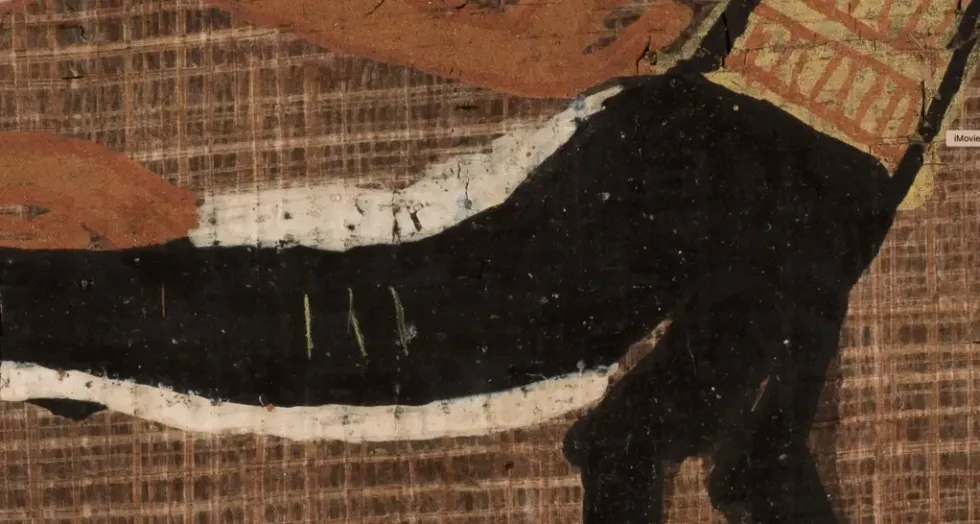
The ancient Tipp-Ex was used to slim the jackal
|THE FITZWILLIAM MUSEUM
Helen Strudwick, senior Egyptologist at the museum and curator of the Made in Ancient Egypt exhibition running until April 12, explained the analytical process.
"We have been using different analytical techniques to work out what this white paint is made of," she said.
"The results indicate that it is a mixture of huntite and calcite."
Examination with a 3D digital microscope also detected traces of orpiment, a yellow pigment, likely added to help the correction blend with the original pale cream colour of fresh papyrus.
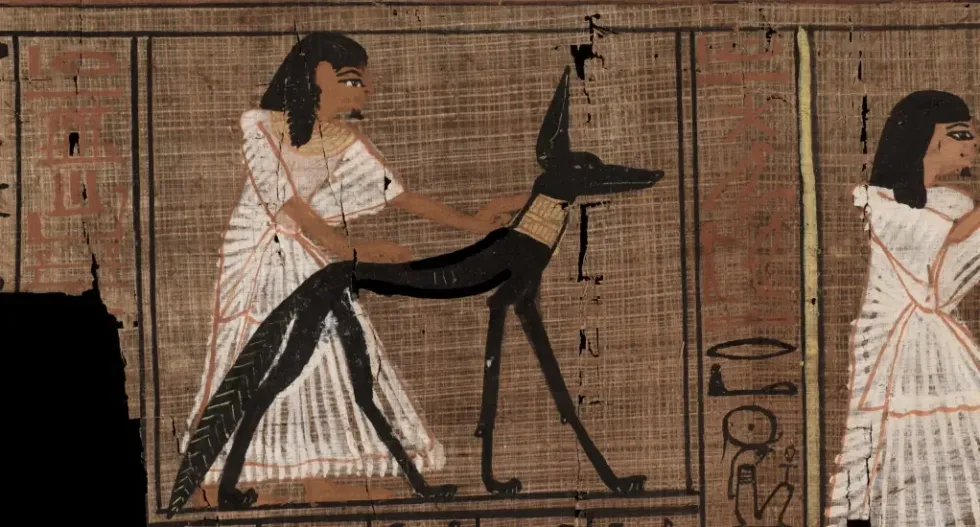
White lines were used to thin the body of the jackal, thought to be an image of the god Wepwawet
|THE FITZWILLIAM MUSEUM
"It's as if someone saw the original way the jackal was painted and said 'It's too fat make it thinner', so the artist has made a kind of ancient Egyptian Tipp-Ex to fix it," Ms Strudwick noted.
She has subsequently identified similar correction techniques on other ancient Egyptian manuscripts, including the Book of the Dead of Nakht held at the British Museum, and the Yuya papyrus housed in Cairo's Egyptian Museum.
"When I've pointed it out to curators, they've been astonished," she said, "it's the kind of thing you don't notice at first".
The complete scroll originally measured approximately 20 metres in length, comprising numerous papyrus sheets joined together.
Having been stored away from damaging light for most of the past century, the document remains in remarkably good condition, with portions now on display in the exhibition.
The jackal figure accompanying Ramose most likely represents Wepwawet, a deity known as the "opener of the ways" who guided both armies and the deceased through Duat, the underworld.