










Scientists have been left stunned after discovering that a mysterious interstellar object contains unusually high concentrations of alcohol.
Researchers studying the 3I/ATLAS comet found it is releasing the substance in quantities unlike anything previously observed near Earth.
The 3I/ATLAS object captured global attention late last year when it was identified as just the third known object from beyond our solar system ever seen passing through.
The enormous celestial body - estimated to have a solid core up to 3.5 miles wide - made its closest approach to Earth shortly before Christmas and will never return.
TRENDING
Stories
Videos
Your Say
Researchers have now discovered that 3I/ATLAS contains extraordinarily high levels of methanol.
Methanol is a form of alcohol, though not the type found in drinks due to its extreme toxicity.
The substance is more commonly used in rocket fuel and antifreeze.
The discovery was made by scientists working at the Atacama Large Millimeter/submillimeter Array observatory in Chile.
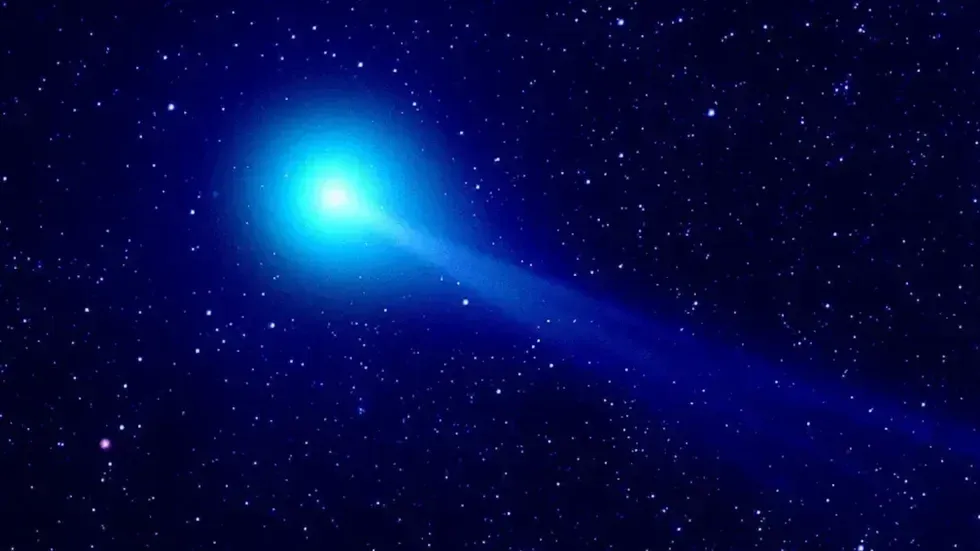
The enormous celestial body made its closest approach to Earth shortly before Christmas
|GETTY
They analysed gas plumes released from the comet as solar heat warmed its frozen surface during its approach.
While detecting methanol and hydrogen cyanide in comets is fairly common, the sheer volume of alcohol streaming from 3I/ATLAS is highly unusual.
The organic molecule methanol appears in far greater quantities than in almost all comets native to our solar system.
Professor Nathan Roth from American University said: "Observing 3I/ATLAS is like taking a fingerprint from another solar system.
SPACE - READ THE LATEST:

Methanol is a form of alcohol, though not the type found in drinks due to its extreme toxicity
|GETTY
"The details reveal what it's made of, and it's bursting with methanol in a way we just don't usually see in comets in our own solar system."
Scientists are still unsure what explains the phenomenon.
One theory suggests the comet formed in an extremely cold region of its original star system.
Another possibility is that exposure to intense cosmic radiation during its seven-billion-year journey altered its chemical composition.

Some researchers have suggested 3I/ATLAS could have extraterrestrial origins
| NASAResearchers believe the findings could help pinpoint the comet's origins.
The object continues its journey through our solar system, with its closest approach to Jupiter expected on Monday.
Although most astronomers believe 3I/ATLAS is a large comet, some have suggested the object could have extraterrestrial origins.
Harvard astrophysicist Professor Avi Loeb has been among those advancing theories about a possible alien connection since the object was first detected in July 2025.
He previously said: "As we get more data, when the sun puts more heat on this object, it might reveal its true nature.
"It could be a wake-up call for humanity if we realise that there is a smarter kid on our block."
Our Standards: The GB News Editorial Charter