










Astronomers have spotted a "cosmic birth" which outshines our sun by more than 10 billion times for the very first time.
A superluminous supernova, first detected in December 2024, has provided crucial answers into a long-standing space mystery.
These rare cosmic events blaze 10 to 100 times brighter than typical supernovae, which themselves outshine the sun by roughly a billion times.
The explosion occurred in a galaxy approximately a billion light-years from Earth.
Researchers used the California-based Las Cumbres Observatory and Chile's ATLAS survey telescope to study the phenomenon.
A light-year represents the distance light covers in one year, equalling 9.5 trillion kilometres.
The explosion's extreme light comes from a magnetar left behind after the star's death.
A magnetar is a rapidly spinning type of neutron star with an incredibly powerful magnetic field.
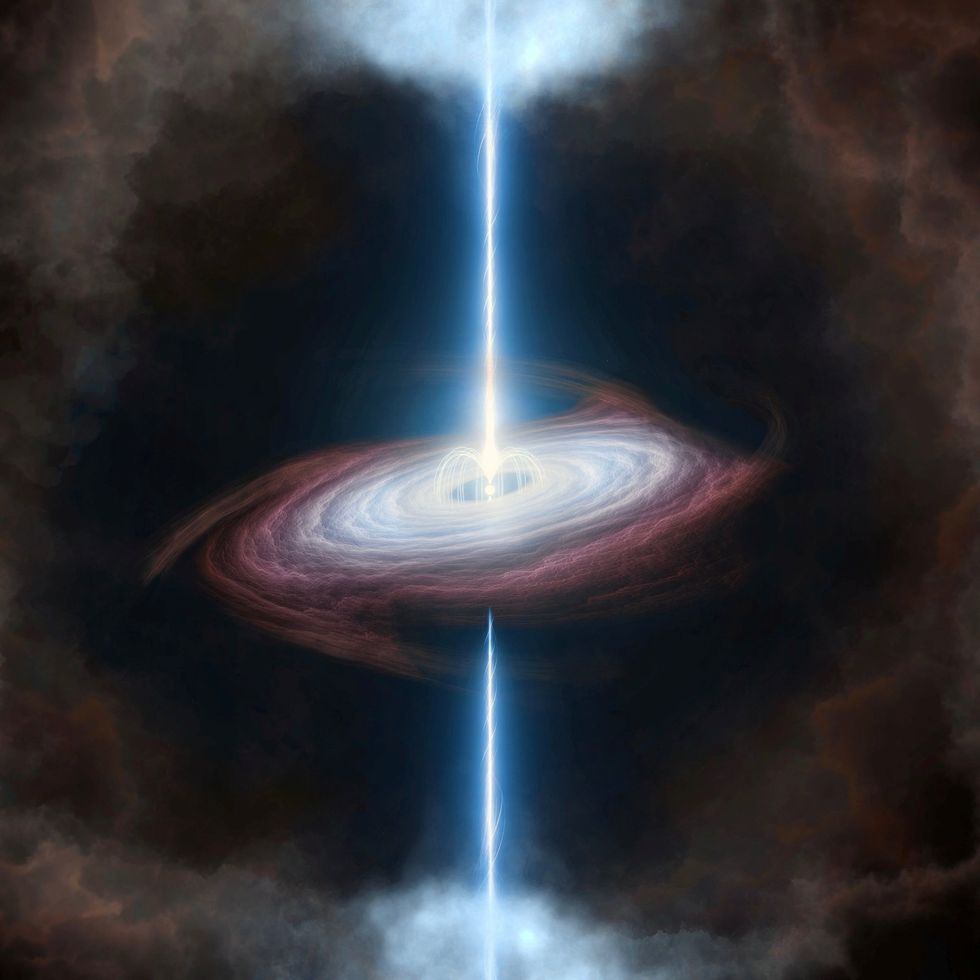
PICTURED: Artist's conception of a magnetar surrounded by an accretion disk exhibiting Lense-Thirring precession
|REUTERS
Rotating hundreds of times each second, it sweeps up charged particles and hurls them into the expanding debris cloud.
"When a massive star exhausts its nuclear fuel, it can no longer resist the crushing force of gravity," said Joseph Farah, a doctoral student at the Las Cumbres Observatory and University of California, Santa Barbara, who led the research.
"The core of the star is squeezed under the weight of the entire star above it, crushing it so hard that protons and electrons merge to form neutrons," Mr Farah said.
If conditions are right, the collapsing core survives as a neutron star rather than becoming a black hole.
LATEST SPACE HEADLINES FROM GB NEWS:
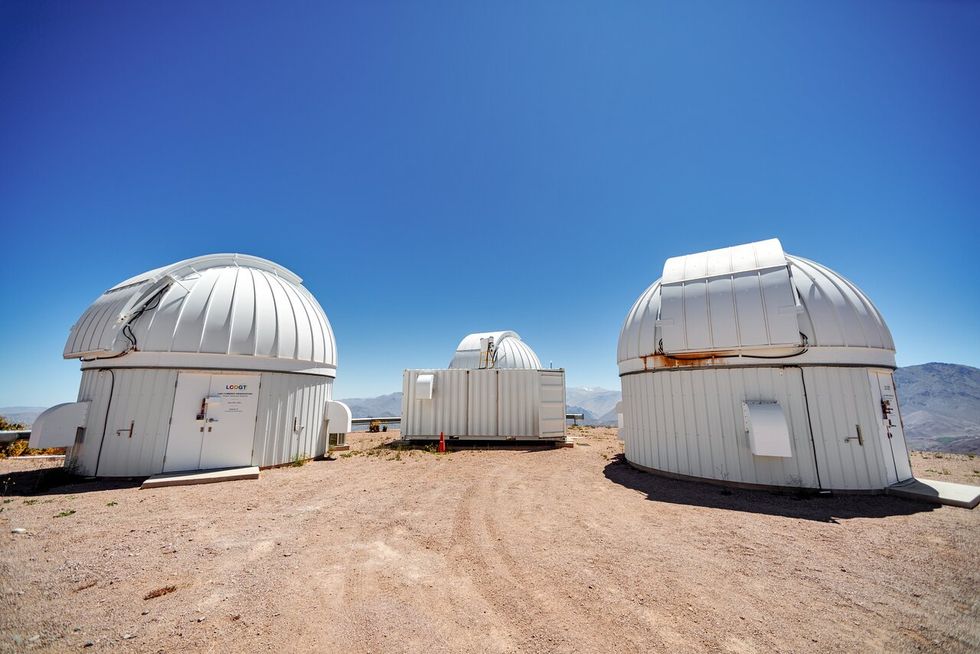
Joseph Farah, a doctoral student at the Las Cumbres Observatory (pictured) led the research
|EPO/CTIO/AURA
The magnetar sits hidden at the supernova's centre, driving its immense brightness from within.
Unlike typical supernovae that brighten and dim predictably, this one fluctuated in luminosity over several months.
Scientists attribute this fluctuation to "Lense-Thirring precession", where the spinning magnetar twists the fabric of space-time.
Stellar material drawn in by the magnetar's gravity forms a wobbling disc around it.
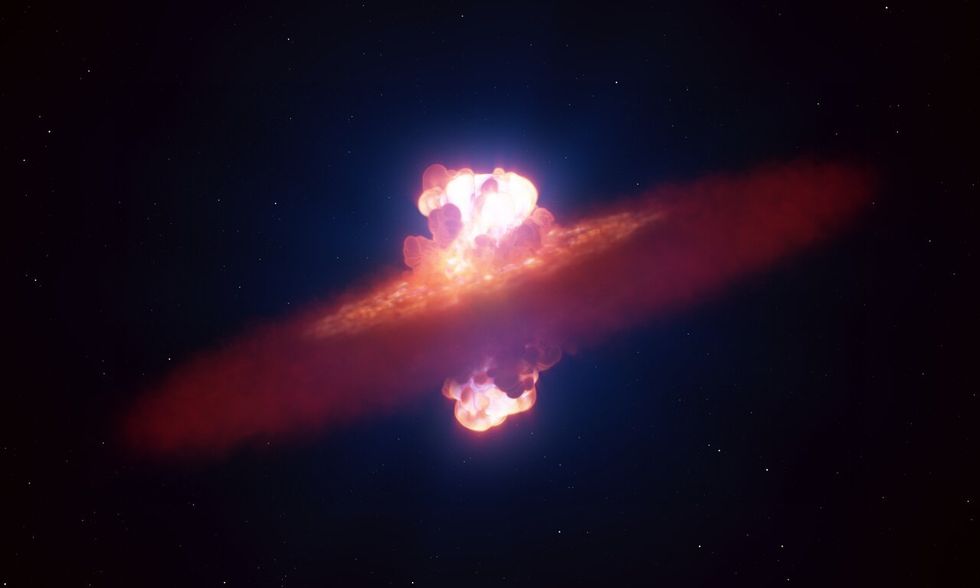
PICTURED: An artist's impression of a supernova exploding
| ESO"This causes the transfer of the energy from the magnetar to the newly expanding supernova to vary," creating undulations in the supernova's brightness, said co-author Andy Howell, who first identified superluminous supernovas in 2006.
The scale of such explosions defies comprehension.
"There's a great 'what if'," Mr Farah said.
"What would be brighter, the sun going supernova 93 million miles from Earth, or a hydrogen bomb detonating on your eyeball?
"And the answer is the supernova - by nine orders of magnitude."
"So that's just a regular supernova.
"A superluminous supernova is 10 to a hundred - or more - times brighter than that. In absolute terms, our supernova had a luminosity brighter than the output of the entire Milky Way galaxy combined," Mr Farah added.
The research was published in the journal Nature.