







Scientists from the National Aeronautics and Space Administration (Nasa) have changed the course of an asteroid in order to stop future doomsdays for the first time ever.
In 2022, an asteroid "moonlet", which orbits a larger asteroid, was deliberately hit by a spacecraft launched by the US space agency.
Analysis of the mission, named the Double Asteroid Redirection Test (Dart), has revealed that humanity successfully changed the trajectory of the asteroid moonlet Dimorphos around its larger parent asteroid Didymos.
The time of Dimorphos's orbit was decreased by 32 minutes and the two asteroids were brought 37-metres closer.
TRENDING
Stories
Videos
Your Say
New research, conducted by the University of Illinois Urbana-Champaign has revealed the effect of the Dart collision on the larger asteroid, and further insights on the asteroid moonlet.
This marked the "first ever measurement" of humanity changing the course of a "heliocentric orbit of a celestial body".
The larger asteroid, Didymos, had its speed reduced by about 11.7 micrometres per second as it orbits around our sun.
Published in journal Science Advances, the study noted: "By demonstrating that asteroid deflection missions such as Dart can effect change in the heliocentric orbit of a celestial body, this study marks a notable step forward in our ability to prevent future asteroid impacts on Earth."
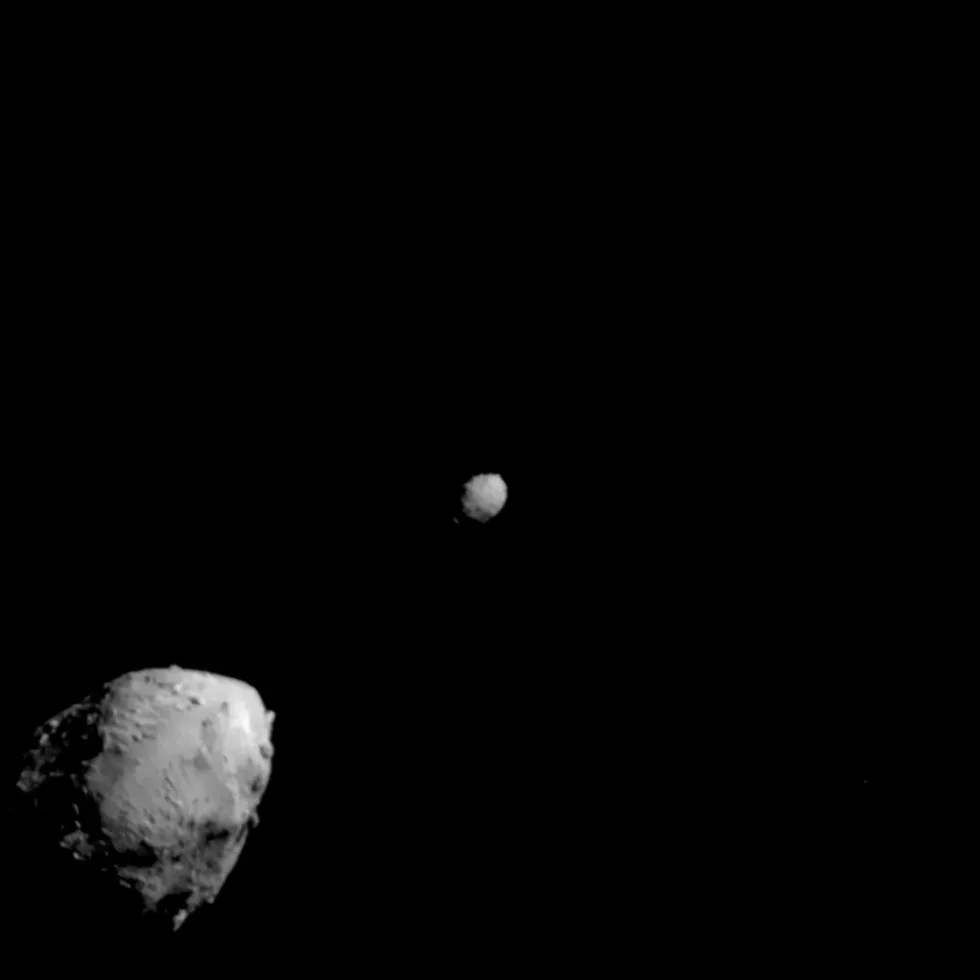
Asteroid Didymos (bottom left) and moonlet, Dimorphos, two and a half minutes before impact
|Nasa
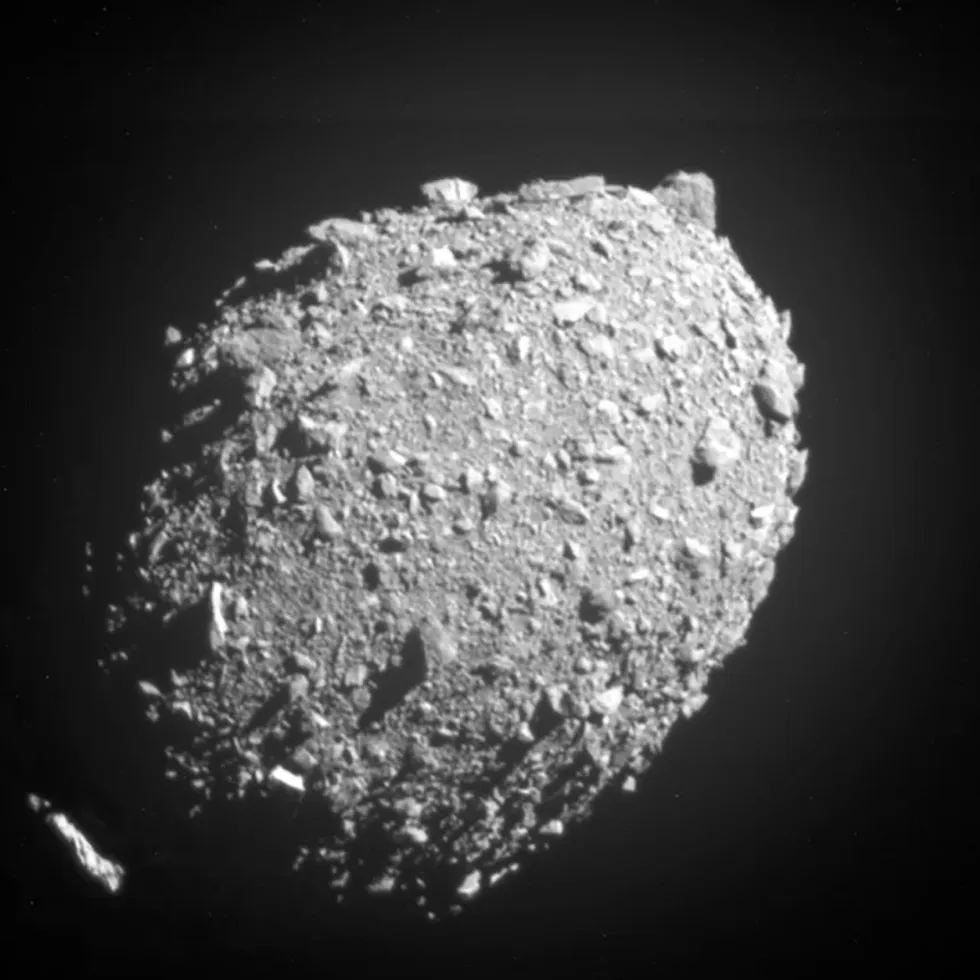
PICTURED: Moonlet Dimorphos 11 seconds before Dart's impact
|Nasa
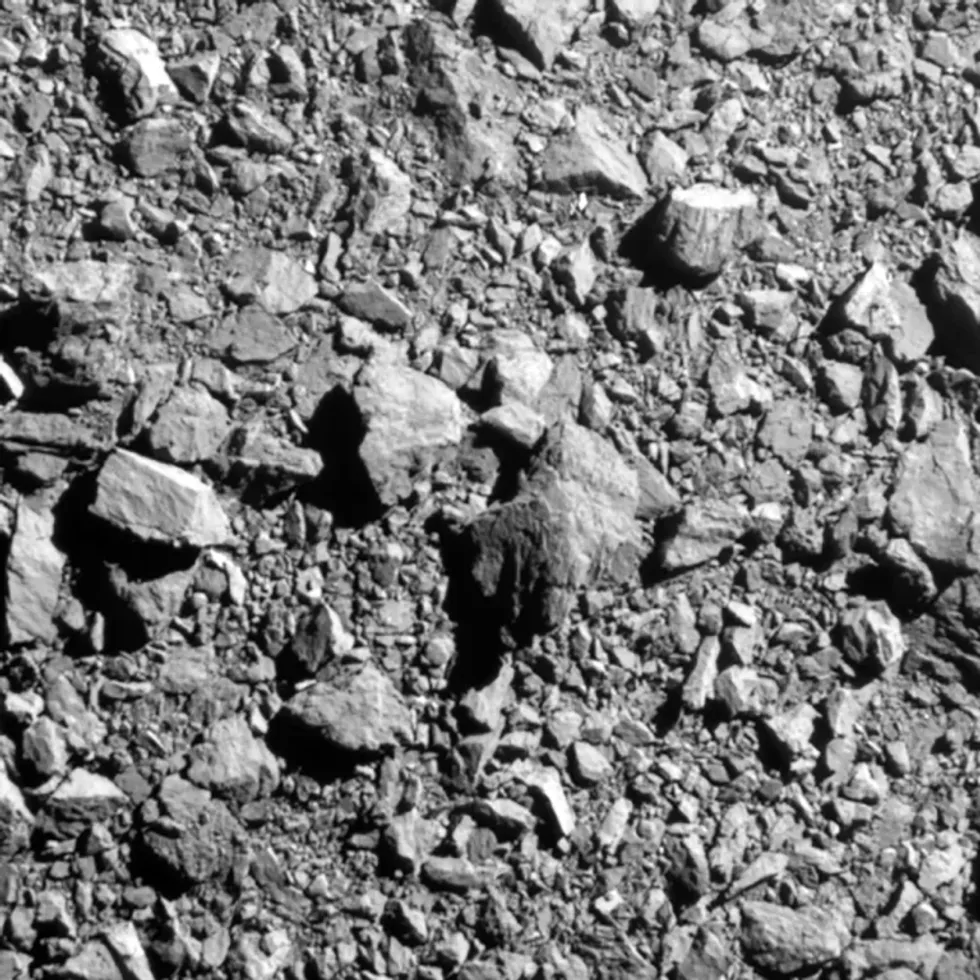
The last complete image of Dimorphos before impact, just two seconds before Dart collided with the asteroid
|Nasa
The large asteroid's change in speed was described as a "kinetic impact deflection", and scientists now believe that by targeting a smaller asteroid orbiting a larger asteroid, humanity could add another layer of "planetary defence".
Dart's impact was noted to be the cause of the change in trajectory in the study.
A scientist at Johns Hopkins University, Nancy Chabot, led Nasa's original Dart mission.
She warned that Earth currently has no defensive probes or weapons ready to launch in the case of an impending asteroid impact.
LATEST SPACE BREAKTHROUGHS:
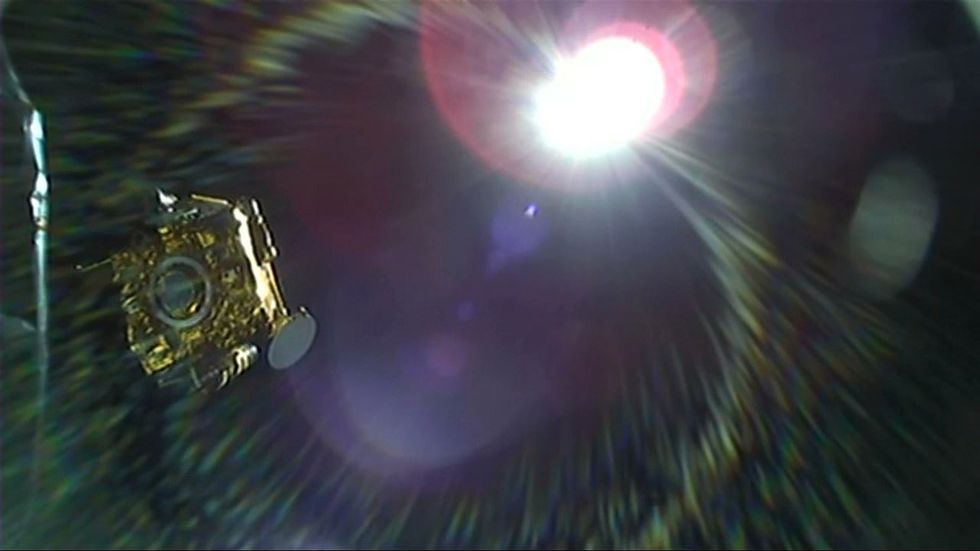
PICTURED: Dart's separation from the second stage of SpaceX's Falcon 9
|Nasa
The scientist said fears of an asteroid collision with the Earth "keeps me up at night".
Neither Didymos nor Dimorphos were on course to hit the Earth, but their joint characteristics made them ideal for Nasa to test the system.
On Friday, Nasa and the European Space Agency (ESA) said a 90-metre wide asteroid known as YR4 was confirmed to miss the moon.
Previous data from the James Webb Space Telescope had suggested the asteroid was on course to crash into the moon within the next decade.
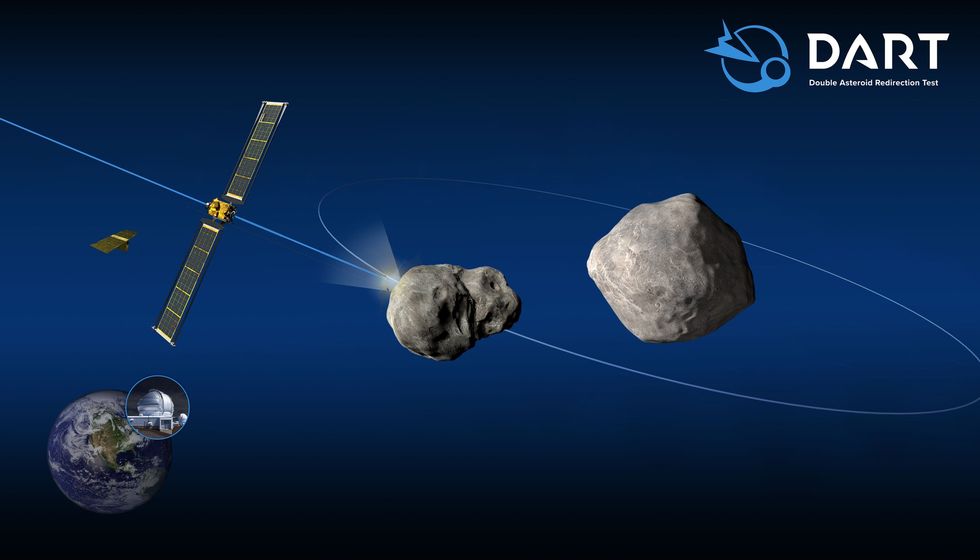
Diagram depicting Dart's mission to hit Dimorphos
|Nasa/Johns Hopkins Applied Physics Laboratory
Initial observations of YR4 in 2024 suggested the asteroid might hit the Earth on December 22, 2032, at one point hitting a 3.2 per cent chance of hitting the Earth — the highest recorder for an asteroid of that size.
Chances of hitting the Earth soon fell, but the odds of hitting the moon rose to 4.3 per cent, but the risk has now been set to zero.
The $330million Dart had a mass of 610kilogrammes, and was deployed from the second stage of SpaceX's Falcon 9 Rocket.
The original Dart project was a collaboration with Johns Hopkins' Applied Physics Laboratory, with the Italian Space Agency providing a 10cm CubeSat to photograph the impact event.