

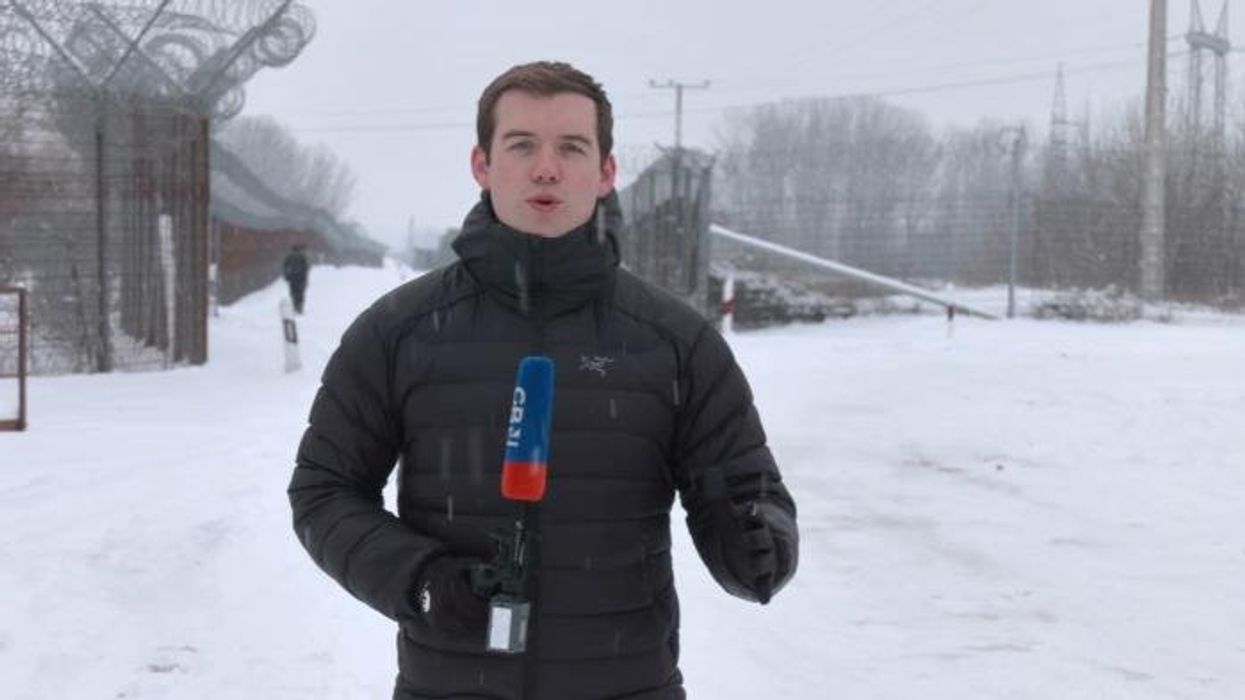







Today at the invitation of the Hungarian Embassy, GB News was granted access to the border between Hungary and Serbia, witnessing firsthand the security measures the Hungarian government has put in place to prevent illegal migration.
We arrived at the border in deep snow and freezing temperatures.
Along the length of the border stretches 155km of 4.5m high double fencing capped with coils of barbed wire. Border police continually patrol the fences, looking for suspicious activity.
The guards are aided by thousands of surveillance cameras and a continuous length of the fibre optic cable that alerts officers to any interference with the fences.
The set-up has been extraordinarily successful, reducing the number of attempted crossings from over 100,000 in 2022 to just 12,000 last year.
Most of the attempts are foiled by the police, but even those migrants who do successfully make it through the fence are not allowed to remain in Hungary.
Police Colonel Levente Bauko told us that Hungarian law allows the police to use force to detain migrants and return them through a gate in the fence to Serbia.
The Hungarian defences are undeniably impressive and have reduced illegal immigration effectively to nil.
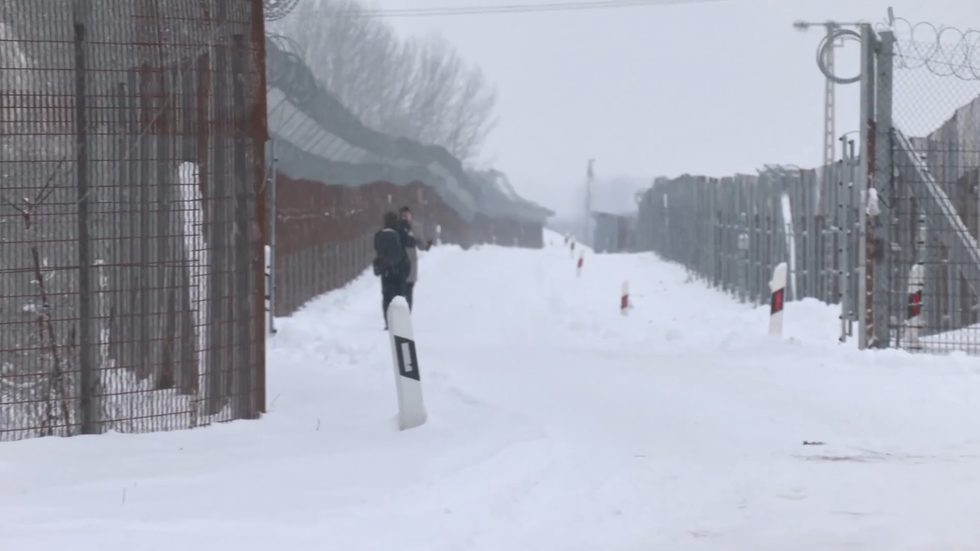
The border stretches 155km with 4.5m high double fencing capped with coils of barbed wire
|GB NEWS
But the border with Serbia has not always been so secure. During the 2015 European migrant crisis, hundreds of thousands of people fleeing turmoil in the Arab world crossed the border into Hungary, seeking entry into the EU and access to Western European social security systems.
The influx caused a crisis in Hungary, a country that had previously experienced almost no immigration.
In response to democratic demand, the Hungarian government began constructing the fence.
Although the impact on reducing migration was rapid, many improvements have been made over the last decade in response to changing tactics by trafficking gangs.
LATEST DEVELOPMENTS:
- PM could get 'very close' to opening borders to millions of migrants in 'Brexit Election', ally says
- 'Labour's failing to show interest!' Viktor Orbán's right-hand man warns of 'civil war' if Europe fails to deal with migrant crisis
- Hungary's Viktor Orban offers Britain a blueprint to stop the small boats crisis - Miriam Cates
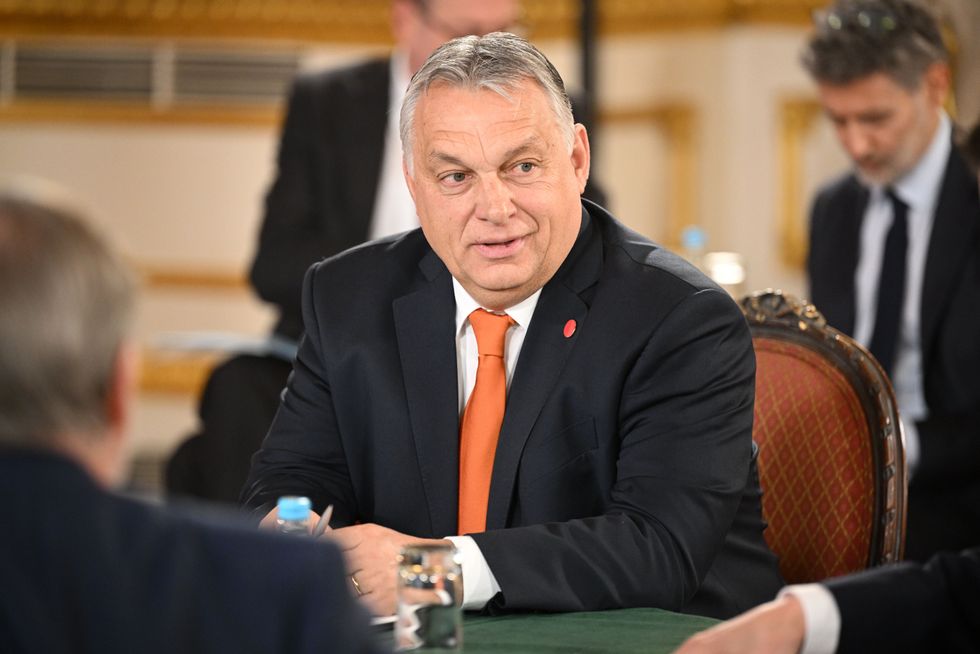
Prime Minister Viktor Orban changed the asylum rules so that anyone wanting to claim asylum in Hungary has to do so from an embassy in another country
| PAColonel Bauko told us that initially, migrants used ladders to scale the fences, prompting authorities to increase the height of the structures.
Subsequently, migrant gangs began to dig under the fences and in 2022 border guards discovered 30 completed tunnels.
More recently, the gangs have moved on to cutting holes in the wire to create an opening; fences are now being reinforced with steel.
Border guards told GB News that the accompanying technology - thermal image cameras, drones and ‘movement sensors - have been crucial in keeping migrants out.

At the border station, GB News saw the remains of a dozen patrol vehicles that had been severely damaged by migrants
|GB NEWS
Guards also told The People’s Channel that they use drones and can call on helicopters if needed.
But cooperation with Serbian border forces has also been essential, especially after a spate of violence in 2022 when 30 border guards were injured by smuggling gangs.
At the border station, GB News saw the remains of a dozen patrol vehicles that had been severely damaged by migrants.
At a command centre, we were also shown footage of smugglers brandishing rifles and firing pistols.
Yet it isn’t just the physical measures - fences and patrols - that keep Hungary’s borders intact. Security also depends on the legal framework that allows border guards immediately to apprehend and return anyone who does make it across from Serbia.
In addition to the threat of instant deportation, Prime Minister Viktor Orban changed the asylum rules so that anyone wanting to claim asylum in Hungary has to do so from an embassy in another country.
This ‘embassy first’ policy has reduced the number of asylum claims from 122,000 in 2016 to just 25 in 2024.
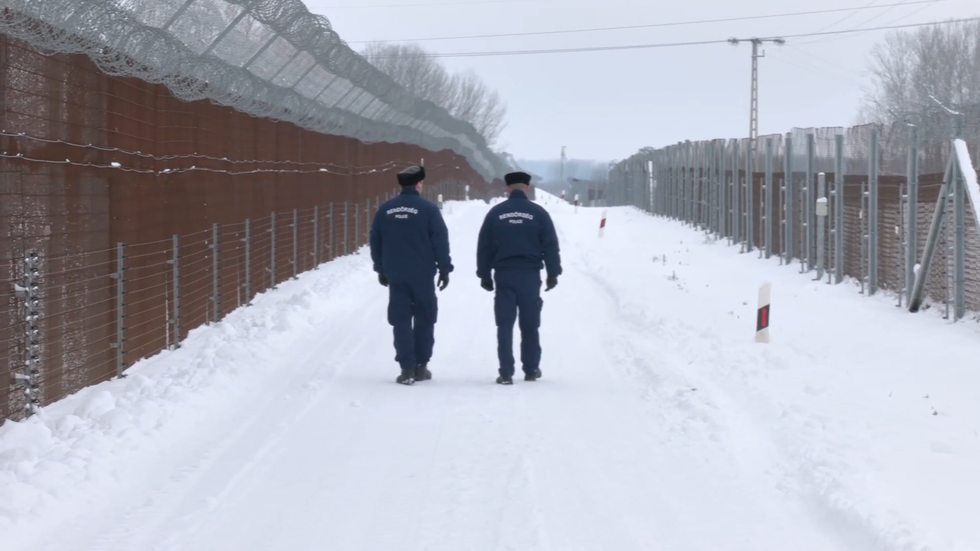
Border guards have the power to immediately apprehend and return anyone who does make it across from Serbia
|GB NEWS
After joining the border guards on patrol, GB News visited the immigration command centre a few miles from the border.
We were shown footage of migrants trying to cross the border from as recently as Thursday night, when 20 men attempted to scale the fences.
In much of the footage we saw, migrants were carrying weapons, but we were told these are almost always discarded on the Serbian side so as not to incur criminal charges in Hungary.
We were told the majority of migrants carry no identity documents but claim to be Afghan, Syrian or Turkish.
The people smuggling networks running the trafficking networks are predominantly Romanian, Ukrainian and Moldovan criminal gangs.
The construction of such a water-tight border control system has come at a price to Hungarians, and not just in terms of the costs of fences and surveillance.
The Hungarian measures to prevent migrants into the country, and their refusal to allow internal asylum applications, has incurred the wrath of the EU.
Brussels has issued the Hungarian government with a €200million fine in addition to a daily penalty of €1million. Nevertheless, the Hungarian government thinks this is money well spent to avoid the negative economic and social consequences of mass migration that are now so familiar to us in Britain.
Indeed, the situation in the UK could not be more different to the Hungarian example.
Despite being surrounded by a natural moat, successive British Governments have failed to stop tens of thousands of migrants arriving illegally on our shores each year, spending billions of pounds providing them with accommodation and seemingly finding it almost impossible to remove someone once they have claimed asylum.
Viktor Orbán's right-hand man warns of 'civil war' if Europe fails to deal with migrant crisis
Britain voted to leave the EU in 2016, in part to regain control of our borders - and yet we have been unable to reform our legal system, or our physical defences, to effectively prevent illegal immigration.
The fact that Hungary has managed to achieve this without a sea defence and within the EU is frankly embarrassing.
Speaking exclusively to GB News yesterday, the Prime Minister’s political director Balazs Orban said that the Hungarians see Britain’s failed migration policy as a warning and that Europe should not repeat Britain’s ‘mistake’.
UK authorities could learn a lot from the Hungarian model.
Colonel Bauko told GB News that successful border control relies on three ‘pillars’ of physical barriers, cross-border cooperation and an effective legal framework that allows swift deportation.
These things should not be impossible to achieve but they require political courage: something the Hungarians have in spades but seems sorely lacking in Britain.
Our Standards: The GB News Editorial Charter