










Unmanned drones will protect British undersea cables from Russian sabotage after a defence pact between Britain, the United States and Australia was confirmed.
Defence Secretary John Healey announced that the alliance would deliver advanced technology capable of defending vital submarine cables and pipelines.
Mr Healey the initiative would "rapidly give our forces the very most advanced battlefield technology as together we produce a range of cutting edge sensors and weapons systems for undersea drones".
He added: "This will give us the ability to detect, to deter and deal with the threats, including our underwater cables and pipelines on which so much of our daily life depends."
Submarine communication links form the backbone of Britain's digital infrastructure, facilitating internet connectivity, telephone calls, instant messaging and social media platforms across the nation.
These underwater cables underpin financial transactions worth £1.4trillion every day, making them essential to the country's economic stability.
Growing anxiety surrounds the potential vulnerability of this critical network to deliberate attacks, with Russia viewed as the primary threat.
A parliamentary committee issued a stark warning late last year that the UK must "prepare for the possibility that our cables can be threatened in the event of a security crisis".
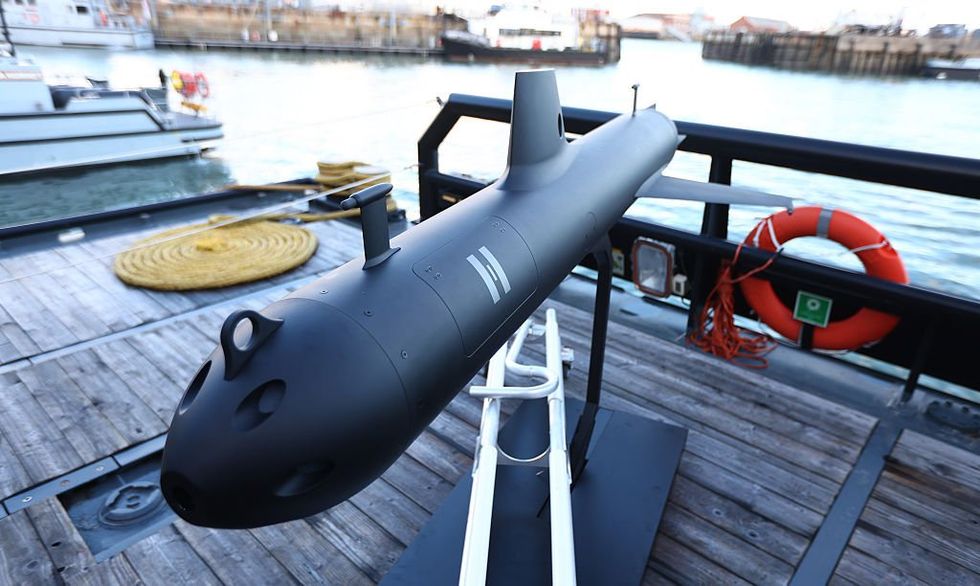
A life-size autonomous underwater drone will protect the cables
|GETTY
MPs and peers cautioned: "Putin has shown every sign of wanting to test the soft underbelly of the Nato alliance. Our cables are sufficiently vulnerable to make them a target."
Concerns intensified in April when Healey disclosed that a Royal Navy vessel and RAF maritime patrol aircraft had tracked Russian submarines conducting reconnaissance of underwater infrastructure in the North Atlantic.
The surveillance operation monitored a Russian Akula-class nuclear-powered submarine alongside two deep-sea vessels belonging to Russia's directorate for deep-sea research.
British forces maintained observation of the Russian craft for over a month before they departed the area.
LATEST DEVELOPMENTS

John Healey alongside his US and Australian counterparts
|REUTERS
Mr Healey indicated that innovations emerging from the Aukus partnership would extend beyond the Indo-Pacific region, benefiting security operations in the Atlantic and the "High North" encompassing northern Europe and Arctic waters.
The pact has primarily concentrated on supplying Australia with nuclear-powered submarines whilst establishing facilities for American and British vessels operating in the Indo-Pacific.
In a separate development, the allies confirmed that Australia would now receive only previously operational nuclear-powered submarines from the United States as part of efforts to simplify the Aukus arrangement.
The original 2021 agreement anticipated Australia obtaining at least three Virginia-class submarines within 15 years, with expectations of receiving two used vessels and one newly constructed craft.
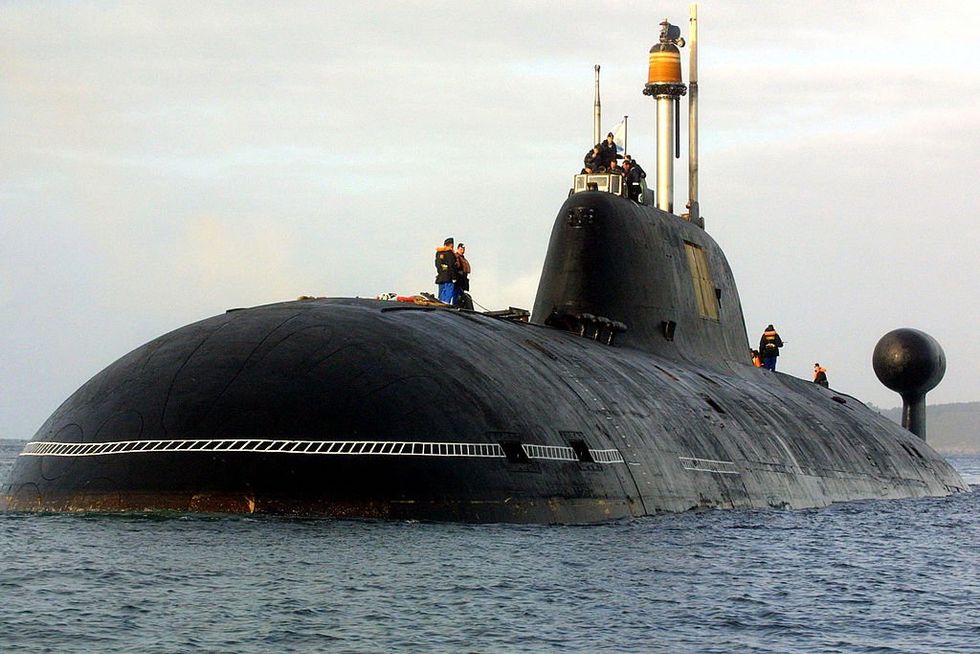
The Akula class submarine is crucial to the Russian naval fleet
|GETTY
Akula submarines have advanced capabilities such as intelligence gathering and striking land targets, and they are a critical component of the Russian navy.
The two spy submarines are specialist submarines from Russia’s ministry of defence deep sea research programme, known as Gugi (Main Directorate of Deep-Sea Research).
The programme is believed to be tasked directly by the Russian president and is designed specifically to conduct sabotage operations of deep-sea infrastructure, according to news outlet Calibre Defence.
Gugi operates a number of vessels and specialised submarines including the Belgorod, Paltus, X-Ray, Kashalot and Losharik submarines.

Defence Secretary John Healey said the technology gave Britain 'the ability to detect, to deter and deal with the threats'
|REUTERS
Gugi specialist submarines are titanium-hulled which enables them to sustain the pressure of operating at extreme depths, according to the Royal United Services Institute (Rusi).
Dr Sidharth Kaushal, a senior research fellow at Rusi, believes in this instance the Akula submarine was used to draw attention away from Gugi submarines while in UK waters.
He said: "By monitoring activity, the Royal Navy can both build a level of awareness about what infrastructure is being mapped and potentially recover any surveillance assets left behind by Russian submarines.
"It can also build a degree of awareness regarding Russian tactics – for example the apparent use of an Akula attack submarine to draw attention away from Gugi submarines in this most recent incident."