










Benefits claimants in Britain are receiving an additional £10billion in "hidden" benefits on top of Universal Credit payments in excess of £100billion, a recent study has revealed.
The "bonus" benefits from the Department for Work and Pensions (DWP) include free prescriptions, travel and school meals, helping with energy, water, broadband and holiday bills.
According to the think tank Onward, these are automatically available to families claiming Universal Credit.
The think tank said the additional benefits were handed out in "uneven" and "opaque" ways, and disincentivised claimants from finding work.
TRENDING
Stories
Videos
Your Say
More than half of those on Universal Credit now have no requirement to work (4,174,256 as of December 2025).
This means many of the benefits are cross-subsidised by working families instead, who are facing higher taxes and increased energy bills.
The biggest "hidden" benefit is council tax support. This costs the UK an estimated £3.2billion for nearly 2.3 million claimants of working age.
Free medical prescriptions are the next largest benefit. This cost the UK £1.4billion with more than 120 million claimants.
The Department for Work and Pensions projects 4.2 million adults will be claiming PIP by 2030
| GettyA further £355million is spent on free dental care, for 3.7 million courses of treatment.
Energy providers do not receive additional government funding for some of the discounts and extra services they are legally required to offer benefit claimants.
For example, in the year to September 2025, 71,000 households on Universal Credit benefitted from additional energy efficiency measures, such as insulation, heat pumps and solar panels.
An average subsidy per household reaches nearly £20,000.
LATEST DEVELOPMENT
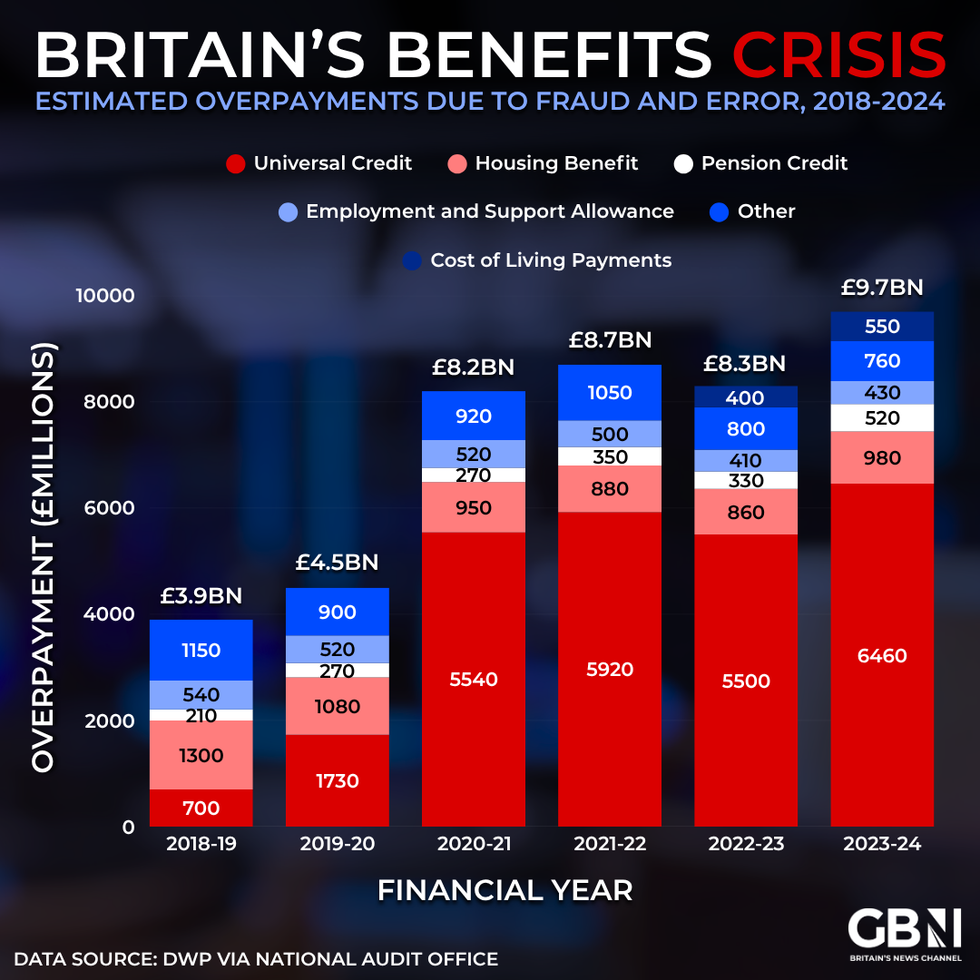 Billions of pounds in benefits are estimated to be overpaid due to fraud or error each year | GB NEWS/DWP
Meanwhile, almost two million claimants benefited from discounts on water bills, seeing an average reduction of £190 and costs suppliers £374million. This is projected to rise to £640m by 2030.
Broadband providers were required to discount the provision of "superfast" service to 506,000 customers in June 2024. This was an increase of a third on the previous year.
Shadow Welfare and Pensions Secretary, Helen Whately, said "our welfare system isn’t working", and the "hotchpotch of benefits outside Universal Credit undermines its purpose to make sure work always pays".
"Welfare needs urgent reform, but instead the Government is adding extra handouts and making the problem worse," she added.
"We need a fairer welfare system which backs people who do the right thing, and serves as a safety net, not a benefits trap."
Onward's research revealed the "vast shadow welfare system" of "passported" benefits for the first time.
These are defined by free or subsidised services that are automatically unlocked through Universal Credit claims.
The report detailed: "The additional payments that claimants can receive because of their eligibility for their regular benefits are rarely included in analyses of how and why spending on working-age welfare has become so out of control."
Some £252million is spent by the Department of Education on free holiday clubs, attended by almost 630,000 children, costing an average of £300.
Sir Simon Clarke, director of Onward, said: "£10billion is a huge cost to taxpayers, and this public money directly cuts across the incentives for people to move from welfare into work. If we are serious about both fairness and affordability, we need root and branch reform as a matter of urgency."
A Government spokesman said: "Passported benefits such as free school meals, are an additional support some people receive because of their entitlement to Universal Credit.
"This government is reviewing the Universal Credit system – for the first time – to make sure that people are always better off in work and to tackle poverty. We are taking a significant step to fix the broken welfare system we inherited by rebalancing Universal Credit sickness and unemployment rates."
More From GB News