







Net Zero advocates must tell the “unpalatable truth” moving to renewable energy comes at a cost, a leading economist has said.
Wind and solar power are frequently cited as cheaper forms of energy, with the Government insisting bills will fall as more renewables come online. But Professor Sir Dieter Helm warned there “is no free lunch in decarbonisation”.
Thousands of solar panels were installed on British homes last month against soaring prices sparked by the Gulf conflict. In total, 27,000 solar installations took place in March – the highest monthly total in a decade.
Energy Secretary Ed Miliband said: “The numbers speak for themselves – the highest monthly installation of solar in over a decade, rising capacity and more than two million solar installations now powering homes across Britain. This is our clean energy mission in action – helping families weather global energy shocks, bringing bills down, and getting Britain off the fossil fuel rollercoaster."
Speaking on a podcast last week, Sir Dieter, professor of economic policy at Oxford University, said renewables were “a good thing”. Decarbonisation was important, he said, "but it’s important, too, to tell the public the truth, that it’s going to cost you to do it”.
He referenced schemes that offer discounted, or even free, electricity. These have included homes near wind farms receiving discounts on particularly blustery days and households offered free or cheaper electricity during periods of excess supply, such as sunny weekends.
“If someone is getting free electricity, someone else is paying,” he said. He pointed out transitioning to renewables requires not just a massive expansion of electrical capacity but also a doubling of the grid.
This is because renewables are intermittent. They cannot be relied upon to provide the 24/7 power supply the UK needs, meaning we require other sources, such as gas and nuclear.

Professor Sir Dieter Helm said there 'is no free lunch in decarbonisation'
|CHATHAM HOUSE
This system made surpluses inevitable, he said. But the underlying costs still need to be paid. He explained on podcast Helm Talks how the UK requires just under 45 gigawatts of capacity to meet peak demand.
“In the bad old days before we discovered the delights of Net Zero, we used to meet that 45gw with about 60gw of capacity,” he said. “We had some stand-by power stations, just in case there was an unanticipated surge in demand or some power stations failed. Now, in our new world of renewables – renewables are a good thing, but not free things – we have got a new problem.
"To put it very simply – the sun doesn’t always shine, and the wind doesn’t always blow at the right speeds. So, in order to make sure we meet that 45 GW of total peak demand, it’s not 60 GW of capacity we need; we actually need 120 GW of capacity because we need a system there for when the wind (doesn’t blow) and the sun doesn’t shine.
"So, we have built in a massive excess capacity to our system to make absolutely sure that the 45 GW is going to be hit. And, of course, some of the time the sun does shine and the wind blows and you have got all that excess capacity, so it’s inevitable, as we go down this pathway we are on, that there will be moments when there is massively more supply than there is demand.”
LATEST DEVELOPMENTS
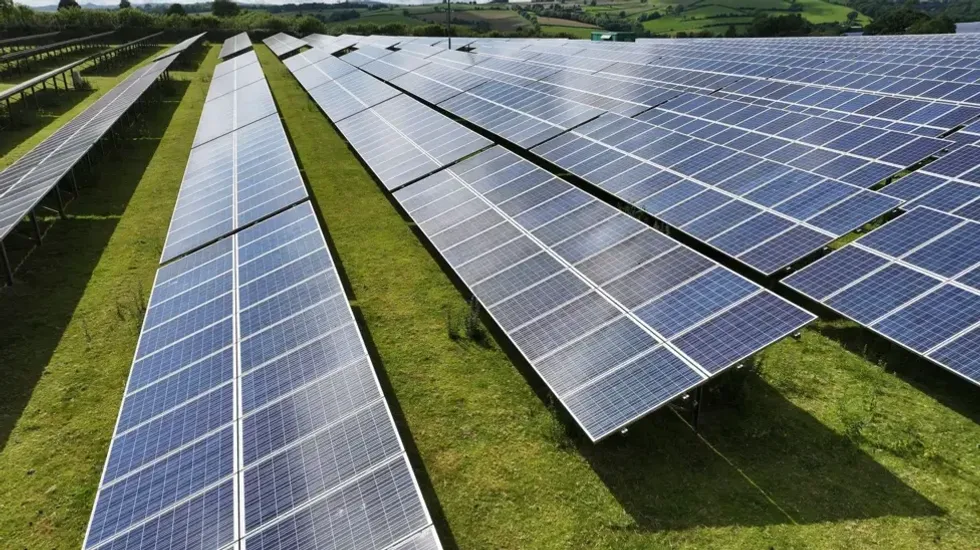
Solar power are frequently cited as cheaper forms of energy
| GETTYIt means we also need to pay for the extra grid network required for the renewable sources, as well as batteries and storage “we didn’t need in the bad old days of the system in which we had 60 GW of nuclear, gas and, indeed, coal”. This meant costs had gone up, he said, pointing out the UK has some of the highest-priced industrial electricity in the developed world.
Domestic costs were also high. Prof Helm said decarbonisation was a good thing, but he warned against claims the price of renewable-generated electricity was “too cheap to measure”.
He said: “It would be helpful if ministers and activists and so on would explain the economic realities of the transition we are engaged in, not because it’s a bad thing to do what we’re doing, but because there’s a very unpalatable truth behind what we are doing.
"That is that; now we are going to have to pay for the pollution we are causing through the carbon emissions that come from the energy that we use, prices are going to go up, not down.
"And you can already see that. Next time someone tells you that you are going to get free electricity, remember – we have the highest industrial electricity prices in the industrialised world and very high prices for domestic customers, too.
"The real truth of all this is there is no free lunch in decarbonisation. It’s important – but it’s important, too, to tell the public the truth: that it’s going to cost you to do it. And let’s not just fall for happy delusions, just like we should generally not fall for the happy idea that there are free lunches all around us.”
A spokesman for the Department for Energy Security and Net Zero said: “Clean power is the route to energy sovereignty, lower bills for good and thousands of good jobs in our communities.
“Wind and solar come with zero fuel costs, and over their lifetime renewables remain the cheapest electricity sources to build and operate at scale. The lesson of yet another fossil fuel crisis is the UK needs to get off the fossil fuel rollercoaster and onto clean homegrown power we control."
Our Standards: The GB News Editorial Charter