








It is three feet wide and 125 miles long – and it has achieved the near-impossible task of uniting Labour, Reform UK, the Conservatives, Liberal Democrats and Greens.
The Government says the Peak Cluster carbon capture scheme is vital to hitting Net Zero targets without decimating the cement industry.
When complete, it will pipe waste carbon dioxide from cement and lime plants in the Peak District to the Irish Sea.
But in Wirral, where the pipeline meets the water, the plans have been met with horror and claims of “coastal vandalism”.
A council vote condemning the scheme passed unopposed. “Not Brexit levels, of 48/52,” says Tory councillor, Max Booth.
“This was a North Korean margin. It was absolute. 100 per cent.”
Further meetings will be held as residents head for Wallasey’s Floral Pavillion and a “community session” with developers.
Residents in Wirral staged protests today after a series of "community sessions" was held at Wallasey’s Floral Pavillion to explain the project.
Hundreds of demonstrators lined the streets with placards against the scheme. Billed as a peaceful protest, they were encouraged to “bring friends and family, signs and banners”.
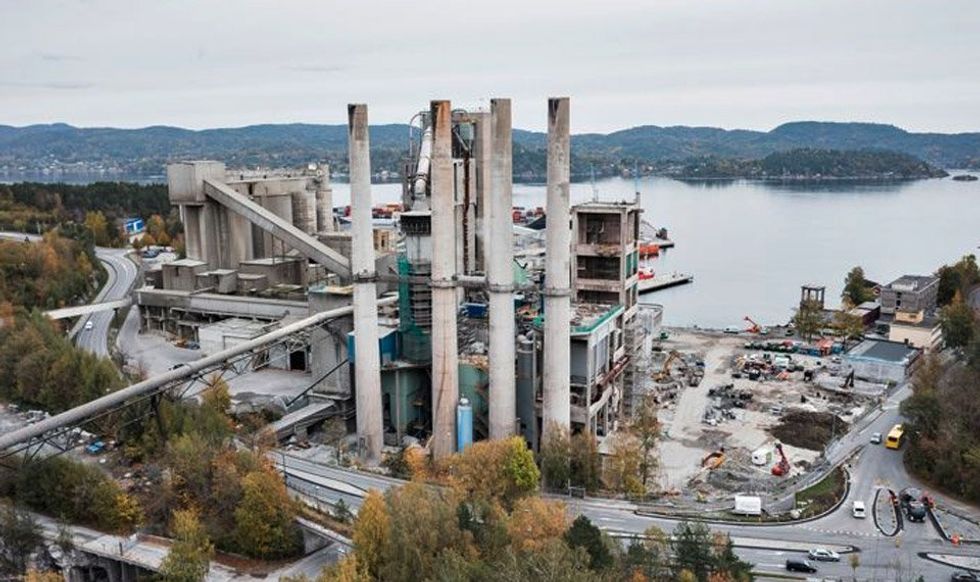
Labour's new 125-mile gas pipeline plans has been met with horror as locals brand the scheme 'vandalism'
|PEAK CLUSTER
The Peak Cluster project, which will capture greenhouse gases from three cement and lime plants, falls beyond the control of local politicians.
Because of its size, it has been classed as a National Significant Infrastructure Project.
This means the final decision for its go-ahead lies with the Secretary of State for Energy Security and Net Zero, Ed Miliband.
The case highlights the difficulty of the task confronting the Government if it wishes to take communities with it on its goal of decarbonising Britain by 2050.
LATEST DEVELOPMENTS:
With a cost estimate of up to £5billion, Peak Cluster aims to balance the needs of the cement industry, which is notoriously difficult to decarbonise, with the demands of Net Zero.
On completion, the scheme will be Britain’s longest industrial carbon capture and storage pipeline, running from plants in Derbyshire and Staffordshire through Cheshire and the Wirral.
The waste gas will be processed in Wirral before feeding into a subsea pipe.
Emissions will be funnelled 35 miles offshore, where they will be injected into former gas fields beneath the seabed. It will take three years to build if permission is granted.
Once complete, the pipeline will capture more than 90 per cent of the carbon emitted from each of the sites.
Without such carbon capture, it would be impossible for the country to meet its climate obligations, the Government says. However, the scale and location of the project have left residents aghast.
The pipe will stretch for more than 100 miles and be at least four feet underground. It will be around three feet in diameter but will require a 100-foot-wide "corridor" during construction.
The Government says the Peak Cluster carbon capture scheme is vital to hitting Net Zero targets
|PEAK CLUSTER
On top of the pipe itself, Wirral will house significant above-ground infrastructure.
A plant the size of seven football pitches is needed, complete with access roads, pipework and a 160-foot chimney to release CO2, including “in case of an emergency”.
“You're going to be walking across a beautiful promenade, and you're going to come across a 50 metre chimney, all these above-ground installations, compressing stations, lights and noise 24/7,” said Mr Booth.
“If this infrastructure goes through it's going to be coastal vandalism.”
Local campaign group Action Against CCS has been set up to oppose the plans.
Laura Beveridge said the group wasn’t anti-environment but said their concerns has not been listened to.
She said: “This isn’t tackling climate change. This is not reducing emissions. It is just hiding them, pretending they will go away or leaving it for the next generation or the one after to deal with.”
She drew attention to incidents overseas, where carbon dioxide leaks had occurred.
Ms Beveridge said: “In the event of a leak, we know that pets and children are affected first, one of the reasons being that they are closer to the ground.
“What happens then, when our babies, when our children, when our future ends up in a situation when their safety is compromised for the sake of so-called progress?”
She added: “We are not about halting industry, we want to ensure public money is used to bring research, development and innovation to the fight against climate change, ensuring longevity for both industry and the environment.
“We understand the need for Net Zero - we are not climate deniers - but not at the cost of the existing green spaces and National Parks the Government promised to protect.”
She said rather than solving the problem of greenhouse gases, the project “is a game of hide and seek”.
The Greens also voiced objections, despite the project being aimed towards enabling Net Zero. They suggest moving waste gases elsewhere does not amount to "decarbonisation".
The council's Green co-leader Gail Jenkinson told a meeting: “This pipeline must not be allowed to exist anywhere – not through the Wirral, not through Lancashire. Nowhere. If we think this pipeline is dangerous, we must not ask for it to be put anywhere.
“That would be wrong. Instead, we should be removing the carbon dioxide at source.”
Mr Booth said: “Everyone's agreed on this. That's slightly unusual as well, isn't it? When the whole argument for this is climate change and Net Zero, you'd expect it to be split along those lines, wouldn't you? But it's clearly not.”
Others asked why their community should house infrastructure for pollution miles away.
Labour councillor Mark Skillicorn said the Wirral should not be treated as “England’s carbon dioxide exhaust pipe” and added: “In our opinion, this is the biggest, most controversial, and upsetting thing to happen to the Wirral in many years.”
The Liberal Democrat's Stuart Kelly said the Government needed to “explain why less damaging options have not been followed”.
Objections reach beyond the Wirral. Derbyshire County Council has also voted to oppose the scheme.
A council meeting heard claims the underground pipeline would carry pressurised CO2 through farms and towns.
Council leader Alan Graves, of Reform UK, said the project asks residents “to bear enormous costs and risks”.
“All for a project where the burden falls locally and the justification is national. That imbalance matters.”
Mr Booth agreed this “imbalance” was a key issue and he said the NSIP classification had taken the power out of local hands.
“It’s considered significant infrastructure – an NSIP – and that means, as a councillor, I've got no say over the final decision.
“It removes the local decision-making power. I’m completely opposed to it, and, in my position as a councillor, I don’t have a vote against it.
“So central decision-making can override local political control, and it’s undermining faith in an already broken system.”
He stressed it was not a party political issue, saying objections came “from across the political spectrum”.
“We are trying to create a conduit of pressure on Ed Miliband because, at the end of the day, it's his signature.
“It's his ballpoint pen that will potentially override thousands of people.”
Peak Cluster says the project “will safeguard and create more than 13,000 jobs”.
It will also “ensure a sustainable, domestic supply of building material to support the delivery of vital infrastructure, attract around £5billion of investment into the UK, and generate around £1.8billion in value for the economy”.
David Parkin, Chair of Peak Cluster, said cement and lime were “essential to our day-to-day lives”.
Although it was produced in Derbyshire and Staffordshire, it was used nationwide. He said there was nowhere to safely store CO2 near the plants themselves.
“The proposed route for the pipeline has been carefully selected as the shortest available option,” he said.
“We recognise that this infrastructure could affect communities along the route, and we do not take that lightly.
“However, it plays a critical role in reducing the UK’s industrial emissions and enabling the continued production of materials that society depends on, in a more sustainable way.”
To address safety concerns, he said the pipeline would be regulated by the Health and Safety Executive and pointed out “the UK has a wealth of experience in designing, constructing and operating pipelines for gas”.
The Government says carbon capture and storage is a “proven technology”. Projects would need to demonstrate they will “provide a high level of protection to people and the environment” before being approved.
A spokesman for the Department for Energy Security and Net Zero said: “Carbon capture, usage and storage is vital for Britain's clean energy future. The Climate Change Committee describes it as a 'necessity not an option' for reaching our climate goals.
“We are delivering first-of-a-kind carbon capture projects in the UK, backed by £9.4billion over this parliament – supporting thousands of jobs across the country and reigniting our industrial heartlands.
“All carbon capture projects must meet strict environmental and regulatory requirements, including ensuring high levels of protection for both communities and the environment.”
It makes a compelling case for the benefits while stressing schemes like Peak Cluster are not a choice but a “necessity” if the UK is to meet Net Zero targets.
Whether the residents of Wirral and Derbyshire are won over by the “no other option” argument remains to be seen. It is a tall order – and it is a very long pipe.
Our Standards: The GB News Editorial Charter