





Millions of Britons face state pension "uncertainty" as analysts increasingly call for the triple lock to be axed to save money for the Treasury.
Anti-poverty campaigners are urging the Labour Government to ignore calls to scrap the retirement payment uprate mechanism despite concerns over its growing cost.
Thanks to the triple lock, state pension payment rates rise every year in line with either the rate of inflation, average wage growth, or 2.5 per cent; whichever is highest.
This comes after the Office for Budget Responsibility (OBR) warned the policy has become £10billion more expensive annually than initially projected.
Millions face state pension 'uncertainty'
|GETTY
Recently, a think tank has called for the abolition of Britain's state pension triple lock, claiming the move would reduce annual spending by £38billion within two decades.
The Intergenerational Foundation argues in a new report that the mechanism has become unsustainable and unjust to younger taxpayers.
Introduced in 2011 by the Conservative-Liberal Democrat coalition Government as protection against retirement poverty, the policy now carries significant costs.
State pension expenditure stands at £154billion this year and is forecast to reach £180billion by 2030, with the triple lock alone adding £15.5billion annually by that date, according to OBR figures.
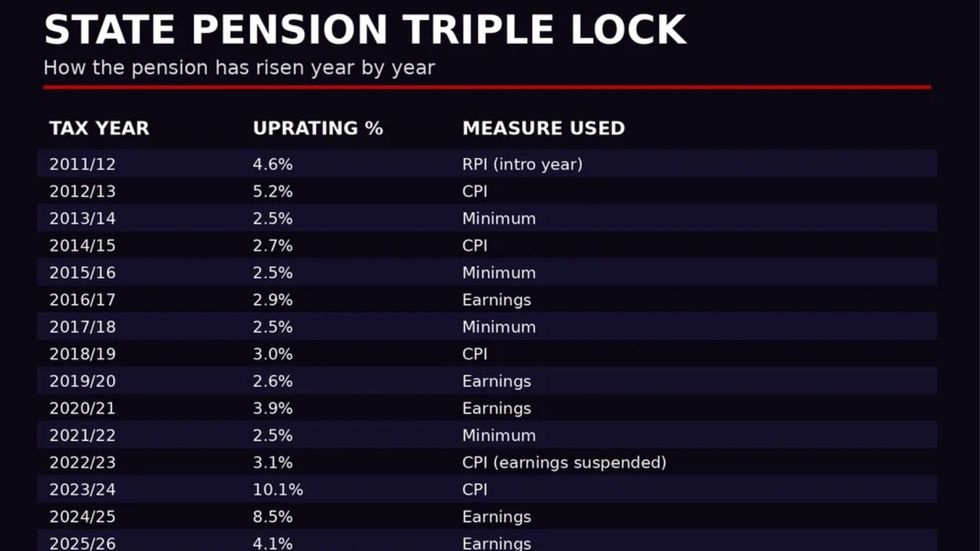 How the state pension triple lock has changed over the years | GB NEWS / FIDELITY INTERNATIONAL
 LATEST DEVELOPMENTS
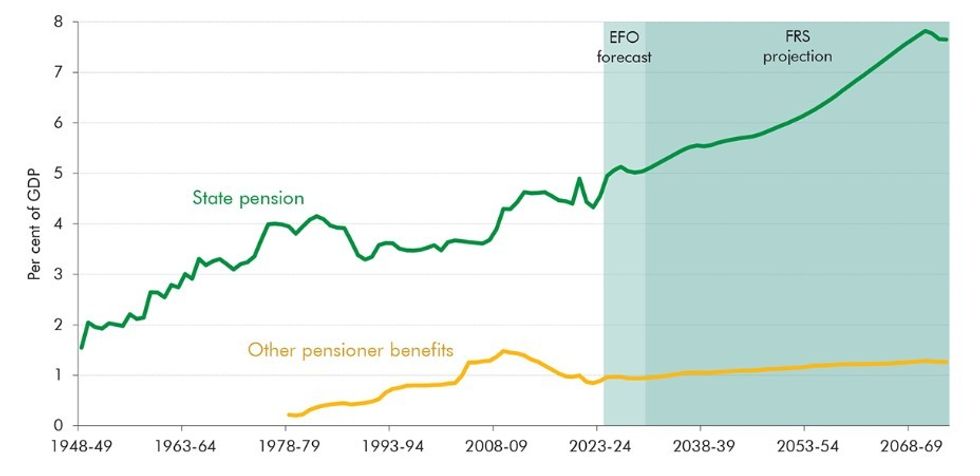 How much will the state pension triple lock cost the British taxpayer? | OBR
 The think tank proposes limiting pension increases to inflation alone until 2030-31, then switching to a formula combining inflation and earnings growth.
These changes would deliver savings of £19billion annually by 2035-36, rising to £38billion by 2045-46. Under the foundation's recommendations, a tenth of the money saved should be redirected to support the most vulnerable retirees.
Rather than relying on the existing means-tested Pension Credit system, which currently tops up weekly income to £238 for single claimants or £363.25 for couples, the foundation suggests introducing a universal £30 weekly payment for the poorest pensioners, rising annually in line with the new inflation-earnings formula.
Conor Nakkan, who authored the report, described the existing arrangements as "fiscally unsustainable" and in urgent need of reform.
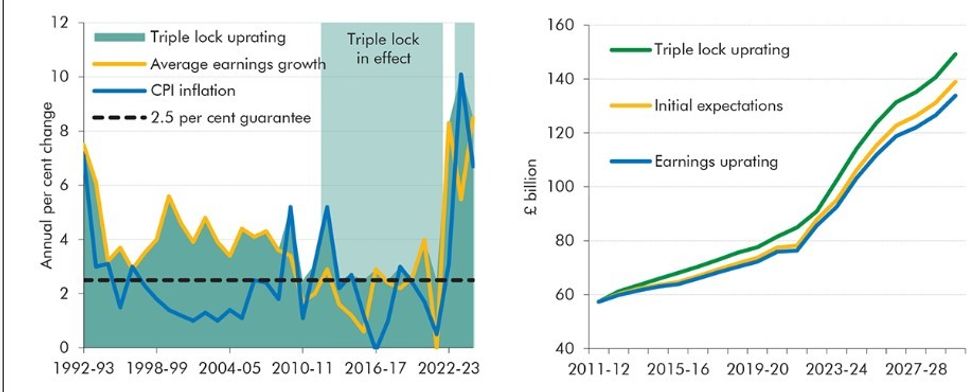 What has the impact of the state pension triple lock been on the public's finances | OBR
 He argued that the mechanism "now delivers large increases to all pensioners, including millions who are already well-off, while younger generations face stagnant living standards, high housing costs and a growing tax burden".
Mr Nakkan added: "The current system is not only fiscally unsustainable, it is also intergenerationally unfair. If the Government wants to protect pensioners from hardship, it should do so directly."
Sally Tsoukaris, from the pensioner campaign group Later Life Ambitions, rejected the proposals, describing the triple lock as "a vital safeguard against pensioner poverty".
"Older people need security and dignity in retirement, not renewed uncertainty about the value of their state pension," she said.
Ms Tsoukaris warned that expanding Pension Credit's role would fail to protect vulnerable retirees, noting the benefit is "chronically under-claimed" with nearly a million eligible pensioners already missing out on support.