








Britain could be heading towards a retirement crisis if the state pension triple lock is scrapped, according to new analysis.
The findings suggest millions more people would struggle financially in later life if the state pension was linked only to earnings growth.
Former pensions minister Sir Steve Webb has warned that abolishing the policy now would create a "retirement disaster" for millions of Britons.
He said: "The triple lock cannot last forever. But scrapping it now would trigger a retirement disaster.
"The level of retirement saving in Britain today has all the features of a slow-motion car crash and scrapping the triple lock on the state pension would make matters worse."
To assess the impact of potential changes, he submitted a Freedom of Information request to the Department for Work and Pensions.
The figures showed that switching to an earnings-only link would leave around 19 million people without enough income in retirement, more than four million higher than current projections.
Mr Webb argued that a strong state pension remains essential because private pension provision is failing to provide adequate support.
Writing in The Telegraph, he said: "In reality, there is a powerful argument in favour of keeping the triple lock, at least in the short to medium-term.
"This is because of what is currently happening to the pension prospects of the working-age population. In short, a decent state pension remains vital because the other leg of retirement provision – private pensions – is simply not pulling its weight at the moment.
"This is especially true for women, who are most at risk of having only modest private pension income to top up their state pension."
According to Mr Webb, the problem stems largely from the long-term decline of traditional final salary workplace pension schemes in the private sector, leaving fewer workers with the generous retirement income enjoyed by previous generations.
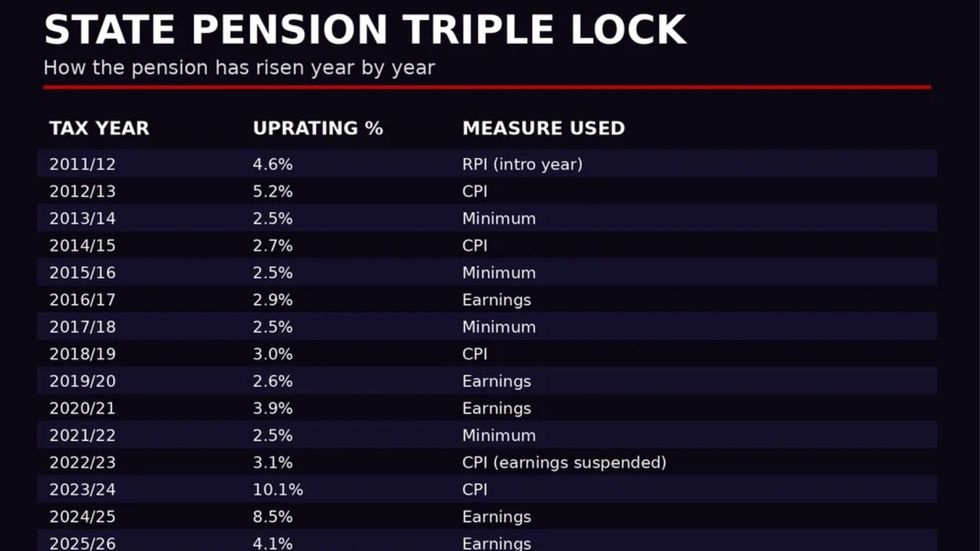 How the state pension triple lock has changed over the years | GB NEWS / FIDELITY INTERNATIONAL
  Currently, the full new state pension stands at £241.30 weekly | GETTY
Each year brings fewer retirees with access to these generous schemes, while those who did accumulate some entitlement often have smaller amounts than previous generations.
The newer defined contribution arrangements have not yet filled this gap. Automatic enrolment into workplace pensions only commenced in 2012 and did not extend to all employers at the full eight per cent contribution rate until 2018.
Mr Webb said it would take considerably longer for these pension pots to grow into meaningful sums for most workers.
The FOI response also examined a more drastic scenario where state pensions were linked solely to inflation rather than earnings.
Under this arrangement, the number of people heading for inadequate retirement income would surge to 26 million — representing more than three quarters of the entire working-age population.
Mr Webb said: "If we end up in a situation where 19 million people (or more) are going to have to tighten their belts sharply when they can no longer work, then our pension system is simply not fit for purpose."
Government figures already estimate that around 14.5 million people are on course for a disappointing retirement under current arrangements, which assume the triple lock continues indefinitely.
While acknowledging that critics have a point when they argue the triple lock cannot continue indefinitely, Mr Webb insisted the policy must be preserved for at least the next decade.

Current headline inflation stands at theree per cent, having retreated from last year's 3.8 per cent peak
| GETTYHe said: "We simply cannot pull the rug from beneath them by watering down the vital support provided by the state pension, uprated by the triple lock."
Think tanks and economists have argued the triple lock is fiscally unaffordable and unfair to younger generations, calling for it to be ended as soon as possible.
However, Mr Webb maintained that millions of people approaching retirement will be heavily reliant on the state pension due to the slow development of private pension provision.
He expressed hope that the forthcoming report from the new Pensions Commission would outline improvements for the 2030s.