






Britain faces a difficult economic road ahead, with inflation potentially surging to 5.8 per cent should the Middle East conflict drag on without resolution.
With more than a quarter of Government debt linked to inflation, any sustained price increases would automatically drive up the cost of servicing that borrowing.
New analysis from the Institute for Public Policy Research warns that a prolonged stalemate in the Iran war could push consumer prices well beyond the Bank of England's two per cent target.
The think tank's modelling paints a concerning picture for households already struggling with rising costs.
The IPPR estimates the Treasury could face an annual hit of up to £8billion through a combination of increased debt interest payments and reduced tax receipts.
Senior economist at IPPR William Ellis said: “The UK cannot afford to sit back and let another energy shock drive up inflation and damage the economy.
“The UK economy and public finances are expected to take a significant hit from the Iran conflict, regardless of whether the Government intervenes."

Weak growth combined with rising prices would create a particularly challenging environment for policymakers trying to balance the books
| GETTYEconomic growth would also suffer badly under this scenario, with real GDP expansion potentially slowing to just 0.3 per cent.
The research institute has called on ministers to take action now to shield the economy and public finances from lasting damage caused by the US and Israel's military engagement with Iran.
Such weak growth combined with rising prices would create a particularly challenging environment for policymakers trying to balance the books.
Daniel Casali, Chief Investment Strategist at Evelyn Partners, captured the mood by referencing Irving Berlin's classic song: "Its opening line, 'there may be trouble ahead', feels particularly apt today in capturing the challenges now confronting the UK economy.
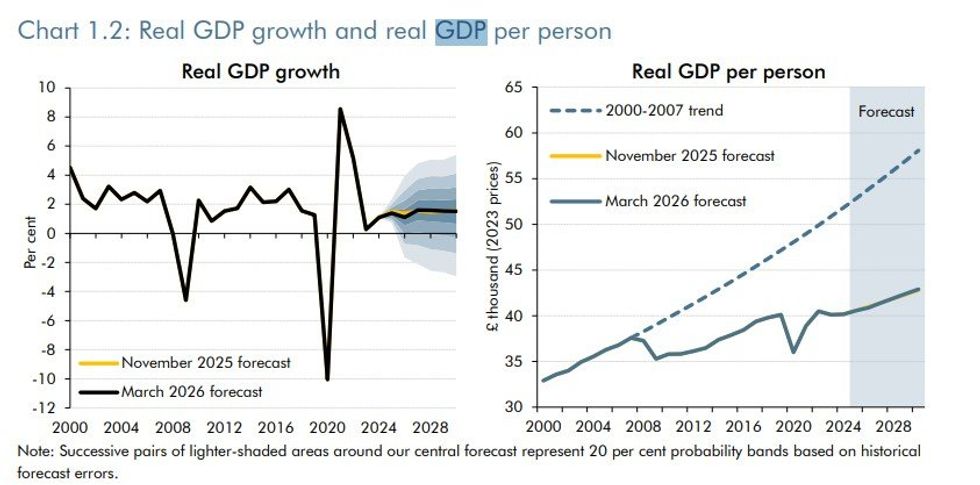 GDP has been downgraded by the OBR for 2026. | OBR
 "That unease is underscored by the Ipsos Economic Optimism Index, which shows public expectations for the UK economy at its lowest level on record from data that goes back to 1978."
Public sentiment on future prices has shifted dramatically in recent months.
According to the Citi and YouGov survey, households now expect inflation to reach five per cent over the coming year, a sharp jump from 3.3 per cent recorded in February.
Rising energy costs are not the only factor pushing prices upward.
Water and sewage bills are set to climb by 26 per cent during the current fiscal year, while broadband and mobile phone providers have already increased their charges by roughly 10 per cent.
Deutsche Bank calculates that these administrative and regulated price rises alone could add approximately 0.7 percentage points to the headline inflation figure.
With the Consumer Price Index already standing at 3.3 per cent in March, these additional pressures threaten to push overall inflation significantly higher even before accounting for any further energy market disruption.
The UK economy faces several other structural weaknesses that compound these inflationary concerns.

Confidence in the housing market has fallen sharply, raising concerns that consumer spending could slow down.
| GETTYHousing market confidence has deteriorated notably, with the Royal Institution of Chartered Surveyors survey trending downward, historically a precursor to reduced consumer spending.
The tax burden has reached its highest proportion of the economy since the Second World War, with the Office of Budget Responsibility projecting it will climb further to 38.5 per cent by the next decade.
Britain's vulnerability to energy price shocks was highlighted when OpenAI reportedly abandoned plans for a £31 billion data centre investment over electricity cost concerns.
Productivity growth has averaged merely 0.4 per cent annually since 2011.