








A senior Bank of England policymaker has warned Britain faces a sharply increased risk of recession, with the probability of economic contraction rising to as much as 40 per cent over the next year.
Alan Taylor, a member of the Bank’s nine-person monetary policy committee, said the central bank’s most severe economic forecasts linked to the US-Iran conflict increasingly appeared to be unfolding.
He indicated that the Bank’s scenario involving crude oil prices remaining above $100 per barrel throughout 2026 was now "likely correct".
Mr Taylor warned that prolonged energy price pressures would require tighter monetary policy in order to contain inflation.
Before the conflict began in February, Mr Taylor had been among the strongest supporters within the committee for cutting interest rates.
Under the Bank’s most pessimistic energy forecasts published in April, inflation could climb above six per cent before the end of the year.
The central bank’s projections suggested inflation would not return to its two per cent target until 2028 if energy prices remained elevated.
Interest rates could also be pushed as high as 5.25 per cent under that scenario as policymakers attempt to prevent sustained inflationary pressures from becoming embedded in the wider economy.
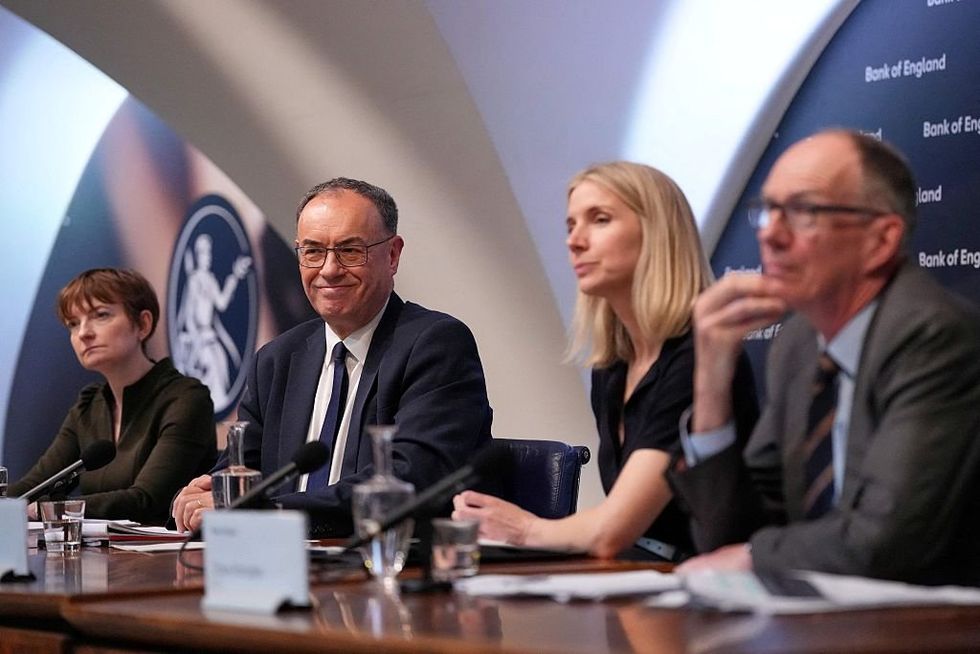
Bank of England policymaker warns UK recession risk could rise to 40 per cent amid energy crisis
|GETTY
The Bank acknowledged in April that such levels of monetary tightening would increase the risk of recession.
Interest rates have remained unchanged at 3.75 per cent since the outbreak of hostilities, with policymakers choosing to monitor the impact of the conflict on inflation and employment before making further decisions.
Mr Taylor said borrowing costs currently sit around half a percentage point higher than they would have been without the conflict in the Middle East.
Despite the warnings, he suggested the current energy shock may prove less severe than the disruption caused by Russia’s invasion of Ukraine in 2022.
LATEST DEVELOPMENTS
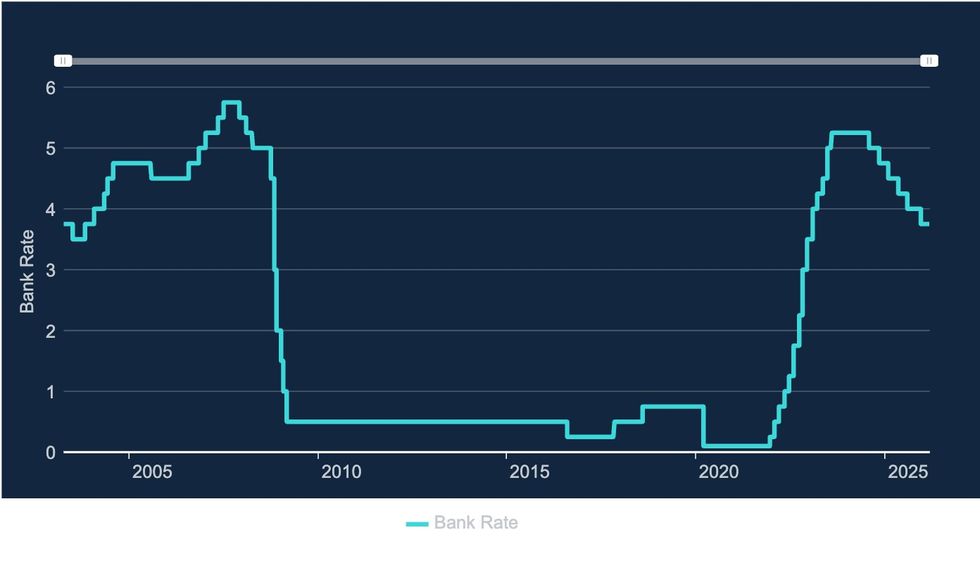 Bank of England interest rates over time | Bank of England
 Speaking at an MNI event, Mr Taylor said: "Economic conditions are such right now that second-round effects are less likely to materialise than they did in 2022, but it's an uncertain situation."
Financial markets have shifted significantly since February, with investors moving away from expectations of two interest rate cuts and instead pricing in two potential increases.
Markets are now anticipating the base rate could rise to 4.25 per cent.
That repricing has pushed up government borrowing costs and tightened financial conditions more broadly across the economy.
Mr Taylor said: "We think at the moment, with the tightening of financial conditions, there is enough restrictiveness in the system to keep a lid on inflationary pressures sufficiently for now."
Andrew Wishart, an economist at Berenberg, suggested market expectations may have reduced pressure on policymakers to raise rates aggressively.
He said: "By pricing in rate hikes, investors have made it less likely that central banks have to deliver all of them."
The conflict has also increased costs for several commodities beyond crude oil, including fertiliser, helium and other industrial raw materials.
There was some relief in April after inflation slowed more than expected to 2.8 per cent annually.
The Bank is now closely monitoring whether businesses choose to absorb higher energy costs or pass them on to consumers through increased prices.
How companies respond over the coming months is expected to play a major role in determining whether inflation remains under control or whether the Bank’s worst-case economic forecasts begin to materialise.