







Those attempting to shed pounds by dramatically slashing their food intake may be unwittingly sabotaging their own efforts, according to nutrition experts.
Registered dietitian Lindsay Allen has warned that extreme calorie restriction can bring weight loss to a grinding halt.
"Eating too little over time slows your weight loss or stops it completely because your body lowers its metabolic rate and preserves energy for your survival," Allen told GB News.
The counterintuitive phenomenon occurs when prolonged under-eating triggers the body's ancient defence systems.

Eating too little can decrease the metabolic rate and decrease your thyroid hormones
|GETTY
"When you eat too little for too long, you're basically telling your body there's a famine and there's not enough food around," she explained.
According to Allen, the human body responds intelligently to perceived food scarcity by activating protective mechanisms.
"Your body is smart and will respond accordingly. It decreases your metabolic rate, decreases your thyroid hormones, and upregulates the metabolic processes that make you REALLY good at storing fat," she said.
These ancient survival adaptations essentially prime the body to conserve every possible calorie during times of shortage.
"This is basic survival mechanisms in place to protect you," Allen noted.
The dietitian further explained that restricted eating not only dampens metabolic function but also enhances the enzymes responsible for converting calories into stored fat.
LATEST DEVELOPMENTS:
The hormonal consequences of severe restriction prove equally damaging to weight loss ambitions.
"You become leptin resistant while your hunger hormone, ghrelin, goes up.
"This makes you hungry more often and LESS likely to feel full because your satiety hormone, leptin, is not working as well," Allen warned.
This double blow leaves dieters battling constant cravings whilst struggling to achieve satisfaction from meals.
Perhaps most concerning is the loss of lean tissue that accompanies prolonged under-eating.
"Your muscle mass DROPS because your body will take amino acids from the muscle tissue if it's not getting enough from the diet," the dietitian explained.
Allen outlined several telltale indicators that someone may not be consuming sufficient nourishment.
"Signs that someone is under-eating: they feel hungry often, they have a hard time feeling satisfied after a meal or they get hungry quickly after a meal, they start having trouble sleeping, their hormones drop, they start feeling sluggish and low energy, and they start feeling moody," she said.
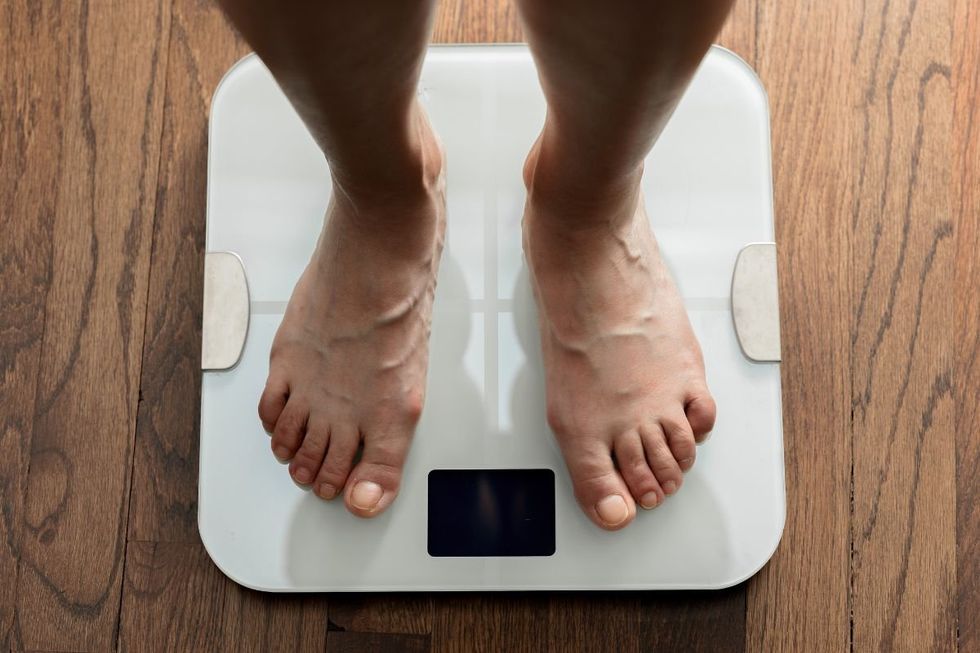
'The quality of food in the right balance is much more important than the amount of food'
|GETTY
"In extreme cases, they start losing hair, and their nails become brittle because the body doesn't prioritise hair and nails when it's starving."
Rather than obsessive calorie counting, Allen advocates a different approach entirely.
"The quality of food in the right balance is much more important than the amount of food.
"When you couple high-quality foods with the right exercise, you can lose weight effortlessly without tracking a single calorie or macro," she advised.