








I watched events unfold from across the Atlantic, disappointed not to be able to stand with the crowds in central London. Yet the images from that Saturday afternoon reassured many of us around who cherish Britain and our respective nation’s sovereignty.
A far brighter future lies ahead than the catastrophe now unfolding under the present government. The march built directly on the momentum of last week’s local elections.
It signalled that the British people are ready, at last, to express their will in a new general election and builds hope that common sense is making a comeback around the world.
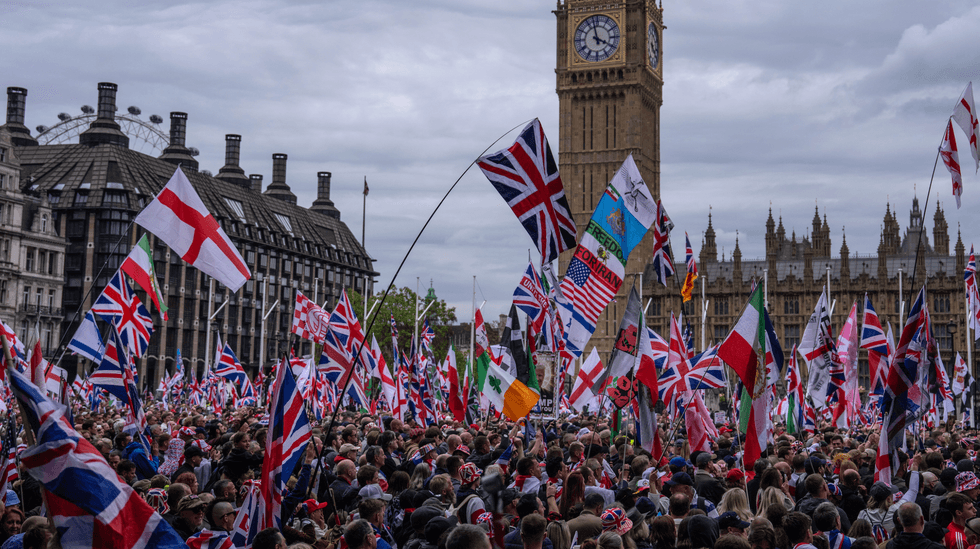
Police put the turnout at 60,000 minimum. That figure alone suggests one of the largest mobilisations in Britain in recent memory. Crowds waved Union Jacks and St George’s crosses.
They filled the streets with a visible, orderly assertion of national identity. Organisers had hoped for more. The Met’s sober estimate still dwarfs most protests staged by the progressive establishment.
This was no fringe gathering. Reports from the scene described families, veterans, and working men and women who have simply had enough.
Contrast that reality with the coverage that followed. The Starmer Government and much of the media framed the event in terms of extremism and hate.
They reached for familiar labels. Yet it was impossible to miss the ordinary character of the participants: people alarmed by mass immigration, two-tier policing, and the steady erosion of British sovereignty.
The march was not a riot. It was a disciplined demonstration against policies that have delivered higher taxes, strained public services, and cultural dislocation.
Labour’s governing class prefers to dismiss such concerns as bigotry. The numbers on the streets suggest otherwise.
The timing sharpened the message. Only days earlier, on 8 May, Labour suffered its worst local election drubbing in a generation.
The party lost more than 1,300 council seats. Reform UK gained over 1,400. In once-safe Labour heartlands—Wigan, Tameside, parts of Greater Manchester — voters delivered a clear verdict. Starmer’s response was characteristic: he vowed to “deliver change” while refusing to acknowledge the scale of the rejection.
The march amplified that verdict. It turned local discontent into a national statement. Britain’s patriots are not waiting for permission. They are moving.
As an American, this is my honest verdict about the Unite the Kingdom march - Lee Cohen
|Getty Images
The presence of American voices added weight. Journalist Glenn Beck addressed the crowd directly. He spoke of free speech, individual liberty, and the shared inheritance of Britain and the United States. Chants of “USA!” rose from sections of the march.
Those moments were not theatrical. They reflected a genuine transatlantic recognition: the defence of Western sovereignty is not a parochial British struggle. It is a common cause. Influential American conservatives noted the event with approval.
They saw patriots pushing back against the same progressive overreach that has reshaped their own country. The solidarity was unsentimental and strategic. It reminded observers that Britain’s fight resonates far beyond its shores.
Labour’s record supplies the context for such resolve. Since taking office, the Government has accelerated net migration, pursued net-zero policies that raise energy costs, and maintained a foreign policy that often appears more deferential to international institutions than to domestic opinion.
The EU remains an unspoken shadow; even after Brexit, regulatory alignment and activist courts constrain independent action.
The march confronted these failures without slogans or hysteria. It simply displayed the scale of public frustration. Police deployed thousands of officers to manage rival protests.
Some arrests occurred, yet the main body of the demonstration remained peaceful. That discipline undercuts the narrative of chaos peddled by NGOs and the broadcast media.
The catastrophe is measurable. Council budgets strain under housing and welfare demands. Crime statistics and grooming-gang inquiries continue to expose institutional timidity. Cultural institutions promote narratives that many Britons reject.
Against this backdrop, the march represented something rarer than outrage: confidence. Participants were not begging for reform. They were asserting that reform is inevitable once the electorate regains its voice.
This is where the inspiration lies. For patriots in Europe, Australia, and the United States, the event demonstrated that large-scale, peaceful mobilisation remains possible even under hostile governance. It showed that scepticism toward the progressive consensus is not fringe but mainstream.
Britain’s nationalists have endured years of institutional scorn. They have watched their country change in ways never put to a serious vote. The local elections cracked the façade. The march widened the breach.
A general election cannot come soon enough. Starmer clings to office, citing stability. The public sees stagnation. Reform’s gains and the march’s scale point to the same conclusion: the governing class has lost touch.
An independent United Kingdom—free of EU supranationalism, guided by its own electorate—can still chart a different course.
Mass immigration can be curtailed. Sovereignty can be reclaimed. National identity can be defended without apology.
The images signalled to the rest of the world that Britain is not finished. The future of the country we look to as the model for sovereignty, liberty and limited government will be bright once again.
The Unite the Kingdom march was proof that resolve endures. The brighter future is not a slogan. It is the logical outcome when citizens decide they have waited long enough.
Our Standards: The GB News Editorial Charter