









Marine archaeologists have discovered the remains of a Danish warship sunk by Admiral Horatio Nelson's fleet more than two centuries ago.
Resting on the seabed of Copenhagen Harbour, the vessel, dubbed the Dannebroge, went down during the Battle of Copenhagen in 1801, leading to the tragic deaths of 375 crew members.
As part of the remarkable discovery, researchers extraordinarily recovered part of a sailor's lower jaw, as well as a number of impressive relics, including a cannonball.
The 1801 battle ranks among Nelson's most celebrated naval escapades, with the 48-metre Dannebroge positioned at the heart of the Danish defensive line.
During the centuries' old combat, British forces sought to compel Denmark to abandon its alliance with Russia, Prussia and Sweden, which London dubbed a threat to vital Baltic supply routes.
Danish defenders braced for overwhelming odds, fielding 833 guns against the British fleet's monstrous 1,270.
During the clash, the Admiral's warships unleashed devastating volleys tearing through the Dannebroge's upper deck, while incendiary shells ignited a catastrophic blaze.
Though a ceasefire was eventually negotiated, the stricken vessel drifted northward before exploding with such force that the blast echoed across the entire city.
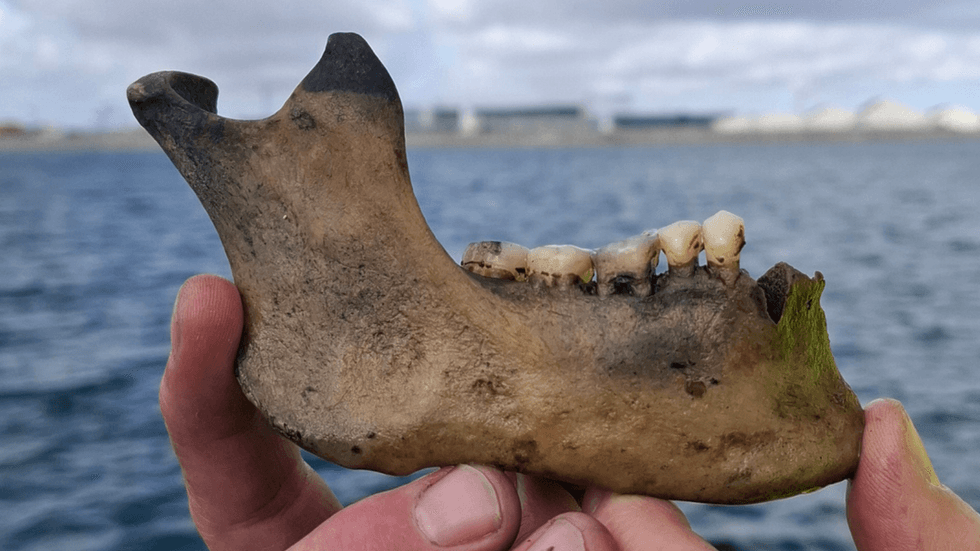
Archaeologists recovered a sailor's jaw
|VIKING SHIP MUSEUM
Denmark's Viking Ship Museum is spearheading the excavation, with experts noting there is so much more to discover about life aboard the Dannebroge.
"(It was) a nightmare to be on board one of these ships," Morten Johansen, the museum's head of maritime archaeology said.
"When a cannonball hits a ship, it's not the cannonball that does the most damage to the crew, it's wooden splinters flying everywhere, very much like grenade debris."
Researchers first identified the wreck by carrying out comparitive assessments of the recovered wooden sections with historical illustrations.
LATEST ARCHAEOLOGICAL BREAKTHROUGHS:
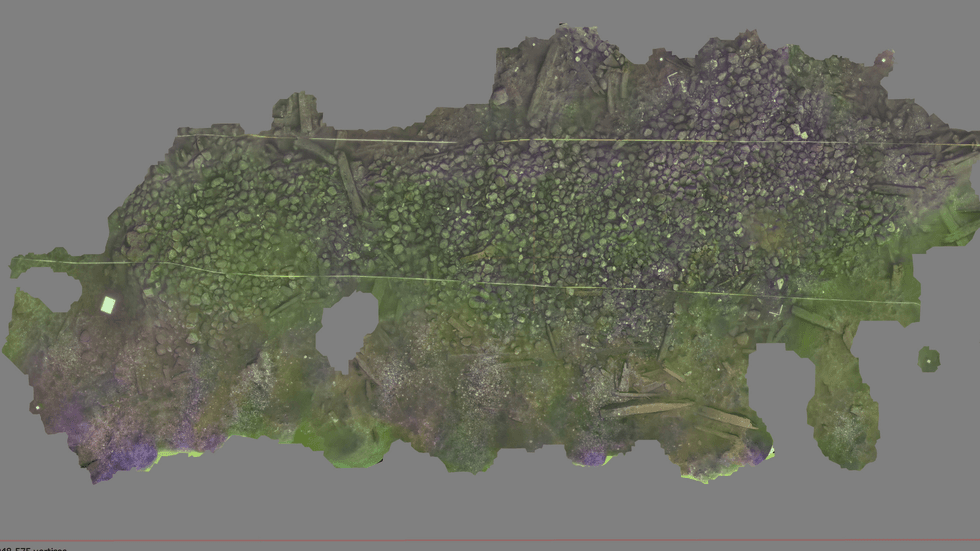
The Viking Museum created a 3D illustration of the shipwreck site
|VIKING SHIP MUSEUM
The site, littered with cannonballs, was a particular challenges the dive team encountered, leading researchers to scrounge around the area with little to no eyesight.
"Sometimes you can't see anything, and then you really have to just feel your way, look with your fingers instead of with your eyes," diver and maritime archaeologist Marie Jonsson said.
The very same battle also was the birthplace for one of the English language's most enduring expressions.
During the engagement, Nelson's superior Admiral Parker signalled for the fleet to withdraw amid concerns over mounting British casualties.
The British naval officer, who had previously lost sight in his right eye, famously refused to acknowledge the order.
"I have only one eye, I have a right to be blind sometimes," he famously declared.
The military chief's act of adamant defiance is subsequently widely credited as the origin of the phrase "to turn a blind eye".
The excavation of the historical site continues as archaeologists race to complete their work before construction begins on the harbour site.