










Pioneering scientists have created a miniature nuclear fireball and uncovered a surprise discovery in the realm of chemical reactions.
Research conducted at Lawrence Livermore National Laboratory sought to fill potential gaps in knowledge of nuclear fallout models, with findings published in Analytical Chemistry.
The study examined the behaviour of uranium, cerium, and caesium as these elements undergo vaporisation, chemical reactions, and condensation under precisely managed temperature conditions.
Scientists discovered established models may fail to account for sizeable chemical interactions occurring during the formation of fallout particles – radioactive debris propelled into the atmosphere by a nuclear explosion.
When nuclear weapons detonate or severe reactor accidents take place, enormous energy releases vaporise surrounding materials within microseconds, generating an expanding plasma cloud that eventually cools and solidifies.
To investigate these phenomena, the research team developed a plasma flow reactor capable of replicating conditions found within a nuclear fireball.
Materials were fed into high-temperature plasma, vaporised, and then passed through a tube where cooling rates could be monitored.
The apparatus enabled scientists to test the gradual temperature reduction throughout the tube and observe materials remaining hot for extended periods before rapidly cooling.

A diagram of the plasma flow reactor used to examine particles as they move from a hot plasma (left) to a cooler condensed state (right)
|LLNL
Continuous operation of the reactor meant samples could be gathered at various points along the tube, allowing researchers to witness particle evolution throughout the formation process.
Uranium, being less volatile, solidified early and served as a reference point, while cerium – frequently used as a plutonium substitute – followed a similar pattern.
Both elements displayed chemical variations depending on their thermal history.
Meanwhile, Caesium condensed considerably later than its counterparts, mixing far more thoroughly with uranium and cerium when subjected to prolonged high temperatures.
LATEST DEVELOPMENTS
Rakia Dhaoui, LLNL scientist, said: "Changing how long materials remain at high temperature can alter chemical reactions and how volatile elements like cesium are incorporated into particles.
"These particles preserve a record of how they formed.
"By studying these processes in a controlled system, we can replace assumptions with measurements, improve the models used to interpret nuclear debris, and support decision-making when it matters most."
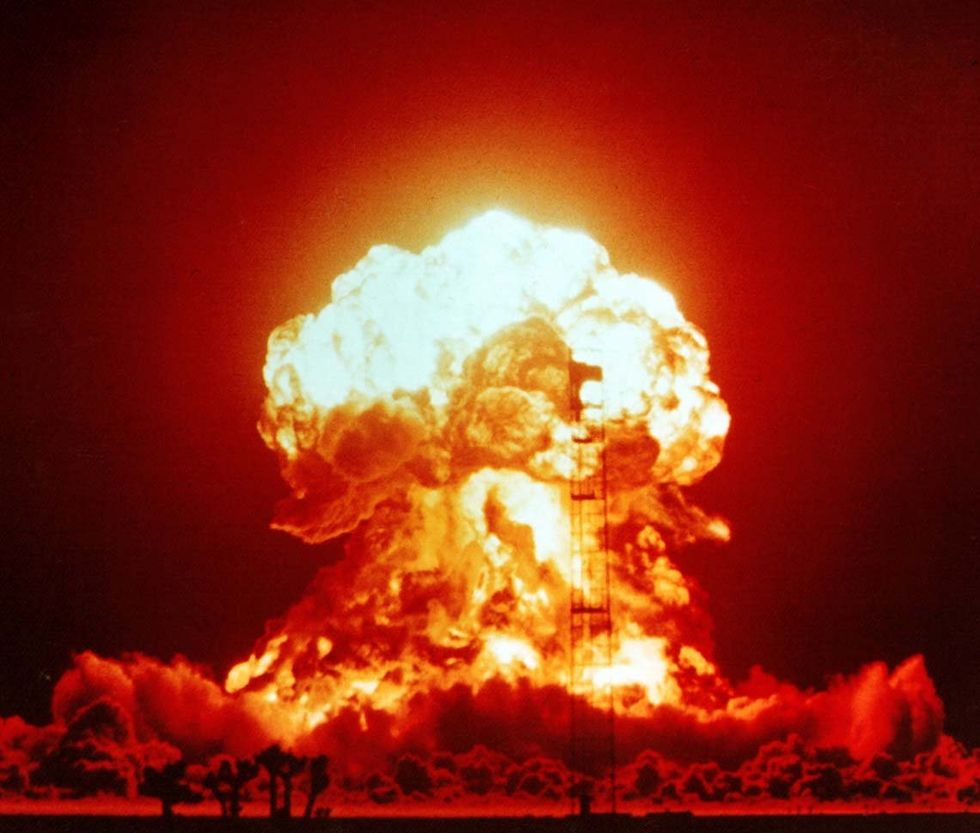
The study aims to better represent the complex processes involved in fallout formation during real-world nuclear events
| WIKIMEDIA COMMONSMany current fallout models treat materials as though they behave independently, meaning chemical reactions between elements are only partially captured.
By isolating thermal history effects within controlled laboratory conditions, the researchers refined models which have historically depended on simplified assumptions.
The team intends to continue this research by examining more realistic material combinations, aiming to better represent the complex processes involved in fallout formation during real-world nuclear events.
Our Standards: The GB News Editorial Charter