








Scientists have discovered the origins of sexual reproduction trace back to a 567-million-year-old sea creature.
Over in Canada, a remarkable fossil discovery in Canada has shaken up the timeline of when complex organisms first began mating.
Researchers from the American Museum of Natural History in New York announced the find "pushes back the origins of sexual reproduction by five to 10 million years".
These ancient creatures, which lived on the seabed shortly after Earth's first complex animals emerged, are tube-shaped and resemble a coral-like appearance.
The Funisia organism was "an immobile tubular organism that lived in clusters of similar size", researchers said.
It provides "the oldest evidence of sexual reproduction in the fossil record, likely with co-ordinated release of sperm and eggs into the water column like coral".
Scientists spent years exploring a remote area of the Canadian Northwest Territories before uncovering more than 100 fossils in the Mackenzie Mountains.
Six groups had never previously been found in North America.
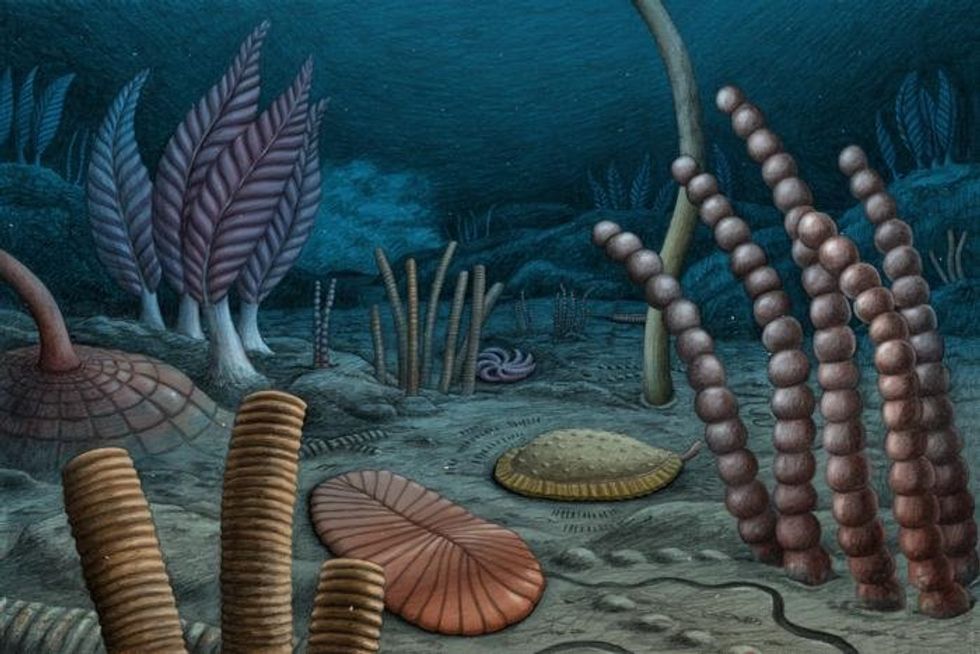
Some of the discoveries 'look nothing like any organism alive today', experts excitedly remarked
|AMERICAN MUSEUM OF NATURAL HISTORY
Among the discoveries was a Dickinsonia, described as "a flat organism that moved around on the seafloor, lacking a mouth and instead absorbing bacteria and algae through its entire bottom surface".
Researchers compared the organism to a "bathmat" or "pancake", which is also the earliest known animal capable of moving to scout out food.
Another find was Kimberella, "with a muscular foot that fed by scraping the seafloor, widely interpreted as an early relative of molluscs".
Scientists believe Kimberella could be in the running for the oldest known bilaterian — animals with "a distinct front, back, top and bottom with symmetric left and right sides".
LATEST SCIENCE BREAKTHROUGHS:
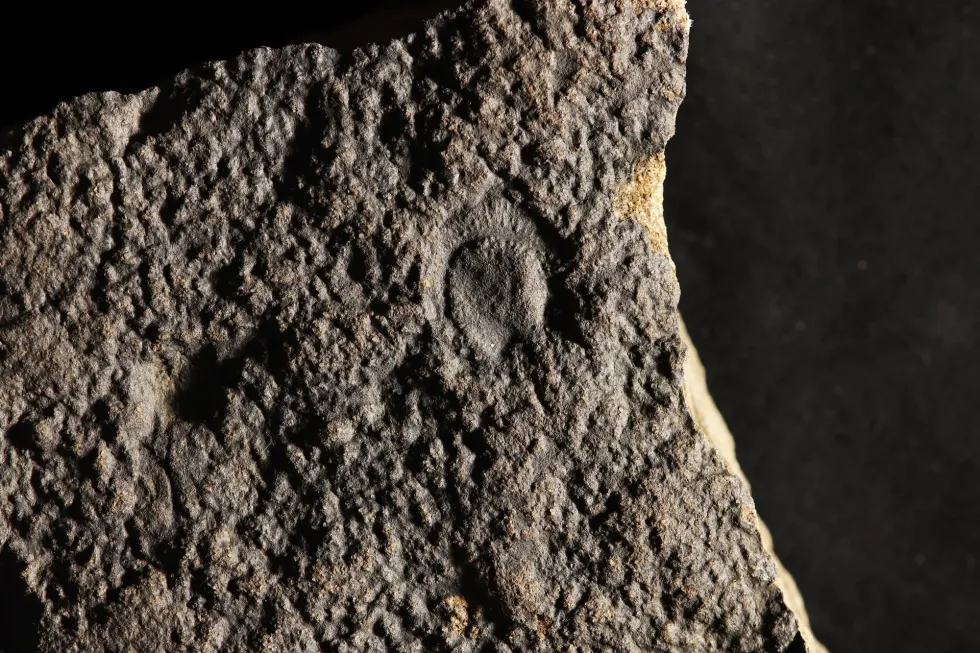
Kimberella was interpreted 'as an early relative of molluscs'
|AMERICAN MUSEUM OF NATURAL HISTORY
This group now comprises more than 99 per cent of all known animals.
Scott Evans said: "For three billion years, life on Earth was dominated by microbes. Then, all of a sudden, we get these strange-looking marine animals big enough to see and capable of behaviours we would find familiar today."
Mr Evans works as the assistant curator of invertebrate palaeontology at the museum, who led the study published in Science Advances.
"If we want to understand this transition, when life first became large, complex and unmistakably animal, this new site has tremendous potential," he added.
His co-author, Justin Strauss, from Dartmouth College in New Hampshire, said: "This is really exciting."
The fossils belong to the Ediacaran group, representing the earliest firm evidence of multicellular animal life between 538 and 575 million years ago.
Some of these ancient organisms resemble the ancestors of modern molluscs, corals and jellyfish, but "others look nothing like any organism alive today", the researchers said.
Before their discovery, scientists had assumed evolution began in shallow coastal waters before spreading to deeper seas.
"These results suggest a pattern where evolutionary innovation begins in deeper environments and later spreads toward the coast," Mr Evans said.
"We think of the deep ocean as a dark, inhospitable place, but it is also relatively stable, with few fluctuations in things like temperature and oxygen essential to most animal life.
"This stability may have provided key opportunities to support early animal life."
Our Standards: The GB News Editorial Charter