










Scientists have discovered a black hole that appears to be growing at around 13 times the expected cosmic "speed limit".
A team of astronomers in Japan used a large optical-infrared telescope to effectively look 12 billion years in the past, shortly after the start of the universe.
This led to the discovery of a distant galaxy with a bright core known as a quasar, which they said "hosts one of the fastest-growing supermassive black holes known at this mass scale".
The experts found the quasar to be undergoing "extremely rapid" growth.
TRENDING
Stories
Videos
Your Say
It was also shining brightly in X-rays and producing strong radio emission from a jet, which they said many theories "do not expect to coexist".
The finding, therefore, raises fresh questions over how supermassive black holes were able to grow in the early universe.
Supermassive black holes, millions to billions of times the mass of the Sun, sit in the centers of most galaxies.
They increase in size by pulling in surrounding gas.
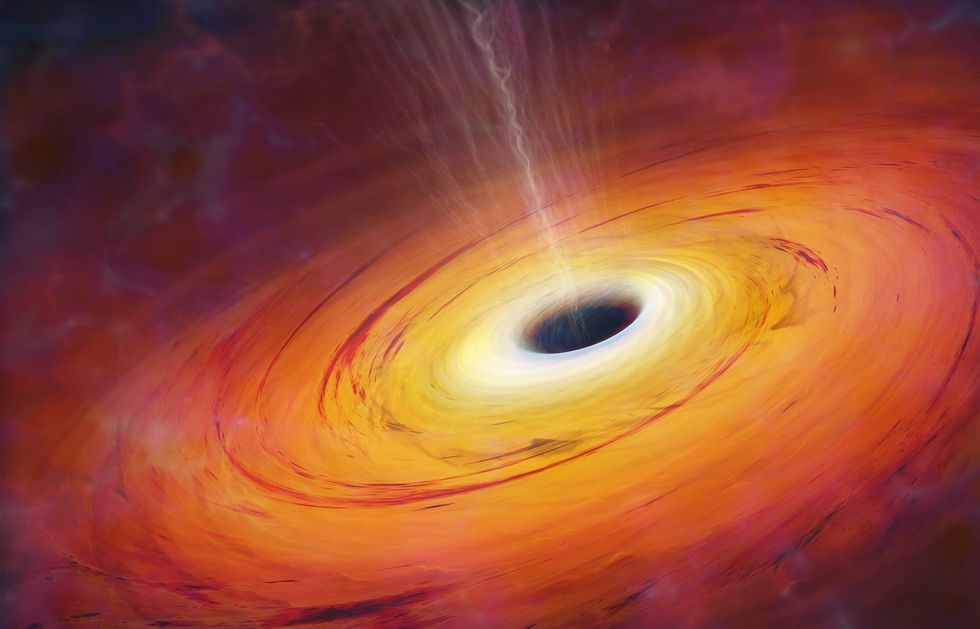
Supermassive black holes are millions to billions of times the mass of the sun
|GETTY/SCIENCE PHOTO LIBRARY/MARK GARLICK
Waseda University in Tokyo, which took part in the study, stated: "What makes this object especially striking is its multi-wavelength behaviour.
"During super-Eddington phases, many models predict that the inner flow structure changes in ways that can reduce the observed X-ray emission and that jets may be less prominent.
"However, this quasar shines brightly in both X-rays and radio wavelengths, indicating that it is growing at an extreme rate while simultaneously sustaining an active corona and a powerful jet.
"This unexpected combination hints at physical mechanisms not yet fully captured by current models of extreme accretion and jet launching."
LATEST DEVELOPMENTS
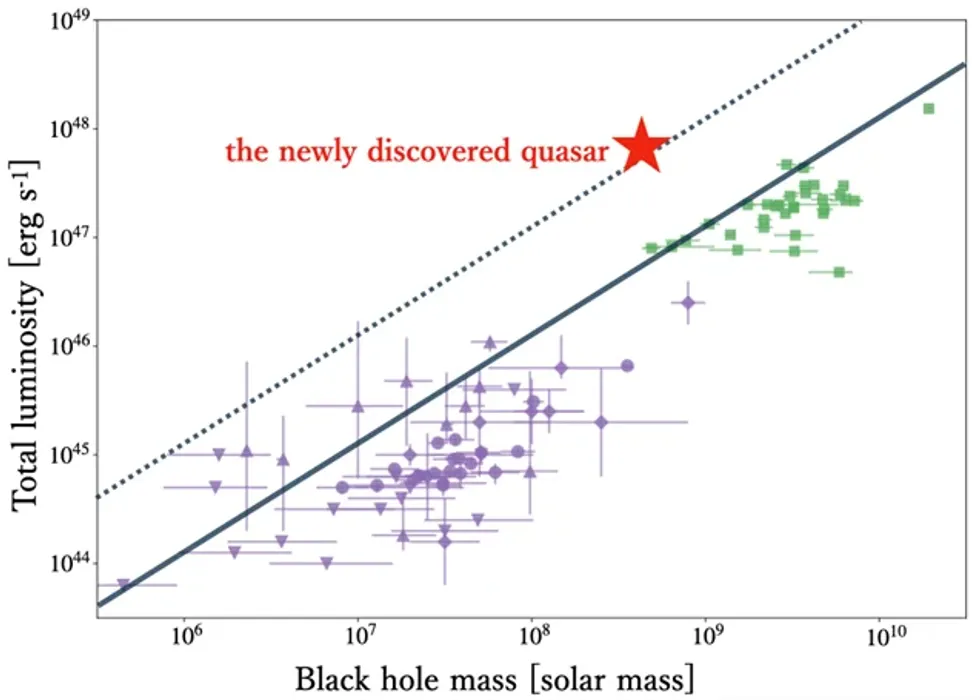
The newly discovered quasar was found to have undergone 'extremely rapid' growth
|NASA/JPL-CALTECH
The scientists, who published their findings in The Astrophysical Journal, have proposed the black hole could have been caught during what they referred to as a "short-lived transitional stage", such as a sudden burst of inflowing gas.
"If correct, this discovery offers a rare observational window onto time-variable black hole growth in the early universe—an important step toward understanding how the massive black holes assembled so quickly," the university stated.
Lead author Sakiko Obuchi added: "This discovery may bring us closer to understanding how supermassive black holes formed so quickly in the early Universe.
"We want to investigate what powers the unusually strong X-ray and radio emissions and whether similar objects have been hiding in survey data."
Our Standards: The GB News Editorial Charter