










Researchers at University College London (UCL) have set a new data "speed record" equivalent to 50 million movies being streamed at the same time.
A team, led by Polina Bayvel, set the groundbreaking data transmission speed of 450 terabits per second through commercially installed fibreoptic cables running beneath the capital's streets.
Researchers sent the data between their lab in Bloomsbury, central London, and a Canary Wharf data centre using existing underground infrastructure.
This remarkable speed translates to approximately 50 million films being streamed at the same time.
TRENDING
Stories
Videos
Your Say
The achievement represents a tenfold improvement over current commercial network capabilities.
Perhaps most significantly, the breakthrough demonstrates that internet bandwidth could be dramatically expanded without the expense and disruption of installing additional cables.
If rolled out widely, this would be the equivalent of adding nine new cables for every existing one, without the cost of having to install any new infrastructure.
This increase in speed might be beyond what humanity can take advantage of, but it could prove to be useful for the AI boom, which currently runs somewhere in the range of 100 to 400 gigabits per second.
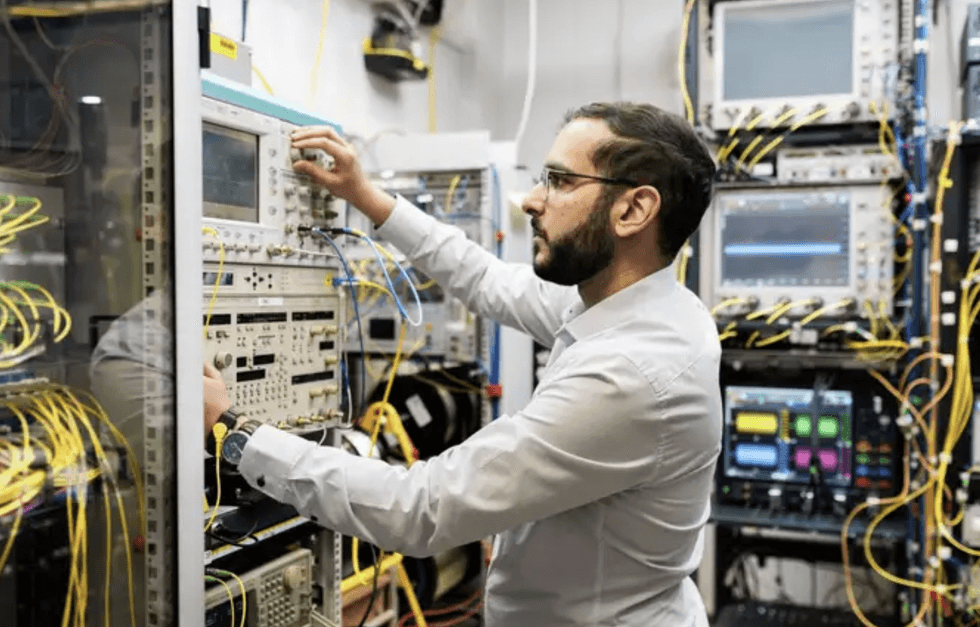
Team member Ronit Sohanpal works on the high-speed data transmission set-up
|UCL
Dr Bayvel said: "There’s only a certain amount of data that anyone could process – you can only watch so many movies.
"But AI infrastructure is generating a lot of data, and that data is is spewing into the network."
In order to achieve the incredible speed, custom designed hardware allowed data to be sent in a wider spectrum of frequencies than current commercial networks.
These new frequencies - ranging from 1264 nanometres to 1617.8 nanometres - required new approaches to correct different amounts of distortion.
BRITISH SCIENCE BREAKTHROUGHS - READ MORE:

University College London's team, led by Polina Bayvel, has set new record internet speeds which could be used by AI
|WIKIMEDIA/DILIFF
While faster speeds have been recorded in highly regulated experiments, UCL's experiment marks the first using existing cables, and demonstrates that the technology could be rolled out onto existing real world infrastructure.
The researchers have suggested the internet speed-up could be implemented within five years.
Kerrianne Harrington at the University of Bath said the research represented a "practical approach" to squeezing more bandwidth out of existing cables, rather than developing new types of cables.
She said: "The interesting thing about this work is it’s using what’s already in the ground, which is the expensive thing to change.
"I do think it’s a very practical approach to the problem. I would say that the work that’s shown in this paper has a more immediate benefit to increasing capacity than new fibres."