








A groundbreaking study has put forward a radical new explanation for how the Great Pyramid of Giza was really built.
The pyramids' construction has long been the source of wild theories - from slavery to aliens - but new research could upend that altogether.
Dr Simon Andreas Scheuring from Weill Cornell Medicine in New York argues that the ancient Egyptians used a mass network of counterweights and pulley-like devices inside the monuments as they were raised to the sky.
His calculations indicate that workers could have positioned enormous stone blocks at extraordinary rates, potentially as fast as one block every minute.
Blocks weighing up to 60 tonnes were raised hundreds of feet during a construction period spanning roughly two decades.
According to Dr Scheuring's analysis, the pyramid's Grand Gallery and Ascending Passage functioned as ramps rather than ceremonial walkways.
Heavy counterweights sliding down these internal passages would have generated sufficient force to hoist blocks elsewhere in the pyramid's core.
The Antechamber, a small granite room positioned just before the King's Chamber, has traditionally been interpreted as a security feature designed to thwart tomb robbers.

The ancient Egyptians may have used a mass network of counterweights and pulley-like devices to build the pyramids
|GETTY
But Dr Scheuring's research reimagines this space as a pulley-like lifting station.
Grooves carved into the granite walls and stone supports which may have held wooden beams suggest the chamber operated as functional machinery rather than a finished ceremonial space.
Scratches, wear marks and polished surfaces along the Grand Gallery's walls point to large sledges moving repeatedly through the space.
Dr Scheuring interprets this evidence as mechanical stress from sliding loads rather than foot traffic or ritual activity.
EGYPTIAN MARVELS - READ MORE:
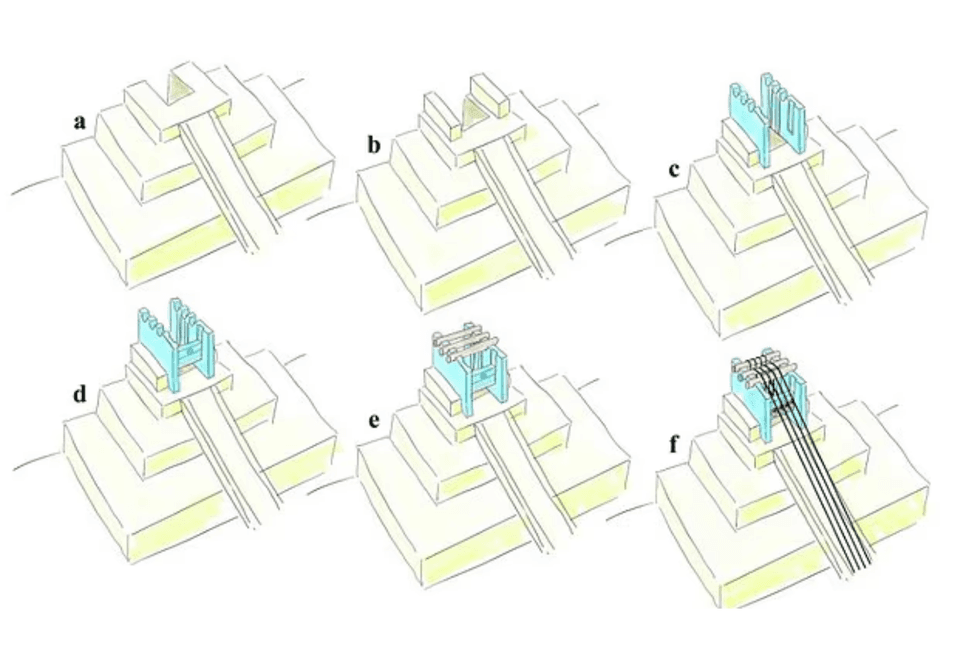
Dr Scheuring argues that the ancient Egyptians used a mass network of counterweights and pulley-like devices inside the monuments as they were raised to the sky
|DR SIMON ANDREAS SCHEURING
The pyramid's internal layout has also raised eyebrows.
Major chambers and passages cluster in a vertical line - yet appear oddly offset rather than perfectly centred.
The Queen's Chamber sits centrally on the north-south axis but not east-west.
The King's Chamber lies noticeably south of the pyramid's central point.
These asymmetries prove difficult to explain through conventional ground-up construction using external ramps.

Dr Scheuring proposes the Great Pyramid was assembled from the inside out
|GETTY
Dr Scheuring proposes the Great Pyramid was assembled from the inside out, beginning with an internal core and expanding as hidden pulley systems raised stones higher.
But his research also may disappoint Egyptologists hoping for further secrets to be revealed.
He believes that no large undiscovered chambers remain concealed within the pyramid's core - a conclusion that aligns with recent muon-scanning surveys.
However, smaller corridors or remnants of internal ramps may still exist in outer portions of the structure, particularly at greater heights.
Should subsequent discoveries support this model, archaeologists may need to fundamentally reconsider construction techniques across ancient Egyptian pyramid building.