










Scientists may have finally cracked one of palaeontology's most enduring puzzles: the Tyrannosaurus rex’s famously tiny arms.
A new study by researchers at University College London (UCL) and the University of Cambridge suggests the answer lies not in the arms themselves, but in the dinosaur's extraordinarily powerful head.
The research found smaller arms in meat-eating dinosaurs were closely linked to the development of large, robust skulls and jaws, rather than simply being a by-product of growing overall.
Published in the journal Proceedings of the Royal Society B, the study examined data from 82 species of theropod, the group of two-legged, predominantly meat-eating dinosaurs that includes T. rex.
Researchers identified five groups of theropods that evolved shortened forelimbs, including tyrannosaurids, abelisaurids, carcharodontosaurids, megalosaurids and ceratosaurids.
The team found in each case, the reduction in arm size had a stronger association with skull robustness than with overall body size, suggesting the two developments were directly connected.
Lead author Charlie Roger Scherer, a PhD student at UCL Earth Sciences, said the findings pointed to a clear evolutionary logic.
He said: "Everyone knows the T. rex had tiny arms, but other giant theropod dinosaurs also evolved relatively small forelimbs.
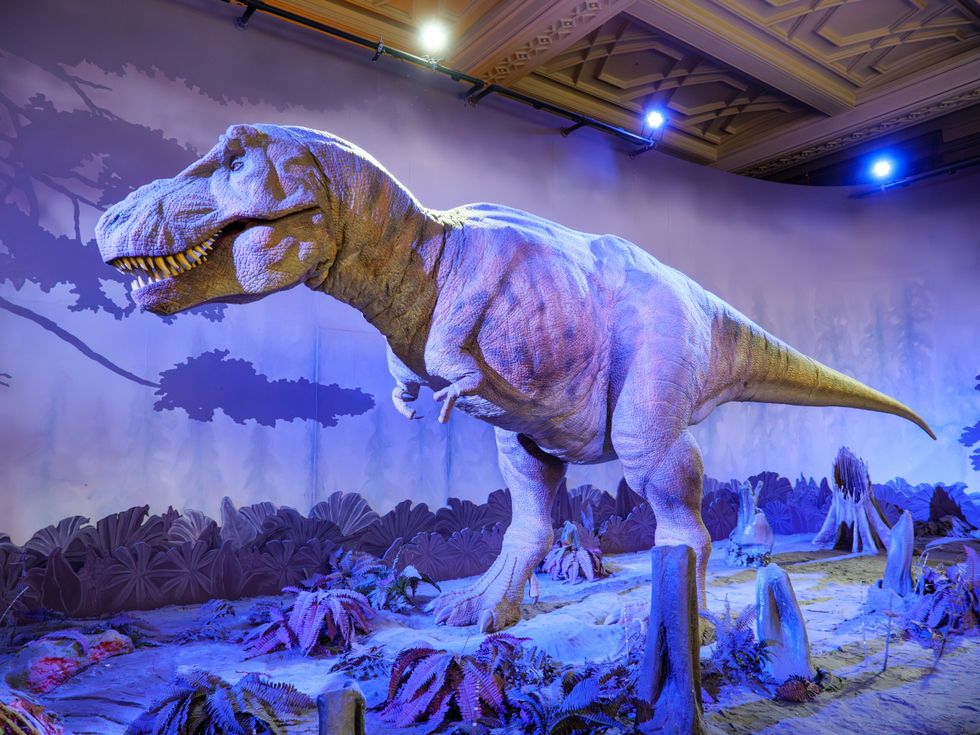
On the T.rex's short arms, Charlie Roger Scherer said it was a case of 'use it or lose it'
|GETTY
“The Carnotaurus had ridiculously tiny arms, smaller than the T. rex."
Mr Scherer said the research revealed a strong relationship between short arms and large, powerfully built heads, with the head effectively taking over from the arms as the primary method of attack.
He said: "It's a case of 'use it or lose it' - the arms are no longer useful and reduce in size over time."
The researchers believe the trigger for this evolutionary shift was the emergence of increasingly gigantic prey, including enormous sauropods, the long-necked, long-tailed plant-eating dinosaurs that could reach lengths of around 100ft.
LATEST DEVELOPMENTS
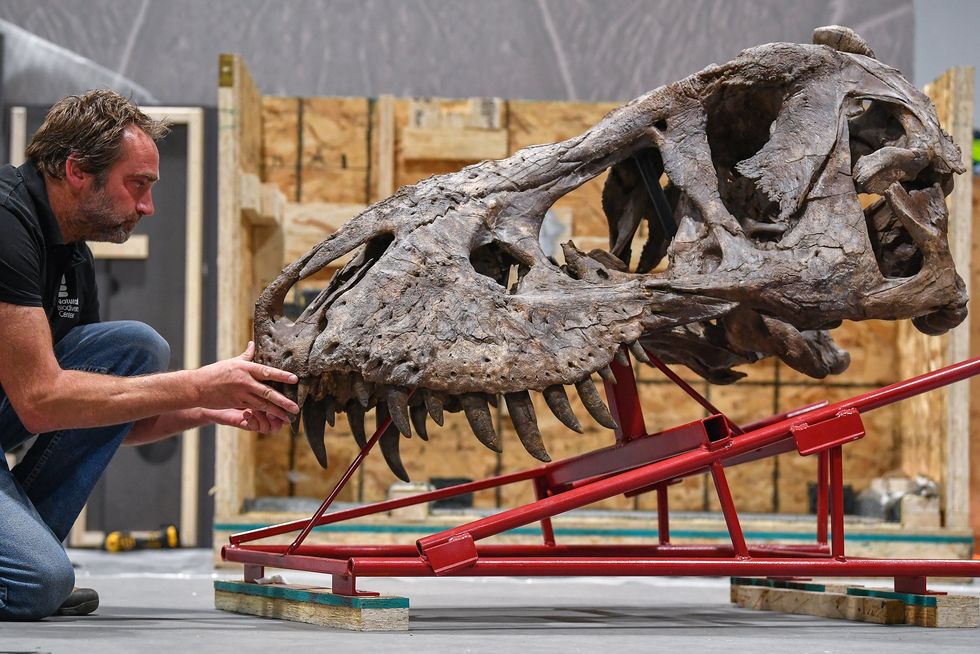
Despite the T. rex's small arms, it was one of the most formidably equipped predators in prehistoric history
|GETTY
Mr Scherer said: "Trying to pull and grab at a 100ft-long sauropod with your claws is not ideal.
“Attacking and holding on with the jaws might have been more effective."
The team described the process as an "evolutionary arms race" in which theropods developed increasingly strong skulls and jaws to better subdue increasingly large prey, whilst their forelimbs became progressively redundant.
Mr Scherer added: "It is highly likely that strongly built skulls came before shorter forelimbs.
“It would not make evolutionary sense for it to occur the other way round, and for these predators to give up their attack mechanism without having a backup."
To measure skull strength, the researchers developed a new method of quantifying skull robustness, taking into account factors including how tightly connected the skull bones were, the overall dimensions and shape of the head and estimated bite force.
On that measure, the T. rex scored highest of all the species examined, confirming its status as one of the most formidably equipped predators in prehistoric history.
It was followed closely by the Tyrannotitan, a theropod of comparable size that lived in what is now Argentina during the Early Cretaceous period, more than 30 million years before T. rex walked Earth.
The study also found the pattern of arm reduction differed between species, with hands and the lower portion of the arm shortening most dramatically in abelisaurids, while in tyrannosaurids each element of the forelimb reduced at a broadly similar rate.
One example highlighted by the researchers was the Majungasaurus, which resided in Madagascar around 70 million years ago.
The apex predator had an exceptionally powerful skull and tiny arms despite weighing only around 1.6 tonnes – roughly a fifth of the T. rex's body weight.
Its inclusion in the findings helped reinforce the point that small arms were driven by skull development rather than sheer body size.
The team concluded that while the same outcome of reduced forelimbs appeared across multiple groups of dinosaurs, it was likely achieved through different developmental pathways in different species.
Previous theories had proposed alternative explanations for the T. rex's reduced arms, including suggestions they aided balance, helped the animal stand upright after falling, or played a role during mating.
Our Standards: The GB News Editorial Charter