










Lord Vallance will unveil a £2.5billion Government strategy aimed at igniting a nuclear fusion revolution in Britain on Monday, March 16, with ministers seeking to shield the nation from the volatile energy markets exposed by the Iran conflict.
The Science Minister's five-year investment plan represents Westminster's most ambitious push yet to achieve what he described as "complete energy independence" from foreign price shocks.
"The current crisis shows that energy prices are volatile and they're internationally determined," Lord Vallance said ahead of Monday's announcement.
"The more we can be self-sufficient and in control of where our energy comes from, the more protective we can be, not only of household bills, which is crucial but also energy bills for companies and our industrial sector."
TRENDING
Stories
Videos
Your Say
The centrepiece of the strategy is a prototype fusion power plant called Step, to be constructed at West Burton in Nottinghamshire on the grounds of a former coal-fired power station.
An initial £1.3billion will fund this flagship project, which aims to become operational in the early 2040s.
Paul Methven, chief executive of the government-owned UK Industrial Fusion Solutions, delivering the scheme, acknowledged the ambitious timeline.
"It's quite an aggressive programme," he said. "We need to show that we can achieve genuine 'wall socket' energy which has not been done before."
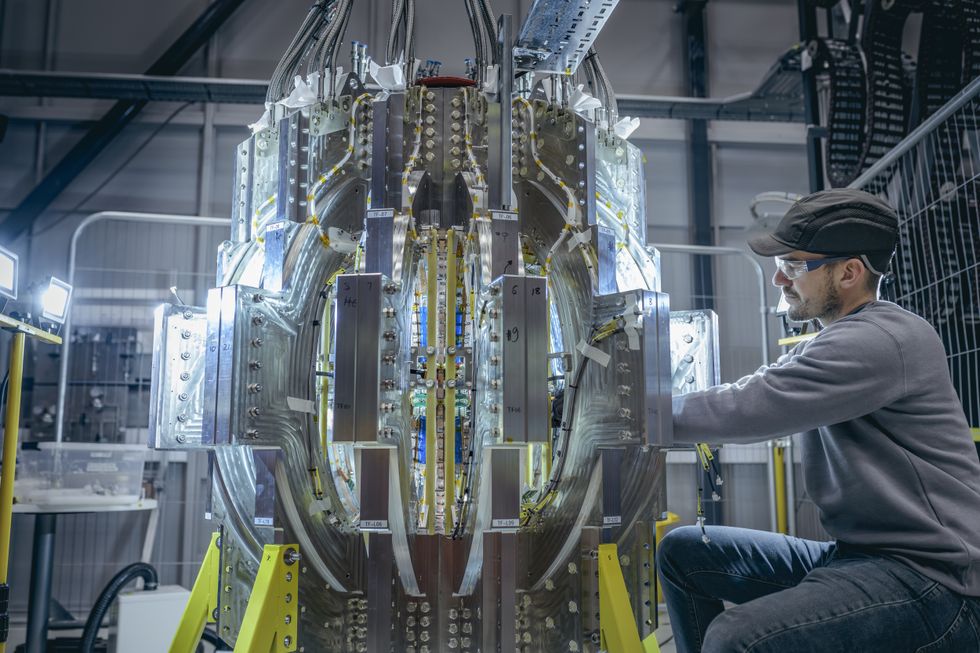
The Science Minister will tomorrow unveil a £2.5billion government strategy aimed at igniting a nuclear fusion revolution in Britain, with ministers seeking to shield the nation from the volatile energy markets exposed by the Iran conflict
|GETTY
The broader investment is projected to generate 10,000 jobs across the British fusion sector by 2030, positioning the UK alongside the United States, China, Germany and Japan in the global race to harness this potentially limitless clean energy source.
Britain's approach centres on a spherical tokamak design, which heats hydrogen isotopes to 150 million degrees Celsius—roughly ten times hotter than the sun's core—until they form plasma and fuse together.
Monday's announcement will also include £180million for a tritium fuel manufacturing facility at Culham in Oxfordshire, alongside £50million dedicated to training 2,000 scientists and engineers in fusion-related disciplines.
The Government is additionally purchasing a £45million AI supercomputer named Sunrise, purpose-built to model plasma physics.
LATEST DEVELOPMENTS:
This investment builds on recent breakthroughs by UK Atomic Energy Authority scientists, who developed artificial intelligence capable of simulating ultra-hot fuel behaviour in seconds rather than days.
Lord Vallance described fusion as "the holy grail of how you get clean, effective, limitless energy".
British companies are already making significant strides in the field.
Tokamak Energy, which emerged from the UK Atomic Energy Authority in 2009, achieved a world first for a private firm in March 2022 by reaching temperatures exceeding 100 million degrees Celsius in its reactor.
First Light Fusion, headquartered north of Oxford, pursues an alternative technique using intense pressure on fuel droplets, and has begun collaborating with space and defence organisations.
Lord Vallance, who served as chief scientific adviser during the pandemic before joining Sir Keir Starmer's Government in 2024, issued a stark warning about Britain's historical tendency to pioneer discoveries without reaping commercial rewards.
"If we don't back it, we will end up being the place that did all the discovery and never made the product," he cautioned.