










A team of British researchers have helped discover the remains of a giant dinosaur who spanned a whopping 88ft in south-east Asia.
Skeletal remains of Nagatitan, a member of the dinosaur lineage called sauropods known for having a long neck, long tail, small head and four columnar legs, have been found in Thailand.
The fossils of this Cretaceous Period dinosaur were first spotted by a villager in Thailand's northeastern province of Chaiyaphum.
Scientists over a period of years then dug up spine, rib, pelvis and leg bones including a front leg bone, the humerus, measuring 5.8 feet (1.78 meters) long.
Based on the dimensions of its humerus and femur, the corresponding hind leg bone, the researchers estimated Nagatitan's body mass at 25 to 28 tonnes.
Its head and teeth were not among the fossils recovered, but the researchers now have a good idea of its feeding preferences based on other sauropods.
"Nagatitan was probably a bulk browser that focused on consuming high volumes of vegetation that required little to no chewing such as conifers and possibly seed ferns," said Thitiwoot Sethapanichsakul, a University College London doctoral student in palaeontology and lead author of the research published in Scientific Reports.
The climate was probably subtropical, with some forests, but also savanna-like and shrubland habitats.
Nagatitan lived alongside other dinosaurs as well as flying reptiles called pterosaurs.
The rivers were teeming with crocodiles and fish including freshwater sharks.
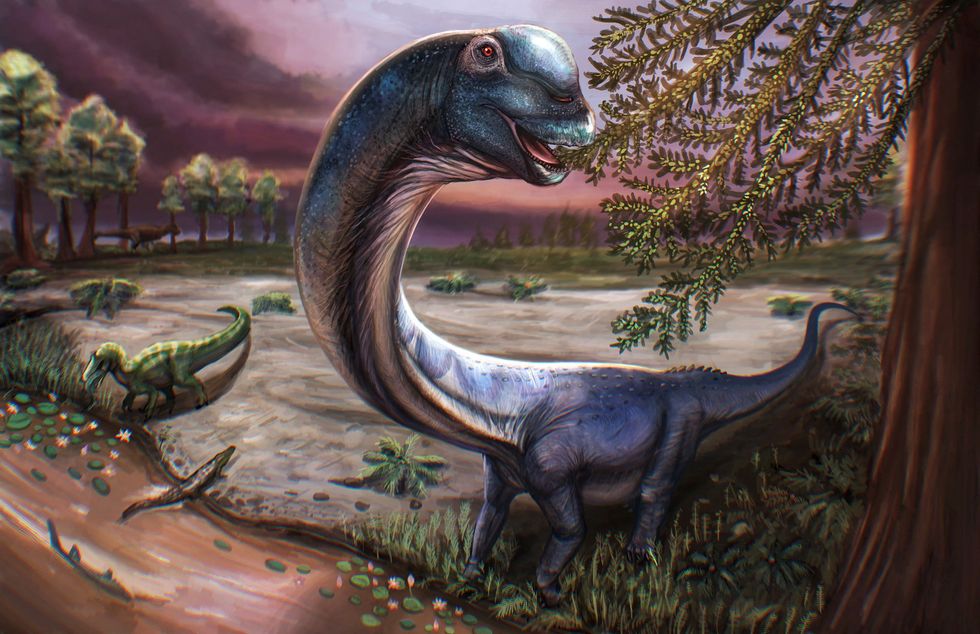
An artists rendition of the Nagatitan which roamed south east Asia millions of years ago
|REUTERS
Mr Sethapanichsakul said: "At that size, it was dwarfed by Nagatitan. At full size, Nagatitan likely had very little to fear in terms of predation."
Predators probably avoided attacking healthy adults of any large sauropod species because of the danger of being squashed. But they may have targeted old or sick adults or vulnerable babies.
University College London paleontologist and study co-author Paul Upchurch said: "Indeed, sauropods are known to have grown very quickly after hatching, and this probably relates to the dangers of predation.
"The sooner sauropods could become large, the safer they were because they would have been more difficult to tackle."
Sauropods included the largest land animals in Earth's history.
Nagatitan was huge by any standard, but not on the scale of some South American sauropods such as Argentinosaurus and Patagotitan that topped 100 feet long.
LATEST DEVELOPMENTS
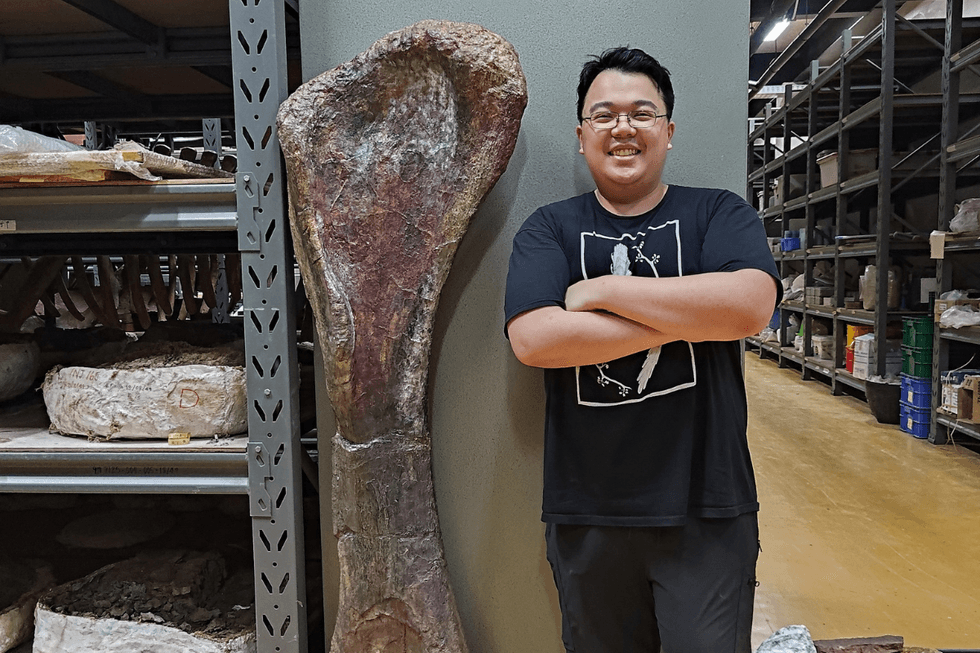
Researcher Thitiwoot Sethapanichsakul posed with a front leg bone of the nagatitan
|REUTERS
Nagatitan's name references Naga, a serpent-like being in some Asian religious traditions that is prominently depicted in various Thai temples. In all, there are 14 named dinosaurs known from Thailand.
The names of several large sauropods include the word titan.
Mr Sethapanichsakul said it might be appropriate to call Nagatitan Southeast Asia's last "titan" because the region became a shallow sea later in the Cretaceous, meaning no more sauropods would live there.
Nagatitan provides insight into sauropod diversity in the region, as not many sauropods are known from Southeast Asia, and Nagatitan is the largest and the geologically youngest of them.
The creature belonged to a subgroup of sauropods that possessed bones with lots of internal air sacs and thin walls, traits that lightened their skeletons.
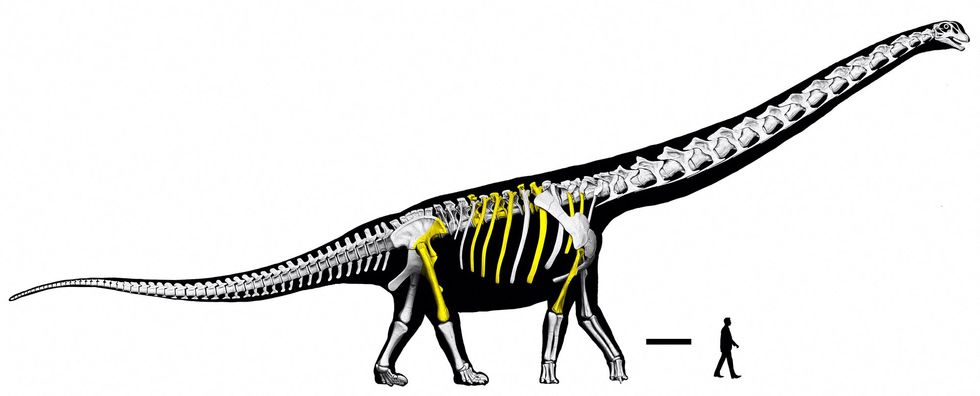
A guide showing the size of the colossal beast
|REUTERS
This group originated around 140 million years ago, achieved a global distribution and, around 90 million years ago, became the only sauropods left worldwide, thriving until the dinosaur age ended 66 million years ago with an asteroid impact.
Nagatitan lived at a time when Earth's atmospheric carbon dioxide levels were climbing, corresponding to high global temperatures.
"Sauropods seem to have become particularly large at this time, with gigantic forms living in South America, China, probably North Africa, and now with Nagatitan a fairly large one in Southeast Asia," Mr Upchurch said.
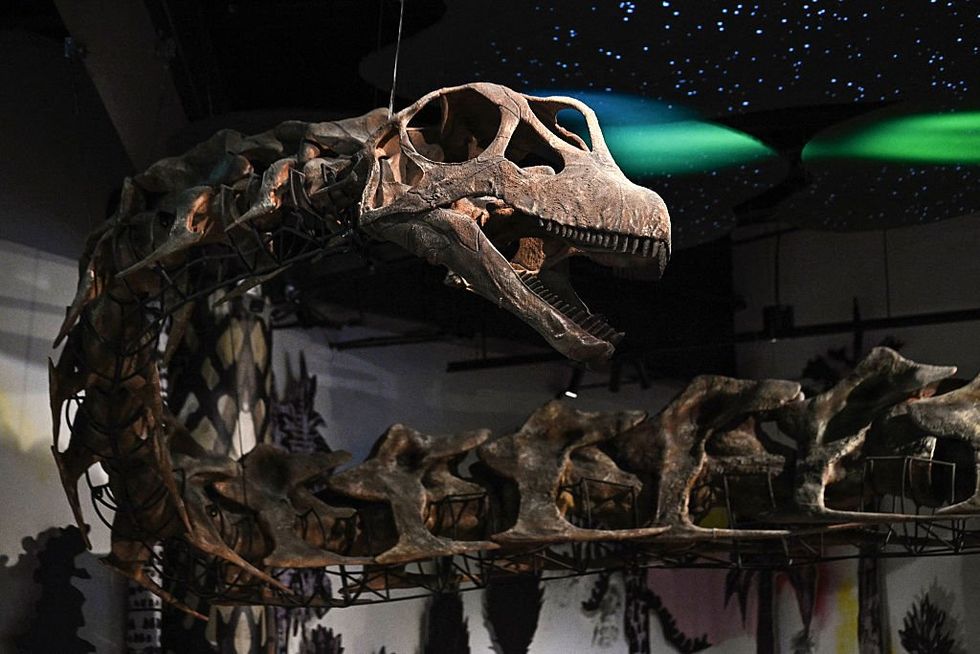
A model skeleton of Nagatitan chaiyaphumensis, is on display at the Thainosaur Museum in Bangkok
|GETTY
He added: "This possible relationship between large body size and high climatic temperatures is not fully understood, but it's likely that the high temperatures had an impact on the plant fodder that was important to sauropods, which were very large-bodied herbivores.
"Nagatitan gives a glimpse of the period leading up to the eventual peak in body size and temperatures about 10 to 15 million years later."