










Scientists have identified a new species of feathered dinosaur that once glided through the ancient forests of China.
The creature, named Jian changmaensis, was a close relative of Velociraptor and belonged to a group of small, birdlike dinosaurs known as microraptors.
These animals were nothing like the large, scaly raptors depicted in Jurassic Park.
Instead, they were lightweight, covered in feathers, and moved by gliding.
Fossil evidence shows J changmaensis had long feathers on both its arms and legs, giving it the appearance of a small dragon with four wings.
The predator likely hunted early birds by swooping between trees, much like a flying squirrel.
The fossil was described yesterday in the journal Annals of Carnegie Museum.
Only a partial left shoulder and forelimb were recovered from the ground, but these bones were enough to identify a new species.
The discovery may also help explain a longstanding puzzle at China's Changma Basin, where numerous ancient bird fossils and broken bird bones resembling owl pellets have been found.
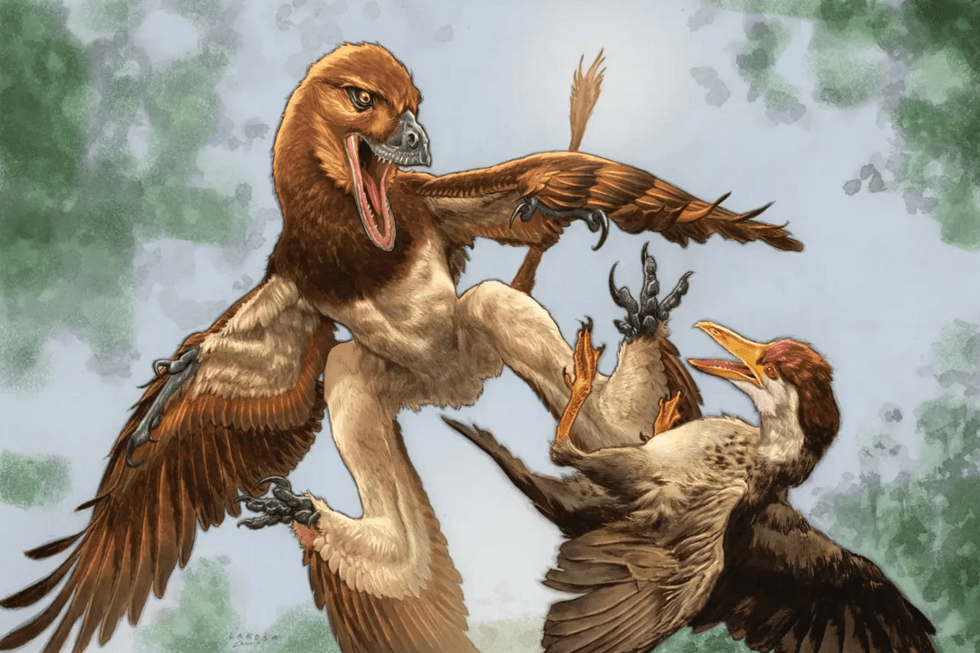
J changmaensis had long feathers on both its arms and legs, giving it the appearance of a small dragon with four wings
|LEWIS LAROSA
"Our team has recovered more than one hundred bird fossils at Changma, but only this single non-avian dinosaur specimen," study co-author Dr Matthew Lamanna, a senior dinosaur researcher and curator of vertebrate paleontology at the Carnegie Museum of Natural History in Pittsburgh, said in a statement.
"[Microraptors] provide a window into what the closest ancestors of the first birds were probably like," he told Live Science.
"Studying them yields clues as to how birds got their start and how they learned to fly."
The specimen was found in the Lower Cretaceous Xiagou formation near Changma village in Gansu province.
The rocks there date back as far as 124 million years, when the area contained a large lake filled with birds, fish, turtles and other creatures.
DINOSAUR DISCOVERIES - READ MORE:
The fossil consists of a fused shoulder blade, upper arm, radius and ulna, preserved in three dimensions.
"Jian is one of the biggest microraptor specimens that has ever been found," Jingmai O'Connor, the associate curator of fossil reptiles at the Field Museum in Chicago and co-author of the study, said.
"The piece of its upper arm bone that we have is about 4 inches [10 centimeters] long, so the entire dinosaur probably had something like a four-foot [1.2 meter] wingspan, around the size of a barn owl."
"This is neat, a new fossil of those dinosaurs that were basically on the cusp of becoming true birds," Steve Brusatte, a professor of paleontology and evolution at Scotland's University of Edinburgh who was not involved in the study, told CNN.
The Changma Basin may have served as a hunting ground for this tree-dwelling predator.
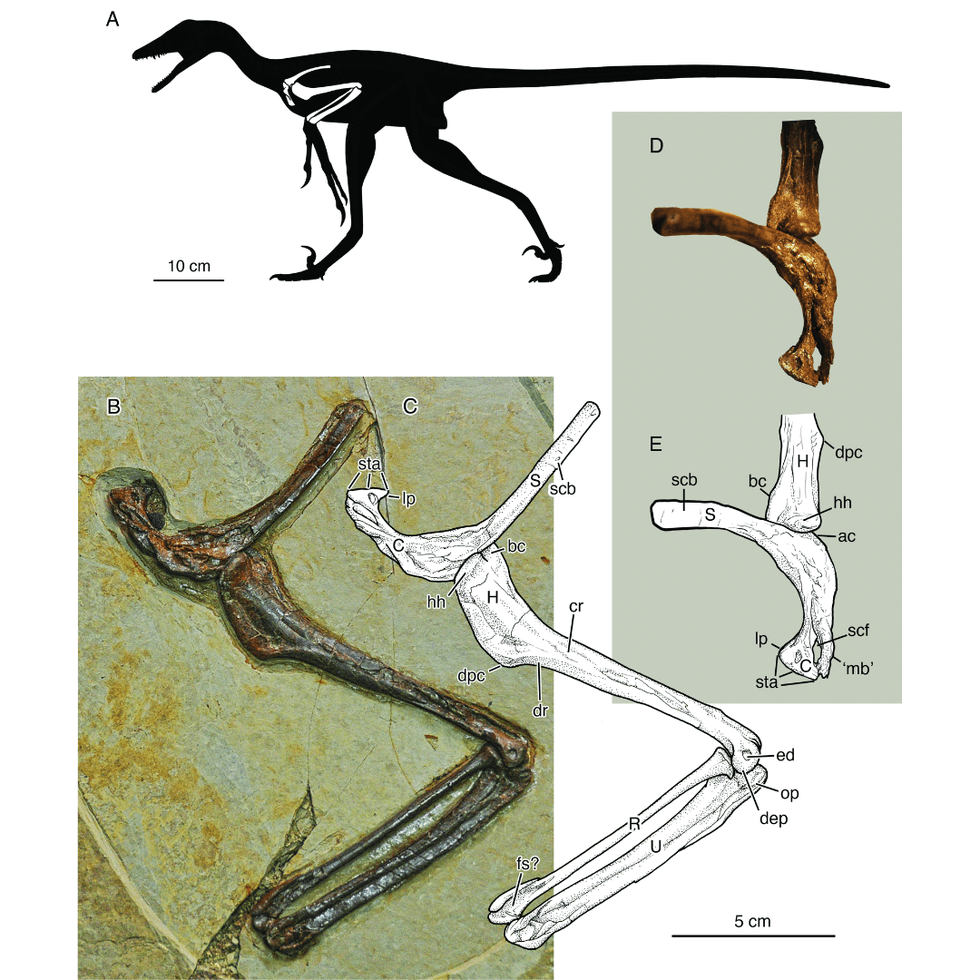
Only a partial left shoulder and forelimb were recovered from the ground
|ZHOU ET AL
The site is dominated by early bird fossils, and the pellet-like remains found there could be the leftovers from the microraptor's meals.
Scientists cannot definitively prove J changmaensis produced those pellets, but it remains the only non-bird body fossil discovered at the location.
The dinosaur was also a meat-eater and considerably larger than the birds preserved there.
Other microraptor fossils have been found with fish, lizards, mammals and birds in their stomachs, suggesting these creatures were opportunistic hunters.
"We don't have very much of Jian, just some bones from the shoulder and forelimb," Dr Lamanna said.
"It's enough to know that there was this interesting new microraptor living 120 million years ago in what's now northwestern China, but not enough to be able to learn everything we'd like to learn about these dinosaurs."