










A meteor streaked across the night sky above East Yorkshire, Lincolnshire and parts of northern Europe in the early hours of Monday morning, scientists have confirmed.
The dazzling fireball was observed at approximately 00:24am, with witnesses capturing footage in locations including Hornsea, Billingborough and Moulton Seas End.
Charlotte Bays, secretary of the UK Fireball Alliance, verified the sighting and explained why so many people noticed it.
The object's brightness was attributed to its chemical composition.
TRENDING
Stories
Videos
Your Say
"Based on the fireball trajectory, the event occurred over the North Sea so, sadly, we do not expect any recoverable meteorites," Ms Bays said.
John Maclean from the UK Meteor Network provided further analysis, revealing that despite its impressive appearance, the space rock was remarkably small.
The organisation's examination indicated the meteor weighed merely 12g, roughly half an ounce.
Mr Maclean noted the fireball was unconnected to any known astronomical phenomenon and probably originated from a larger asteroid.
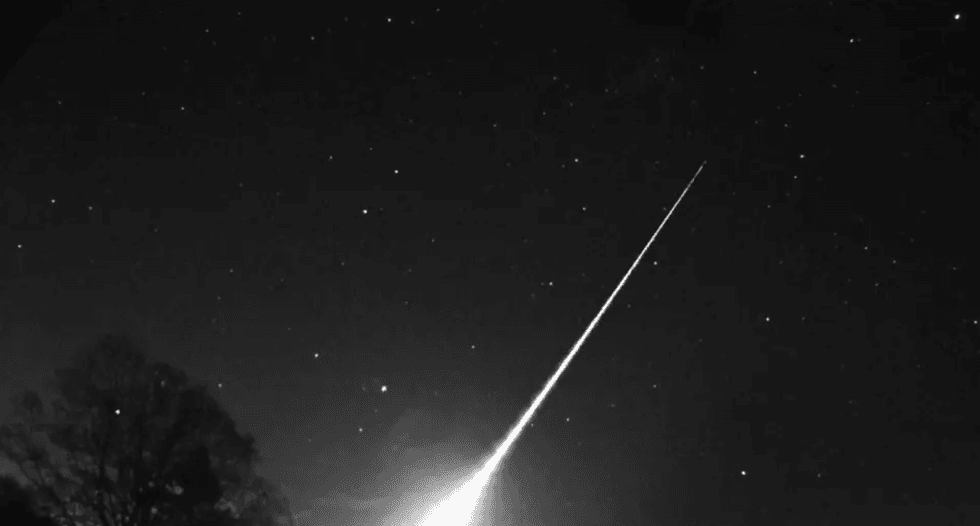
Scientists have confirmed that a bright light over Yorkshire on Monday night was a meteor
|UK METEOR OBSERVATION NETWORK
Ms Bays explained that the object's trajectory eliminates any possibility of recovering fragments.
The meteor's exceptional visibility across such a wide area was entirely down to the magnesium present in its structure, which produced the intense luminosity witnessed by observers throughout the region.
The space rock entered Earth's atmosphere travelling at speeds of approximately 20,000mph, according to Mr Maclean's analysis.
At such velocity, the tiny 12g object would almost certainly have disintegrated entirely before reaching the surface.
LATEST DEVELOPMENTS
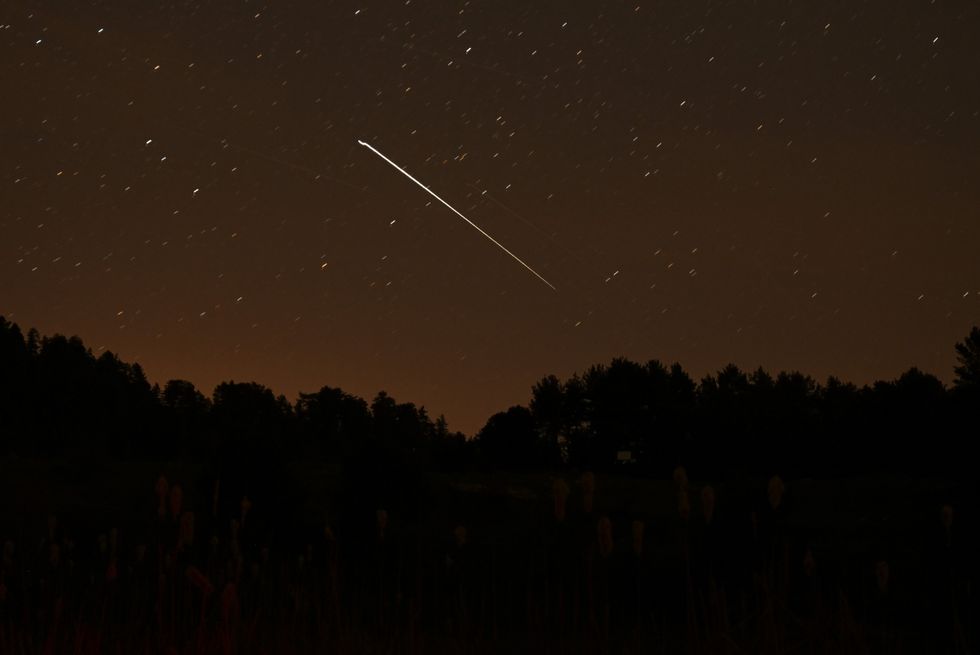
Scientists have made sure to remind people that Lyrids will be appearing towards the end of April, so fans should be on the lookout
|GETTY
Ms Bays described Monday's spectacle as a "one-off" event, distinct from any regular celestial activity.
However, she encouraged skywatchers to remain vigilant over the coming weeks, with the annual Lyrids meteor shower due to commence shortly.
The Lyrids are expected to reach their peak on April 22, offering another opportunity for astronomy enthusiasts to witness meteors illuminating the night sky.
Upon seeing the meteor flying through the sky, locals took to social media confused by the sight.
One user said: "Did anyone just see the ball of fire? Not a shooting star, silent, so not a missile."
A Fakenham local also posted a video, asking: "Does anyone know what this is?"
"Fireballs that explode in the atmosphere are technically referred to as bolides," a Nasa spokesman explained.
"During the atmospheric entry phase, an impacting object is both slowed and heated by atmospheric friction.
"Objects causing fireballs are usually not large enough to survive passage through the Earth’s atmosphere intact."
Our Standards: The GB News Editorial Charter