










A Chilean archaeological site long regarded as the most compelling evidence of early human habitation in the Americas has become the subject of fresh scientific dispute.
Monte Verde, where researchers previously identified traces of human activity stretching back approximately 14,500 years, may actually be far more recent than believed, according to research published last Thursday in the journal Science.
The site had yielded remarkable finds including ancient footprints, wooden implements, structural foundations and remnants of a fire pit - all seemingly confirming its antiquity.
However, the new study proposes a dramatically revised timeline, suggesting the location could be no more than 8,200 years old.
TRENDING
Stories
Videos
Your Say
The research team collected and analysed sediment samples from nine locations along Chinchihuapi Creek, which runs adjacent to the archaeological site.
Their investigation revealed a stratum of volcanic ash deposited by an eruption roughly 11,000 years ago.
According to the study's logic, any materials situated above this ash layer - including the wooden artefacts and other finds at Monte Verde - must date from a later period.
Claudio Latorre, of the Pontifical Catholic University of Chile, is one of the study's co-authors.
He said: "We basically reinterpreted the geology of the site, and we came to the conclusion that the Monte Verde site cannot be older than 8,200 years before present".
The scientists believe geological processes, particularly stream erosion, may have jumbled older and newer sedimentary layers together, potentially leading earlier researchers to misdate ancient wood as belonging to the Monte Verde occupation.
The findings have ignited considerable debate among archaeologists, with several experts challenging the conclusions.
Michael Waters, of Texas A&M University, who was not involved in either the original excavations or the new research, dismissed the findings as inadequate.
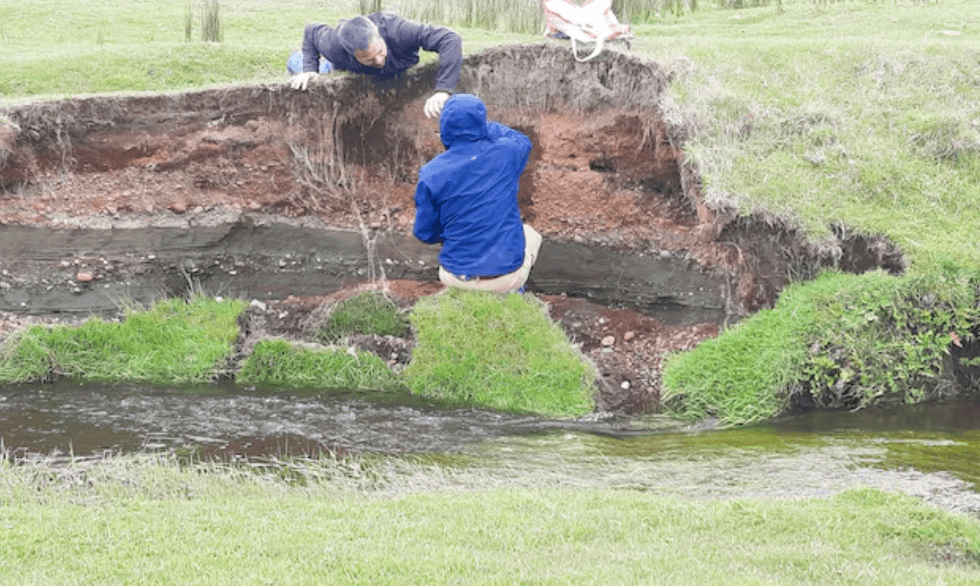
Critics point to dated artifacts discovered when Monte Verde was originally excavated
|REUTERS
LATEST DEVELOPMENTS
"They have provided, at best, a working hypothesis that is not supported by the data they presented," said Mr Waters.
Independent experts have raised concerns that the sediment samples came from areas surrounding Monte Verde, where geological conditions differ from the site itself, and that insufficient evidence exists to demonstrate the volcanic ash layer once blanketed the entire region.
Critics also point to artefacts directly dated to 14,500 years ago, including a mastodon tusk shaped into a tool, a wooden lance and a fire-hardened digging stick.
"This interpretation disregards a vast body of well-dated cultural evidence," said Tom Dillehay of Vanderbilt University, who led the original excavation.
The study authors have rejected these criticisms, maintaining they collected samples from within the site, as well as upstream and downstream locations.
Co-author Todd Surovell, of the University of Wyoming, contended there is insufficient evidence that the artefacts found at Monte Verde genuinely date to the claimed age.
Monte Verde holds particular importance for understanding how humans first reached the Americas, having helped overturn the previous consensus that the Clovis people, who arrived 13,000 years ago, were the continent's earliest inhabitants.
A revised chronology for the site could prompt renewed debate about the routes early humans took from Asia, navigating past the massive ice sheets that once covered Canada.
"Given enough time and given the ability to do science, science is self-corrective," Mr Surovell said, "It eventually reaches the truth".