






It's a speech President Trump vowed to listen to closely: King Charles addressing a joint session of the US Congress to mark 250 years since the Confederation of the United States of America.
Yet, in recent weeks, that relationship has been visibly strained by the President's public spat with Britain's Prime Minister.
His Majesty conveyed to American lawmakers the need for "renewal" and "reconciliation" between the UK and the USA.
In a subtle show of support for his Prime Minister, the King said: "In this unpredictable environment, our Alliance cannot rest on past achievements, or assume that foundational principles simply endure.
"As my Prime Minister said last month: 'Ours is an indispensable partnership. We must not disregard everything that has sustained us for the last eighty years. Instead, we must build on it!'"
Observing President Trump over the last few days, it is clear he has the utmost respect for Britain's Head of State - arguably more so than any other world leader on the planet.
Therefore, the UK Government, which consulted Buckingham Palace on the contents of His Majesty's speech, hope the royal charm offensive cuts through - far more than a meeting with Labour's Sir Keir Starmer ever could.
Following the President's recent mocking of Royal Navy aircraft carriers, likening them to "toys" compared to America's, Britain's head of the Armed Forces made clear the country's position on defence.
His Majesty said: "Renewal today starts with security. The United Kingdom recognises that the threats we face demand a transformation in British defence.
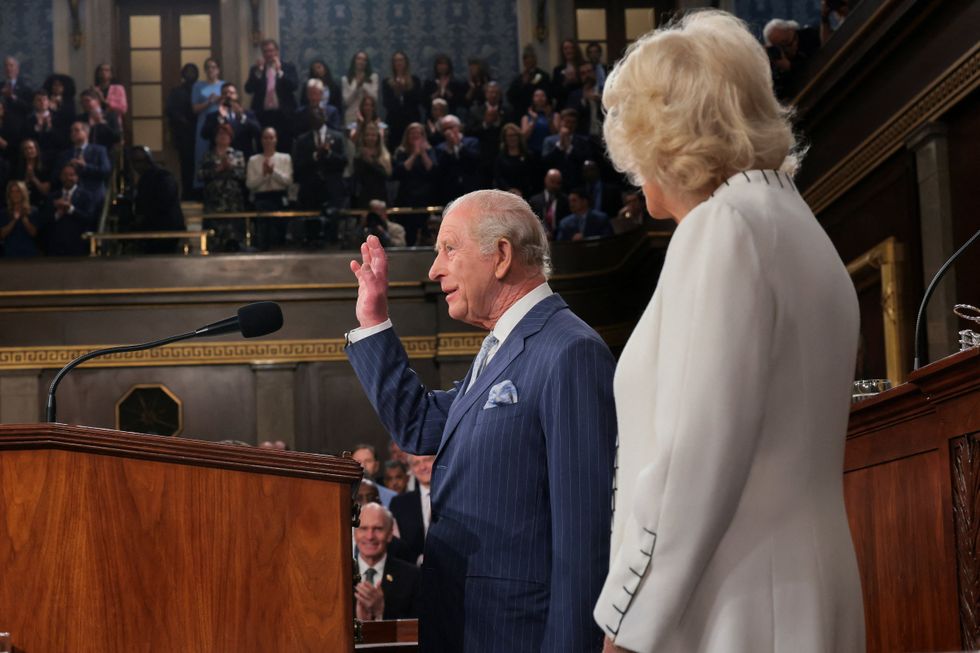
King Charles echoes Labour Government ideals during US Congress speech in soft power move
|REUTERS
"That is why our country, in order to be fit for the future, has committed to the biggest sustained increase in defence spending since the Cold War - during part of which, over fifty years ago, I served with immense pride in the Royal Navy, following in the Naval footsteps of my Father, Prince Philip, Duke of Edinburgh; my Grandfather, King George VI; my Great-Uncle, Lord Mountbatten; and my Great-Grandfather, King George V."
The King, speaking there with great sentimental passion, agreed to echo the Labour Government line that the "biggest sustained increase in defence spending since the Cold War" is on the horizon.
Could this soft-power move persuade President Trump to dial down the criticism of Britain's Armed Forces?
Well, it's a valiant attempt, but President Trump's unpredictability means such a success is far from certain.
In a further reminder to the President that the UK has historically come to America's aid, the King mentioned Britain's response following the 9/11 terrorist attacks in 2001.
LATEST ROYAL DEVELOPMENTS
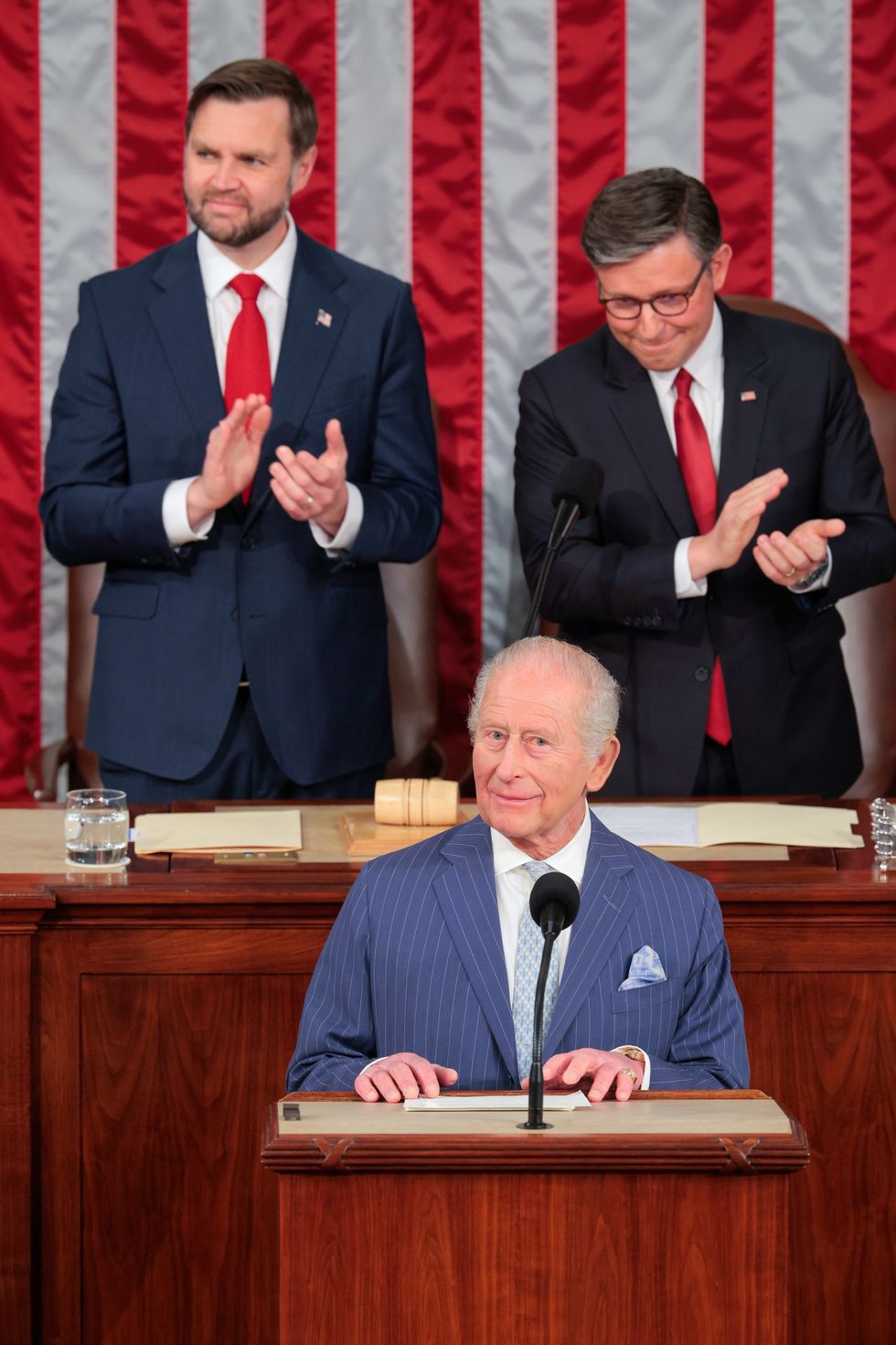 King Charles received multiple standing ovations during the speech | GETTY
He said: "In the immediate aftermath of 9/11, when Nato invoked Article 5 for the first time, and the United Nations Security Council was united in the face of terror, we answered the call together - as our people have done so for more than a century, shoulder to shoulder, through two World Wars, the Cold War, Afghanistan and moments that have defined our shared security."
His Majesty then turned his attention to Ukraine - a country where his estranged son visited last week, and appeared to call on President Trump to honour America's commitment to defend the country from Russian aggression.
After, President Trump told reporters that Prince Harry "does not speak for the UK" - as many accused the King's son of meddling in world affairs unnecessarily.
During his time in Ukraine, Prince Harry said: "I am not here as a politician. I am here as a soldier who understands service, as a humanitarian who has seen the human cost of conflict, and as a friend of Ukraine who believes the world must not grow used to this war or numb to its consequences."
King Charles's very existence as Britain's Head of State means he has overwhelming authority to speak on behalf of the UK.
On Ukraine, he said: "That same, unyielding resolve is needed for the defence of Ukraine and her most courageous people - in order to secure a truly just and lasting peace."
The King's message of peace for Ukraine was perhaps a tad more diplomatically sensitive than his son's attempt.
In the build-up to His Majesty's arrival in Washington, there have been repeated calls for the King to meet survivors of Jeffrey Epstein's abuse, and alleged wrongdoing for which King Charles's own brother has been accused.
Andrew Mountbatten-Windsor has always denied the allegations against him.
Royal sources have said His Majesty was unable to meet with survivors because he didn't want to deny them justice by prejudicing any future criminal proceedings.
So, many speculated whether His Majesty would reference Epstein or the victims of abuse.
I understand acknowledging victims of abuse were "certainly" on his mind when he said: "In both of our countries, it is the very fact of our vibrant, diverse and 8 free societies that gives us our collective strength, including to support victims of some of the ills that, so tragically, exist in both our societies today."
Not a direct reference, but perhaps as far as he could have gone without overshadowing the rest of his 20-minute, diplomatically important speech.
The lack of direct acknowledgement could well bitterly disappoint survivors of Epstein's abuse, who are in Washington DC this week to try and make their voices heard.
Later, the King is expected to deliver remarks ahead of the State Dinner at the White House.
Perhaps another chance for him to big-up Brand Britain in front of an Anglophile President.