

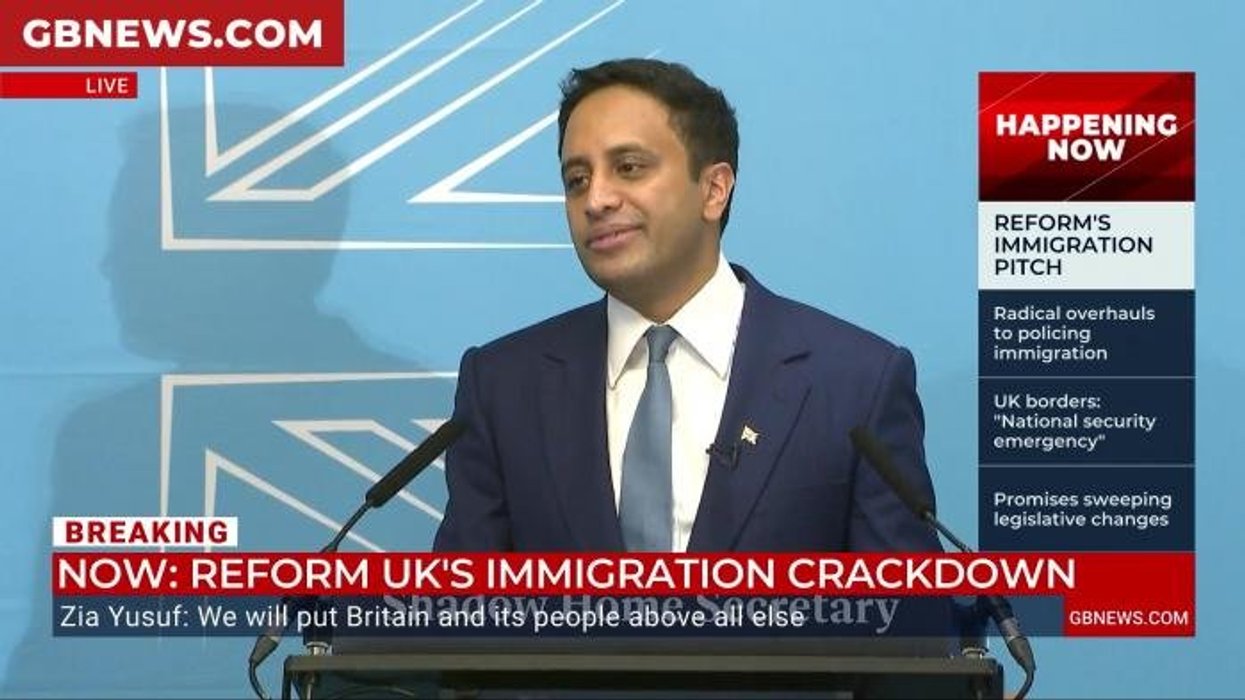






This week, just hours before Zia Yusuf announced Reform would protect churches from being turned into mosques, a huge fire ripped through a Methodist chapel in London.
The timing could almost have been providential. But is there any actual link in Britain right now between the politics of religion and the destruction of places of Christian worship?
As yet, it’s not clear what caused the blaze at the King’s Hall Methodist Church in Southall. Much of the building was destroyed, in spite of the intervention of 70 firefighters.
The church was built during World War One, when Southall was ethnically a very different place to the one it has become. Now it is said to have an 86 per cent non-white population, and speculation online suggested the fire might have been deliberate and motivated by sectarianism.
There was a precedent for such an attack. Last November, a court heard how an Islamist had tried to set fire to a church in Slough, ten miles from Southall. The accused man later pleaded guilty to plotting a terror attack against soldiers at Windsor Castle barracks.
But it would be wrong to leap to conclusions. Arson is a human universal that has been happening since men first built homes from wood (archaeologists have found numerous examples from Antiquity). And it is a crime carried out for a range of reasons. Derelict, rather than occupied, buildings suffer most. And the King’s Hall was no longer used as a chapel.
More significantly still, in the last year or so, a mosque, an asylum seeker hotel and a Labour MP's office have all been targeted by fire-starters.
But while not all victims are Christian, the brutal arithmetic is that across Europe, most are. Year on year, the number of churches being torched is growing sharply.
The Observatory on Intolerance and Discrimination Against Christians in Europe in Vienna began monitoring attacks against church property in 2005. The Observatory says attacks against Christian targets have been doubling annually in recent years.
Few European nation-states publish data on church attacks, but the exceptions are Germany and France, two nations with large Muslim immigrant populations. In Germany, arson is on the rise, as is vandalism.
In August 2025, a spokesman for the German bishops’ conference told a Catholic news website that the attacks on church property had become more “brutal” in recent years.
“Broken offering boxes and overturned, broken candles were always annoying, but since around 2015, we have been dealing with an intensified dimension,” he said.
Things like: “excrement in holy water fonts and confessionals, decapitated statues of Christ and the saints.”
 Our churches are catching on fire. I fear the cause as much as the solution - Colin Brazier
But it is France where attacks on churches have become a grim staple of the culture wars.
In 2023, according to the French territorial intelligence service, there were 38 recorded cases of arson against churches. In 2024, there were 50. There’s no suggestion that all this was the work of Islamists, but the location of church fires often tallies with areas of high immigrant populations, like the Île-de-France and the Grand-Est.
Islamists have also repeatedly targeted church services, most horrifically in 2016 when an 86-year-old Catholic priest was forced to kneel by terrorists who slit his throat while filming their murderous actions.
Britain does not appear to face anything like this onslaught. But are appearances what they seem? I say that, not to incite anger, but to question our methods of reporting.
I’ve written on several occasions about how, when I worked at Sky TV, I took a film crew back to my hometown of Bradford. We visited the church - St Clement’s - where I was baptised in 1968. It is an inner-city church, but no less beautiful for that. Built in 1892, its ceiling was designed by the great Victorian artist and poet William Morris.
When I filmed there in 2006, parts of this grade two listed building were still closed-off and under repair. The priest told me there had been a deliberate attempt to set fire to his church five years before. When exactly? On the night that the United States Air Force began bombing Taliban targets 5000 miles away in Afghanistan.
As we’ve seen with protests about Gaza, many Muslims feel a greater sense of ideological kinship with their co-religionists elsewhere in the world than they do with their near - but not Muslim - neighbours.
But the priest at St Clement’s (who has long since moved on) was disposed to take a charitable view. Even though the arson-attempt happened hours after George W Bush's War on Terror got started in earnest, the priest said the fire was probably just the work of a few bored delinquents or local hot-heads, regardless of creed. He may have been right. But I doubt it. The timing suggests ideology rather than ennui was at work.
The point, however, is that no culprits were found. Nor, so far as I could tell, was the story reported. Certainly, I think it’s fair to say that, if the arson target had been a mosque, the local media would have busily swung into action.
Is this lack of journalistic curiosity deliberate? Do the police prefer to turn a blind eye, lest an investigation begets publicity and publicity generates copycat or retaliatory attacks?
The experience of recent years suggests our cops and hacks may well have chosen to bury a story, rather than risk reprisals. How else can we explain what happened to the Muslim grooming gangs which operated with relative freedom in cities like Bradford?
Thankfully, Britain hasn’t seen a wave of arson attacks on churches.
Or has it? My experience suggests we wouldn’t know, even if it had.
And what of the future? If social cohesion really does start to unravel, will churches require the sort of protection hitherto reserved for synagogues?
And what about the Zia Yusuf plan to stop churches from being turned into mosques? To protect, as the Reform Home Affairs spokesman says, Britain’s Christian heritage.
I agree with Zia, a man who is one of the brightest political talents to emerge in the UK in the last decade. But might his plan backfire?
If a church can’t be converted, is it more likely to be damaged? In seeking to protect our Christian roots, might we simply enrage an Islamist fringe who, frustrated, seek to destroy what they cannot have
Our Standards: The GB News Editorial Charter