





A new report published by the think-tank Policy Exchange, Understanding Islamopopulism, reveals the deep social divides between the wider general population and British Muslims living in political battlegrounds where integration challenges continue to persist.
The fresh polling carried out by JL Partners on behalf of Policy Exchange shows that the UK is heading towards a future of competing tensions – having a largely secularised mainstream alongside the growth of faith-based communal politics in Muslim communities.
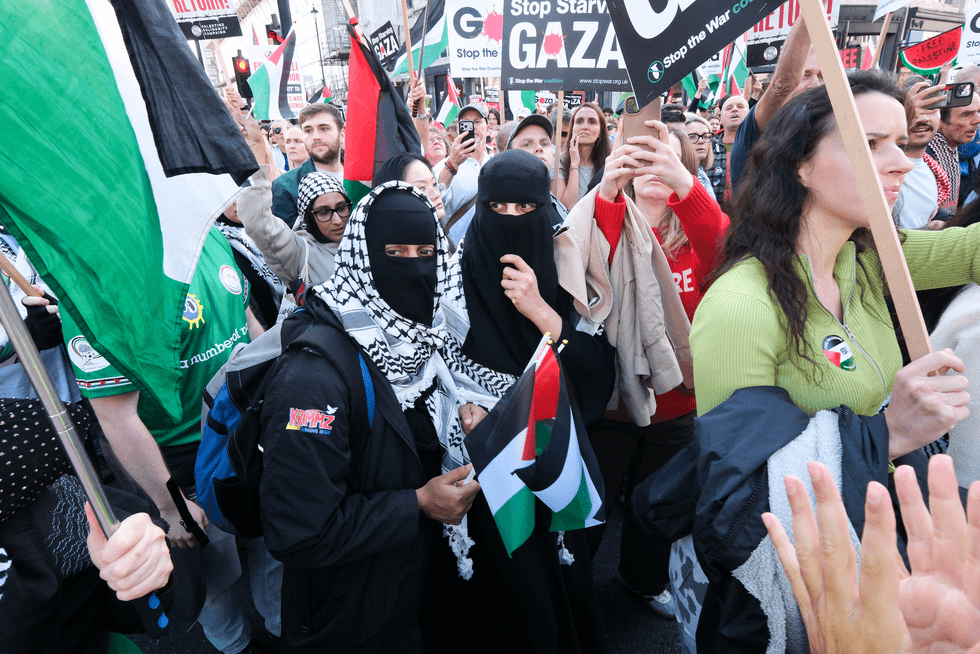
Some of the most striking differences between the wider public and British Muslims in the surveyed areas – all of Greater London, the West Midlands, Greater Manchester, and West Yorkshire, along with parts of Lancashire, South Yorkshire, and Merseyside – centre on the Israel-Gaza conflict.
While three in five British Muslims in these areas support increasing income tax by 1p in every pound to fund a new UK Government fund dedicated to the reconstruction of Gaza, this drops to one in five for the general public.
The scale and intensity of anti-Israelism among British Muslims in such parts of the country is exposed by the reality that nearly half want all Israeli-built technology to be banned from the National Health Service (NHS) – falling to fewer than one in five members of the general population.
The wider public is also fundamentally at odds with many British Muslims in these polled areas when it comes to whether blasphemy should be re-criminalised.
The common-law offences of blasphemy and blasphemous libel were abolished in England and Wales by Section 79 of the Criminal Justice and Immigration Act 2008.
However, more than half – 52 per cent - of the British Muslim respondents across the polled areas support making it a criminal offence to show or create images in public which depict the Muslim Prophet Muhammad.
This compares to fewer than one in five for the general population – 17 per cent.
While one in ten members of the wider public believes that violence can be a legitimate response to someone doing this or burning the Qur’an, this rises to nearly a quarter of British Muslims in the polled areas.
These are worrying levels of support for anti-blasphemy violence, especially after incidents such as what unfolded at Batley Grammar School, when a teacher had to go into hiding after showing a caricature of the Muslim Prophet Muhammad in class.
This report on British Muslims confirms our very worst fears about sectarian Britain - Rakib Ehsan
|Getty Images
There are also elevated levels of anti-Jewish hostility and belief in antisemitic conspiratorial beliefs within British Muslim communities, something which is as virulent as it is deep-rooted.
There have been warning signs given in the past. Back in 2017, a married couple - Ummarayiat Mirza and his wife Madihah Taheer - were jailed for planning a terror attack in Birmingham. Targets they had scouted included the city’s central synagogue.
Last year, we witnessed the deadly Islamist terrorist attack on Heaton Park synagogue in Manchester, followed by last week’s double stabbing of two Jewish men in the north-west London suburb of Golders Green.
The threat of Islamist antisemitic violence in England’s major cities is clearly a serious problem. Some will, understandably, fear the dam has now broken.
The portrayal of modern Britain as a flourishing multi-faith democracy - a paragon of religious diversity – simply no longer holds. In the face of Islamist extremism, which remains the country’s principal terror threat, the UK continues to be presented with significant challenges in terms of cohesion, integration, and security.
Dr Rakib Ehsan is a Senior Fellow at Policy Exchange and the lead author of its Understanding Islamopopulism report