






When The Guardian reports, as it did on Saturday, that Keir Starmer is scrambling to appoint a new US ambassador because relations with Donald Trump may soon be “tested”, it accidentally tells the truth. Not about Trump — but about Labour.
This is not a story about diplomacy. It is a story about a Prime Minister so out of alignment with Trump on style and substance, who recoils from the democratic choices Britain and America have both made. The panic in Whitehall is not that Trump might misunderstand Britain. It is that he understands it all too well — and sees what Starmer is doing to it.
Trump has great respect and affection for the UK. He has consistently admired Britain when it behaves like a nation: sovereign, independent, unapologetic. He praised Brexit when Europe’s political class sneered.
He respected the monarchy when progressives mocked it. He has always instinctively sided with the Britain that governed itself — not the Britain that seeks permission.
Starmer represents the latter.
The establishment media frames Labour’s ambassadorial manoeuvring as a delicate effort to “manage” Trump. This is classic metropolitan arrogance: the assumption that Trump is a problem to be handled, not a democratically elected leader with clearly stated views. That alone is enough to poison relations.
Trump’s worldview is not a mystery. He believes the European Union is a failing supranational bureaucracy that erodes democracy, destroys borders, and replaces accountability with regulation.
He believes mass immigration without consent is national vandalism. He believes speech policing is the refuge of weak elites. And he believes green ideology that de-industrialises the West while enriching China is strategic insanity. Starmer disagrees with Trump on every single one of these points.
On immigration, Starmer has spent years opposing serious deterrence while Britain’s borders collapse in plain sight. Channel crossings mount alarmingly, public confidence is shredded, and Labour’s instinct is still to lecture voters rather than act.
Trump looks at this and sees exactly what he has warned against: a political class paralysed by legalism and moral vanity while sovereignty leaks away.
On speech, the divergence is even starker. Trump’s political rise was fuelled by revolt against censorship — bureaucratic, corporate, and cultural. Britain under Labour is drifting in the opposite direction: expanding definitions of “harm”, normalising police involvement in speech disputes, and treating dissent as a public order problem. Trump will not miss the irony of a government that claims to defend democracy while narrowing the space for democratic disagreement.
Economically, Starmer’s Britain looks less like a partner and more like a cautionary tale. Energy policy driven by climate dogma has pushed costs sky-high, hollowed out industry, and weakened national resilience.
Trump’s position is blunt: a country that cannot power itself cannot defend itself. Britain’s growing dependence and shrinking industrial base will not inspire confidence in Washington.
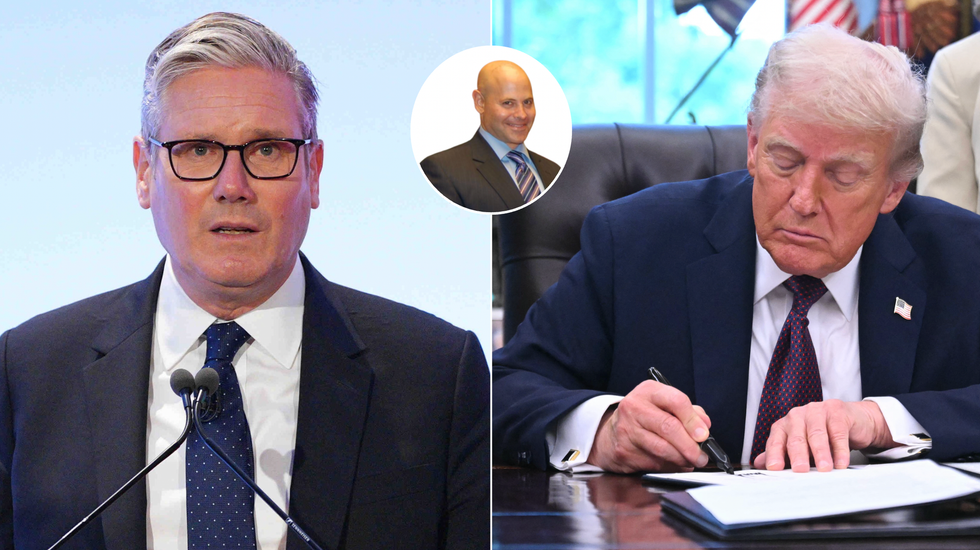
Keir Starmer in a vice-like grip as nightmare decision hands Donald Trump the perfect excuse - Lee Cohen
|Getty Images
And hovering over all of this is Starmer’s quiet but unmistakable Europhilia. The talk of “reset”, “alignment”, and “shared values” is not diplomatic nuance — it is ideological retreat. Britain voted to leave the EU precisely to escape this managerial, post-national mindset. Trump applauds that. Starmer resents it.
Which brings us back to the ambassadorial farce.
The idea that the right appointment can “smooth over” these tensions is laughable. Trump is not fooled by titles or accents. He will judge Britain by whether it behaves like an ally or like an EU auxiliary with delusions of independence.
Send a Europhile grandee or a progressive placeman to Washington, and the message will be unmistakable: Britain may have left the EU formally, but its ruling class is still emotionally captive to it. That would confirm Trump’s worst suspicions — and Britain’s weakest instincts.
The deeper truth is this: Starmer does not want a close relationship with a Trump administration on Trump’s terms. He wants a cosmetically polite relationship that allows him to continue governing Britain as a downward-managed, moralised, semi-sovereign state while hoping Washington looks the other way.
Trump will not.
He respects strength. He respects clarity. He respects leaders who put their own people first and mean it. What he despises is bad faith — leaders who speak the language of sovereignty while emptying it of substance.
The Special Relationship has always been strongest when Britain acted like Britain, not like a continental NGO with a flag. Trump understands that legacy instinctively. Starmer does not believe in it at all.
No ambassador can fix that.
Until Britain has a Prime Minister who respects borders, free speech, energy security, and democratic consent — and who is not embarrassed by Brexit — relations with a Trump White House will remain strained.
Not because Trump is unreasonable.
But because Starmer is fundamentally on the other side, the one that puts Britain last.
Our Standards: The GB News Editorial Charter