

I'm terrified of our future bleak Britain. Where an increasingly assertive strain of Islamism proves impossible to ignore - Colin Brazier
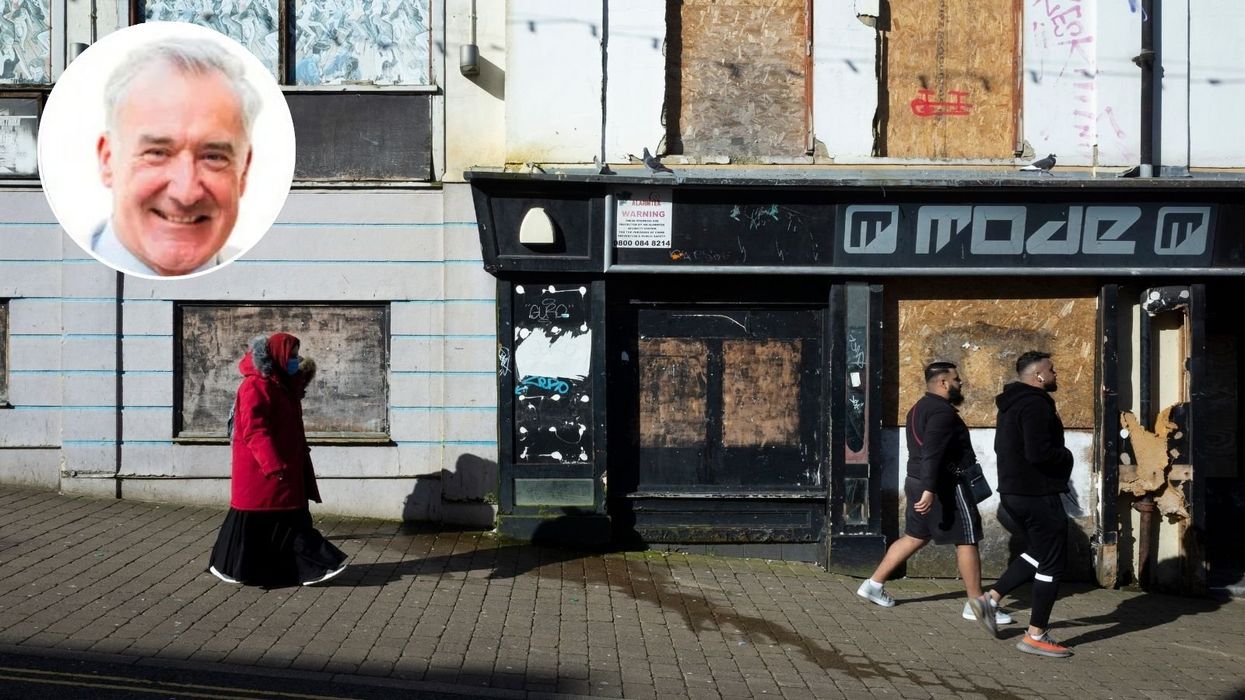
Colin Brazier warns the future of the UK could rapidly become a bleak dystopia
|GETTY



There are two Britains in front of us and I know which one looks more likely to materialise, writes broadcasting veteran Colin Brazier
Don't Miss

Most Read

Trending on GB News
Bluntly, Britain faces two futures. One sees migration managed, minorities told to assimilate or leave, and a coherent national identity restored.
The other future - the bleaker but more probable future - sees none of these things happen. It will mean the Britain of Bradford and Birmingham becoming, not outliers, but increasingly the norm. It would see white-flight from cities and towns accelerate, communities self-segregate and an increasingly assertive strain of Islamism prove impossible to ignore.
So, two Britain’s: bright Britain and bleak Britain; a land at ease with itself or - quite possibly - at war with itself. As an instinctive conservative I believe in hoping for the best, but preparing for the worst. As the late philosopher Roger Scruton was apt to say: pessimism never lets you down.
Let us assume then, that Keir Starmer does not “smash the gangs”, but the gangs continue to smash us. Landing in ever-greater numbers on our shores (the latest net immigration figures show how many newcomers are now asylum seekers rather than legal migrants).
TRENDING
Stories
Videos
Your Say
Let us also assume that Labour back-benchers will thwart the estimable attempts of Shabana Mahmood to bring in tough new anti-migrant laws. And that those same Labour MPs will make it harder to challenge Islamism in the very areas where many migrants head, by introducing a new legal definition of ‘Islamophobia’.
Let us assume that demographic trends persist, and potentially worsen. That the native British birth-rate continues to plummet and business leaders and public sector managers (none of whom live in areas blighted by mass migration) insist that the only answer to those empty cradles is to import more labour from abroad, regardless of the consequences at home.
And, finally, let us assume that at some future point a spark ignites a tinder-box. This is not an unreasonable anxiety. The academic David Betz has written about how many of the pre-conditions which normally mean a civil war is inevitable are present in UK society already.
I thought of his analysis this week when, in my home city of Bradford, the Palestinian flag was officially raised next to the town hall.
The sobering truth is that large swathes of urban Britain now feel the Palestinian flag more accurately reflects their loyalties than our own Union flag. The reaction to the war in Gaza of a substantial minority of British Muslims has made many of us wonder what would happen if, (how to put this delicately?), push comes to shove.
Would a sense of kinship with co-religionists far way, trump any affinity with near neighbours who share a different faith, or have none. What would happen, for instance, if war were to break out between India and Pakistan again, and Britain was to take India’s side? Or simply, as events in the Middle East have shown, not condemn one side (Israel) sufficiently strongly to satisfy Islamist hardliners.
The question, as a pessimist, is what happens if the balloon goes up? What do we do if David Betz is right and civil conflict is unavoidable. What should our response be if parts of Britain insist on an intifada - not on the streets of Ramallah - but in Manningham or Alum Rock or Tower Hamlets.
If it is to be bleak, rather than bright Britain, then the kind of Britain we will become became clearer this week. The Home Office published a study about facial recognition cameras. Eight police forces have been using them since 2017. The Met Police claims these cameras represent the biggest step forward in solving crimes since the introduction of DNA testing. It brought in cameras in 2023 and since then has made 1,300 arrests based on the technology. Rapists and violent offenders are among those who’ve been caught.
The technology is getting better all the time, with one false alert out of every 33,000 biometric scans taken. But the idea is unpopular with two groups. The first is the collective of charities, race-grifters, campaigners and all round grievance-mongers who insist that facial recognition is inherently racist. The Times newspaper summed it up with a headline this week which ran: “Rollout of facial recognition ‘will create no-go areas for minorities’.”
As a middle-aged white man I think - rightly or wrongly - that there are parts of Britain where I am not welcome. And that has nothing to do with technology. But, setting aside the vexed question of who has the greater right to feel excluded or unwanted from certain neighbourhoods, I think it’s fair to say that yelling ‘racist!’ at cameras does not withstand scientific scrutiny.
The Home Office insists the technology is not biased on the basis of skin colour, although there remains a significant proportion of Black Britons who believe it is (and are always reflexively inclined to blame the ‘system’ for failings that might lie closer to home).
But they aren’t the only ones who think using cameras to deter or root out criminals is a road to ruin. I mentioned middle-aged white men. Many of them are also uncomfortable, not because they think facial recognition cameras are the product of white privilege, but because they are a step towards a Chinese-style social credit system by stealth. As David Davis MP said this week: “Welcome to Big Brother Britain.”
Well, I would agree with DD if the Britain he was talking about was Bright, not Bleak Britain. I’d happily row-in behind him, by pointing out that Labour’s authoritarian instincts are instinctively anti-libertarian. Just look at the party’s plans for ID cards and the scrapping of jury trials.
But what use are civil liberties in a Britain broken by the multicultural experiment the country has embarked upon without democratic assent? What happens, say, if a future Reform government decides to ape the White House's policy of aggressive mass deportations under the aegis of an organisation like Trump's Immigration and Customs Enforcement (ICE). At that point, facial recognition cameras will be a vital tool in tracking down illegal migrants.
You can see the shape of this future dystopian landscape already. Even before the cameras are rolled out nationally, many British nationals have developed their own counter-measures. From the delivery riders wearing mufflers and helmets to prevent anyone identifying them as illegal migrants, to the hoodie-wearing shoplifters, drug dealers and phone-thieves.
It’s not solely about street crime though. Ideology is also a factor. The Covid face-mask continues to be favoured by Antifa-types. The burqa has been used before by Islamists who want to escape detection.
In a perfect world, or at least the kind of country Britain once was, the idea of civil liberties as the hill on which right-wingers are prepared to die on, made sense. But the past, as they say, is another country. That Britain, a Britain where Winston Churchill abolished ID cards in the 1950s because we were no longer at war, has dissolved.
Our country faces challenges which demand that we use all the technology at our disposal. After all, those who abuse our hospitality are more than willing to use it against us. Without smartphones, for instance, few illegal migrants would make it ashore. If our nation is bound for a bleaker future, let us not be squeamish about using the fruits of globalisation - cheap and better tech - to repair some of the societal damage caused by globalisation’s excesses.
More From GB News