











A Russian tech start-up is implanting chips into pigeons' brains for spying purposes amid the ongoing conflict in Ukraine and simmering tensions with the West.
Under a project codenamed PJN-1, chips will be installed into the brains of the common birds, whilst the bodies will be fitted with cameras where operators have the ability to alter the bird’s flight path.
The technology is being developed by Russian start-up Neiry Group, who describe the pigeons as having “implanted neural interfaces and compact electronic imaging modules in a small backpack-style unit.”
Alexander Panov, Neiry’s chief executive, is a vocal supporter of Russia’s war in Ukraine and has urged the military to go further to seek other ways to gain military advantages on a battlefield that has become largely dominated by drones.
TRENDING
Stories
Videos
Your Say
He said: “Currently, the solution works with pigeons, but any bird could be used as a carrier.
“To carry more payload, we plan to use ravens, for monitoring coastal facilities, seagulls, and for larger offshore areas, albatrosses.
“With the system ready for real-world deployment, this versatility becomes especially relevant in the scenarios where conventional drones face physical constraints.”
The eccentric boss has also previously spoken about his desire to create a higher-level species of human, known as Homo Superior, which would to all intents and purposes replace human beings.
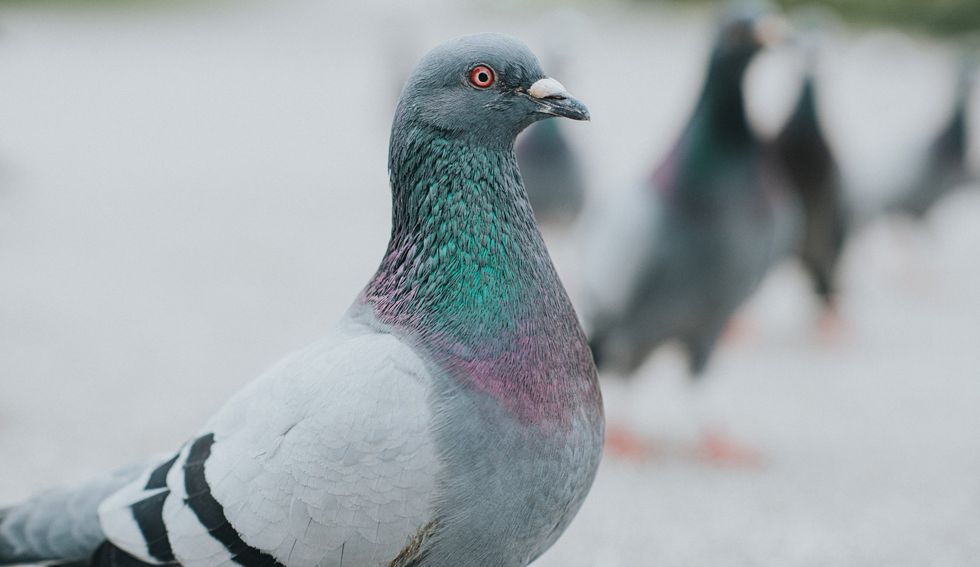
The programme brings the longstanding conspiracy of 'spy pigeons' to life
|GETTY
The company is also believed to be heavily bankrolled by the Kremlin, reportedly granted as much as £10million in funding from the National Technology Initiative - a programme launched by Vladimir Putin in 2014 to promote Russian leadership in global technology.
The initial tests of the programme involve pigeons fitted with a small controller, solar panels mounted on the birds’ backs, and a camera comparable to the ones already present in public spaces, according to the company.
They add that the interface provides mild stimulation to selected brain regions, prompting the bird to prefer a certain direction.
The bird otherwise behaves naturally and the system simply “guides it toward a preset route.”
LATEST DEVELOPMENTS
- Watch moment mushroom cloud erupts over Russian railway station in huge blast
- Fears Britain 'dangerously exposed' to attack with UK's nuclear strategy 30 years behind 'aggressive' Russia and China
- Vladimir Putin tests NEW 'invincible' nuclear weapon in 15-hour, 9,000-mile missile flight

The sheer number of pigeons would make them the ideal surveillance tool
|Reuters
If imaging is activated, identifiable details are filtered out on-device to comply with local privacy regulations.
Unlike traditional UAVs, biological carriers do not require battery swaps or frequent landings and their natural flight behavior makes them suitable for long-duration routes up to 400km without stops daily.
While research involving implanted neural interfaces in birds has appeared in academic settings internationally, it has remained largely experimental, with Neiry’s work focusing on adapting these concepts for practical use.
The company is evaluating potential applications such as infrastructure inspections, search-and-rescue support, coastal and environmental observation, and remote-area monitoring.
The company has conducted limited test flights in Russia and CIS countries to evaluate distance, stability, and data transmission, with birds continuing their normal routines outside flights, cared for by operators between missions.
Neiry has offices in Dubai and Moscow, and is looking into “strong potential” for the scheme’s application in large, monitoring-intensive markets such as Brazil and India, particularly in utilities, logistics, agriculture, and emergency response.
More From GB News