







The UK is "vulnerable to attack" from China and Russia as its nuclear deterrence doctrine is "stuck in the Cold War era", a new report has warned.
The paper, published by think tank Policy Exchange and co-authored by Marshal of the RAF and former Chief of the Defence Staff, Lord Stirrup, argues Britain must urgently update its strategy on nuclear deterrence to suit the "modern era".
Lord Stirrup highlights the "aggressive expansionist intent" of Russian leader Vladimir Putin and the "rapid development of China's nuclear capabilities", urging a re-examination of the UK's approach to deterrence.
He argues the UK needs to return to carrying out large scale military exercises with a nuclear component in order to be able to effectively deter enemies.
TRENDING
Stories
Videos
Your Say
He wrote: "In the last 20 years, of course, the evidence of President Putin’s aggressive expansionist intent and the rapid development of China’s nuclear capabilities have brought us full circle to the consideration of deterrence between states and alliances.
"It is therefore timely to re-examine the whole question of our deterrence doctrine and its applicability to the current international situation."
The report warns that Britain's intellectual capacity for thinking about nuclear weapons has declined sharply since 1989, which has exposed gaps which could be targeted by opponents.
It says revisiting works by theorists such as former British defence strategist, Sir Michael Quinlan, can help provide a framework update its nuclear policy which can be made relevant to modern threats.

Former chief of defence staff, Lord Stirrup, argues Britain must urgently update its strategy on nuclear deterrence
|PA
Coordinator of Policy Exchange’s Nuclear Enterprise Commission, Daniel Skeffington, said: "We are living through the most volatile period since the end of the Cold War, yet our nuclear doctrine remains stuck in a post-Cold War mindset.
"This leaves the UK dangerously exposed.
"In an age of renewed great power competition, Britain’s approach to nuclear deterrence must be thoroughly re-examined.
"Sir Michael Quinlan was one of the last great figures in Cold War nuclear strategy: re-examining his thought shows us how to update the purpose of Britain’s nuclear arsenal in an increasingly uncertain world."
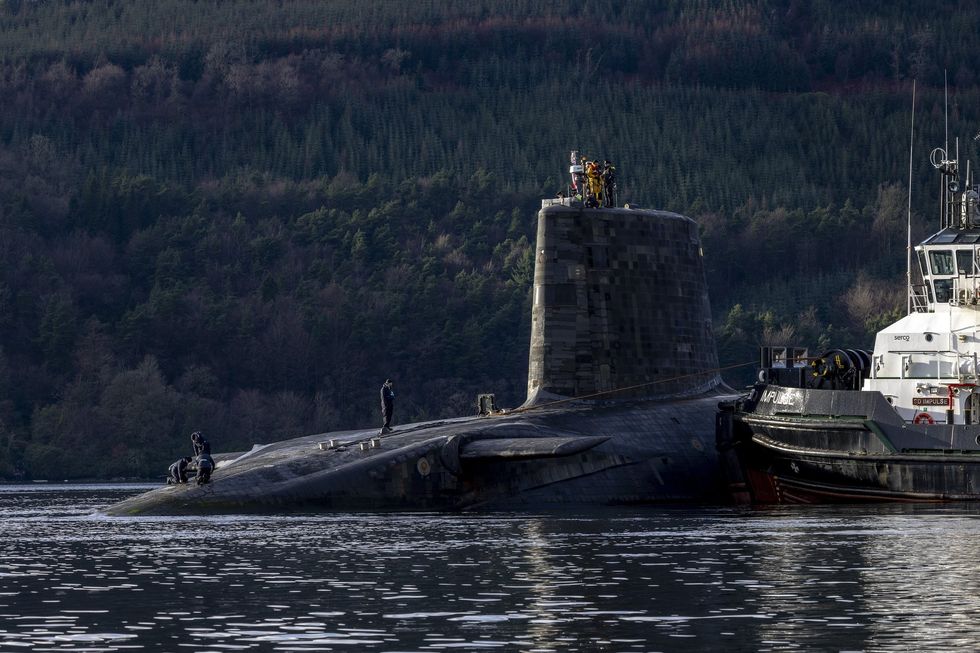
Policy Exchange argued Britain's nuclear deterrent doctrine is 'stuck in a post-Cold War mindset'
|MINISTRY OF DEFENCE
The report highlights seven key principles for rethinking British nuclear deterrence, including that the Government's primary aim should be to make all wars of all "unthinkable", arguing that nuclear weapons "cannot be-un-invented".
It adds that deterrence the UK does not need to have all the necessary military capabilities on its own, but should cover "key areas where it is vulnerable to coercion within broader Nato structures".
Defence Secretary John Healey today said Britain faced an "era of rising threats" as he delivered an emergency statement in the House of Commons after British armed forces provided support to the US’s seizure of a Russian-flagged oil tanker.
He said the Government's "priority" was on deterring Russia's shadow fleet.
Mr Healey told MPs: "We know Russia operates a vast shadow fleet of its own to bankroll its illegal invasion of Ukraine, and last year, it’s estimated that Russia sold 100 billion dollars worth of sanctioned oil – money directly funding attacks on Ukrainian citizens, such as the onslaught during Christmas, involving 600 missiles and drones, which killed at least three people.
“We owe it to the Ukrainians to step up action on these shadow operations, and we are.
“This is why we are deterring, we are disrupting, we are degrading the Russian shadow fleet as a priority for this Government."
Our Standards: The GB News Editorial Charter
More From GB News