








The drive to net zero has created a market for "blood batteries", with children as young as four forced to work in inhumane and often deadly conditions in the green supply chain, campaigners say.
Just last week, women and children were among 227 miners who died when hand-dug tunnels collapsed at a mining site in the Democratic Republic of the Congo, after days of heavy rain triggered catastrophic mudslides.
They were among many hundreds of others who have died in the Congo’s mineral mines over the past five years - where an estimated two million are employed to extract raw materials essential for the clean energy transition. Thousands of those working are children, some as young as four.
Legal cases have highlighted cases of children being buried alive or severely injured in tunnel collapses in the Congo, which supplies over 70 per cent of the world's cobalt and coltan - essential for lithium-ion batteries which power electric cars, smartphones and renewable energy storage.
TRENDING
Stories
Videos
Your Say
Campaigners are warning the global rush to green technology is accelerated exploitation, not ending it.
In the wake of the disaster, leading Congolese activist Maurice Carney is calling on Western governments - including Britain - to break what he describes as a “cycle of misery” at the bottom of the global green supply chain, warning that Net Zero targets are being pursued without consideration of the deadly consequences.
Mr Carney, the executive director and co-founder of Friends of the Congo, said the deaths were not an isolated tragedy but the predictable result of a system driven by global demand.
“Life is extremely precarious at the bottom of the green supply chain,” he said. “We are talking about hundreds of thousands of people suffering, with up to two million people involved in this mining economy. These people are virtually invisible.”
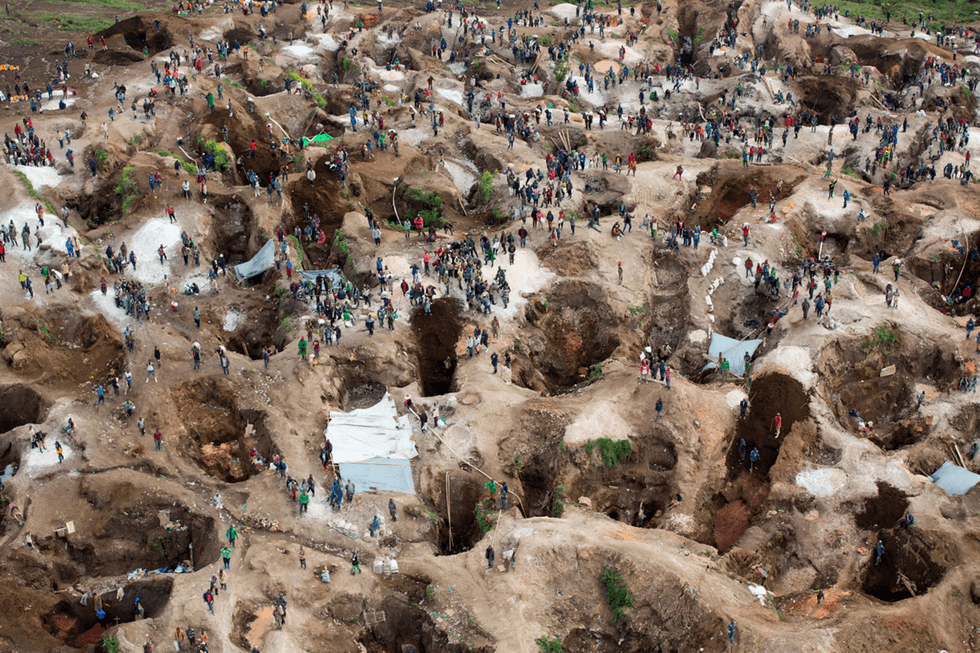
PICTURED: An aerial view of a coltan mine in the Democratic Republic of the Congo
|MONUSCO
Reports show children have been crushed to death in tunnel collapses when unsupported shafts give way, drowned in rain-flooded pits during the wet season and killed by lung disease linked to prolonged exposure to cobalt and coltan dust.
Mr Carney says dozens of children die each year in mining-related incidents - but warns the true figure is likely far higher because many deaths are never formally recorded, bodies are often never recovered with some remaining buried under collapsed tunnels.Others are removed quietly by families, with no paperwork, no investigation and no official count.
Amnesty International has warned that weak oversight means child deaths frequently “disappear into the supply chain”, leaving no accountability further up the line.
Toby Green, a historian of West Africa and of global inequality at King's College London, said: “If people are concerned about climate change and net zero they should also be concerned about the fact this mineral mining is stripping away the environment and eroding the lives of thousands of people in the Congo and the idea that any of this is green is ridiculous. It is utterly disruptive and awful.”
NET ZERO CONSEQUENCES - READ MORE:
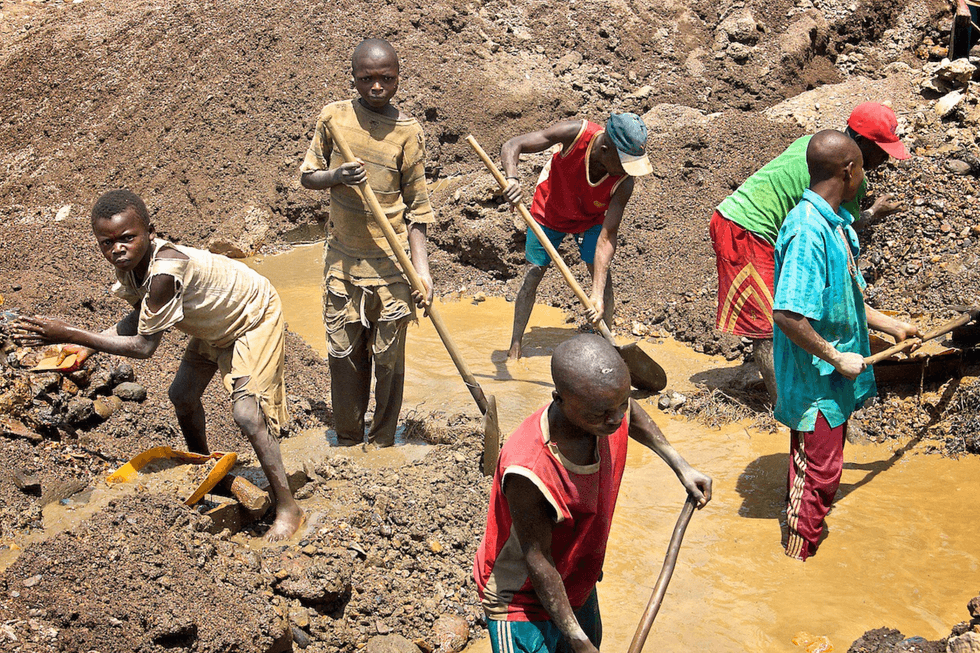
Mr Carney says dozens of children die each year in mining-related incidents (file photo)
|THE ENOUGH PROJECT
He added: “People are detached from reality.”
The news follows recent research from the University of Nottingham which reveals exploitation in the Congolese mining industry is systemic.
The report, “Blood Batteries”, carried out by Nottingham University’s Rights Lab, was based on a survey of 1,431 small-scale miners across Congo’s main cobalt regions. It found:
- 36.8% were trapped in forced labour, unable to leave without losing shelter or food;
- 9.2% involved child labour, despite Congolese law banning it;
- 6.5% were in debt bondage, working to repay inflated loans;
- 4.4% had been trafficked, often moved between sites against their will.
Not a single miner surveyed had a written contract, trade-union protection or guaranteed safety equipment.
Researchers concluded many miners were working under coercive conditions with no meaningful alternative for survival.
The same Nottingham study found male miners earned an average of £2.40 a day while women earned just £1.35 a day.
Children often earned less - or were paid only in food.
Most said they stayed because there was no other way to feed their families.
Campaigners say the system works because risk, injury and death are absorbed at the bottom, while profits flow up global supply chains.
Mr Carney warned the damage extends far beyond the mines themselves.
“The toxic dust settles on vegetation and inhibits the growth of food,” he said. “Run-off from mining contaminates water and affects people’s ability to access drinkable water.”
Medical studies near mining zones show residents with some of the highest recorded levels of metallic contamination in the world, including cobalt, lead and cadmium.
Studies have shown rising asthma and chronic lung disease, increased miscarriage rates and malformed children born around mining areas.
Women face heightened risks of fatal complications linked to prolonged exposure.
Last week’s collapse struck a small-scale coltan mine near Rubaya, a major hub supplying minerals used in phones, batteries and electric vehicles.
“Two hundred people were killed by a mudslide just last week,” Mr Carney said. “This is extremely dangerous mining - at the small scale and at the large scale.”
Mr Carney said the latest disaster must mark a turning point.
“For too long there has been silence about those at the bottom of the green and AI transition,” he said. “We need to make children and minors visible so they are taken into consideration when global powers pass laws to facilitate the net zero transition.”
He called for labour rights, human rights and environmental standards that are already applied in the West to be enforced across global supply chains - not abandoned once production moves offshore.
He said: “For too long there has been too much silence about those at the bottom of the screen and AI transition and a lot of people are not aware of the hundreds of thousands of people who are suffering.
“These people are virtually invisible and we may need to make children and youngsters visible so they can be taken into consideration when the global north passes laws to facilitate the transition. Labour rights, human rights, environmental standards that apply to the global north and do not apply to these people. This needs to change.
“It is vital that policymakers take a holistic view,” he said.
More From GB News