







Driving towards the ancient Armenian city of Vagharshapat, it is impossible to miss the snow-capped peaks of Mount Ararat dominating the horizon under a cloud-washed azure. Set against the backdrop of the “Holy Mountain” — where Noah's Ark is believed to have rested after the Great Flood — lies the rock on which the world's oldest Christian country was built.
The Etchmiadzin Cathedral, the mother church of the Armenian Apostolic Church, was constructed in 301 AD, two centuries after two disciples of Jesus — the apostles Jude and Bartholomew — introduced Christianity to the country.
Armenia is heralded as the first civilisation on Earth to adopt Christianity as a state religion, and despite the country being ruled for most of its existence by a succession of foreign empires — including Persian, Byzantine, Arab, Mongol, Ottoman and Soviet powers — the Church today stands as a spiritual covenant for Armenia’s three million inhabitants and 10 million-strong diaspora.
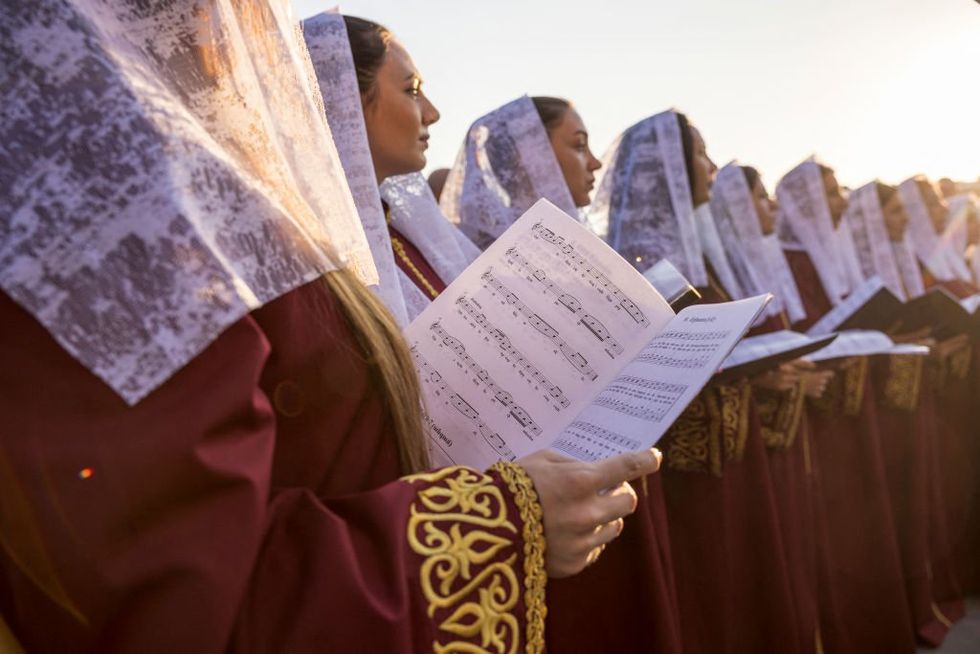
In 301 AD, Armenia became the first nation in the world to adopt Christianity as its state religion
|GETTY
Walking into the medieval temple of St Gregory the Illuminator — a Unesco World Heritage Site that features a museum displaying liturgical treasures, pearl vestments and a piece of wood from the True Cross — gives you a sense of how devoted the Armenian people are to their faith. Now, 1,700 years after Christianity was woven into the fabric of Armenian society, the Church faces a reckoning — this time from within.
Over the past decade, tensions between the Armenian Government and the Church have escalated into a tense stand-off, with officials threatening legal action against Christian ministers and political opponents. At the heart of this crisis lies an unprecedented demand from Armenia’s liberal prime minister, Nikol Pashinyan: a revised ecclesiastical charter to dethrone the Catholicos of All Armenians for the first time in nearly 100 years.
TRENDING
Stories
Videos
Your Say
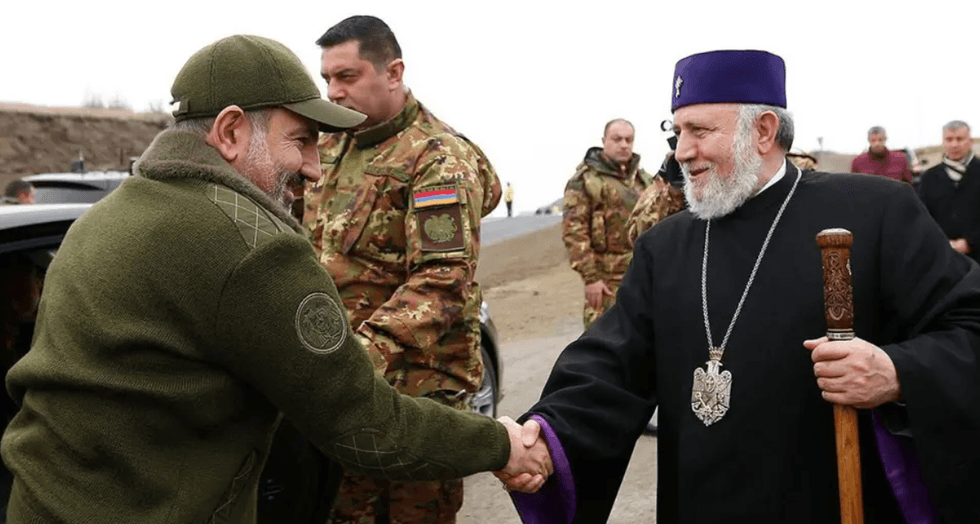
Armenia's prime minister Nikol Pashinyan (Left) and Catholicos Karekin II (Right) are now in a tense political stand-off
|GOV.AM
“Armenia is at a very important crossroads from (a) historical point of view,” says Aram Vardevanyan, a board member of a new opposition party called Strong Armenia. Speaking from the party’s headquarters in the capital Yerevan, Mr Vardevanyan said it was “absurd” how Government officials were treating clergymen, adding: “This is in comparison (to) the president of France or any other country, the society of which is predominantly Catholic, (demanding) the resignation of the Roman Pope.”
Shortly after assuming office in 2018, Mr Pashinyan insisted the Government had no right to meddle in the “Church's internal issues”. The former journalist appeared to change his tune when he removed the Church’s history from Armenia's national curriculum as part of a broader push for secular education.
A major escalation occurred in 2020 following Armenia’s defeat in the 44-day War with Azerbaijan. Three years later, following a lightning offensive by the Azerbaijani military in 2023 — which resulted in 120,000 Armenians fleeing their homes in Nagorno-Karabakh, an enclave that was governed by ethnic Armenians under the breakaway Republic of Artsakh — the Catholicos, Karekin II, joined calls from various political factions for the PM to resign.
Things came to a head in 2024 when a high-ranking Church figure led the “Tavush for the Homeland” — one of Armenia’s most intense protest movements since the end of the Cold War. Archbishop Bagrat Galstanyan, the head of the Diocese of Tavush, urged university students to boycott classes, while citizens were ordered to "engage in peaceful acts of disobedience” over Mr Pashinyan efforts to demarcate the Armenia–Azerbaijan border.
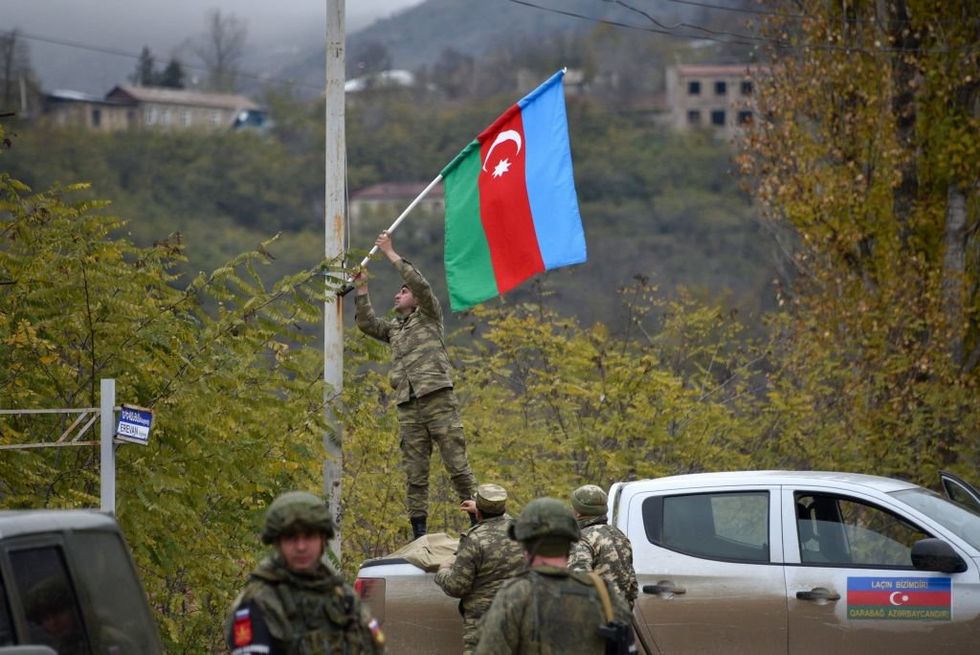
A major escalation occurred in 2020 following Armenia’s defeat in the 44-day War with Azerbaijan
|GETTY
Last year, during a landmark meeting hosted by Donald Trump in Washington, Mr Pashinyan and Ilham Aliyev, Azerbaijan's President, signed a historic agreement aimed at reopening key transit routes and expanding energy trade. Nevertheless, the Church accused Mr Pashinyan of failing to secure the right of return for refugees displaced from Nagorno-Karabakh and "revising national narratives" by removing an image of Mount Ararat from its passport stamps to satisfy Turkey, a close ally of Baku. His administration also stated the international recognition of the 1915 Genocide that killed up to 1.5 million people is "not our number one priority", opting instead to establish economic ties with Ankara.
When diplomatic talks were brokered by the White House, the Armenian Government began detaining several priests — including Archbishop Galstanyan — charged with orchestrating what Mr Pashinyan called a “sinister plan" to stage a coup d'état with the help of two former presidents — Robert Kocharyan and Serzh Sargsyan. Meanwhile, Mr Pashinyan ordered bishops to remove any references to the Catholicos and primates from the Divine Liturgy.
Growing authoritarianism is not just a problem affecting Armenia’s religious leaders: social media users are continuing to be questioned or purged by police under “online hooliganism” laws to clamp down on dissent. One Armenian native, who spoke to the People’s Channel on the condition of anonymity, commented: “We live in a frightened society where people cannot talk.”
A human rights barrister said ordinary Armenians were being sentenced “just for criticising the Government” and branded the charges being pressed on clerics “a mockery against law”.
She told Britain’s News Channel: “A lot of this repression started with legitimate criticism of the way Mr Pashinyan handled the conflict and the forced deportations of people in the (Nagorno-Karabakh) region.”
LATEST DEVELOPMENTS:
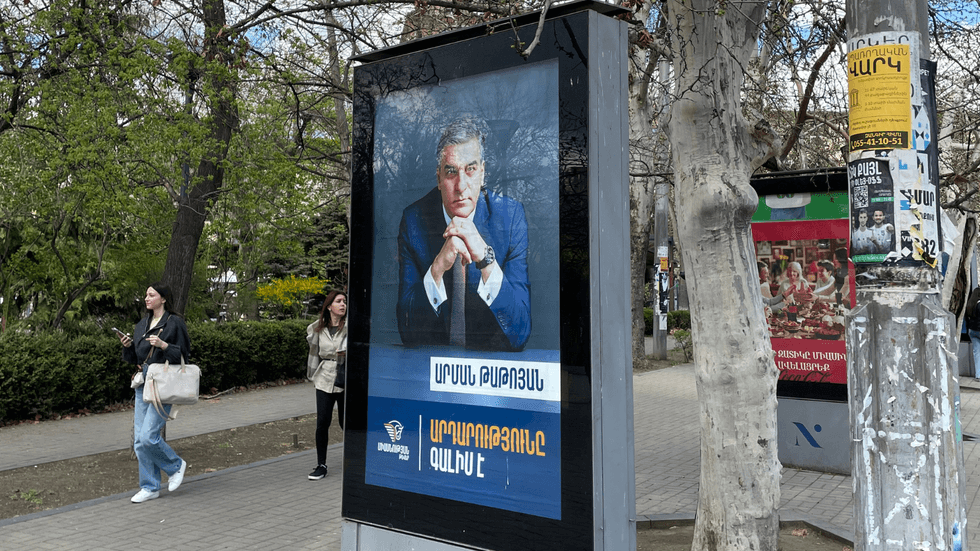
Russian-Armenian billionaire Samvel Karapetyan has been plastered on just about every billboard and bus stop in Yerevan
|GB NEWS
Mr Pashinyan has used various lines of attack to defend his relentless campaign against the Church.
He has accused multiple monks of having sexual affairs in breach of their vows of celibacy. Mr Pashinyan then labelled the Church a “national security threat” over its purported financial ties to the Kremlin and members’ alleged ties to the KGB, although he has not provided proof.
But Doctor of Political Science Arsen Gasparyan, a former senior adviser to Mr Pashinyan and Director of Projects at the Genesis Armenia think-tank, accused the PM of fuelling a culture of “anger and indifference” by pivoting Armenia towards the West in the ambitious hope of joining the European Union but failing to address issues closer to home, including high rates of poverty. “People are depressed,” he added.
The row threatens to divide public opinion even more going into this year’s general election, scheduled for June 7, in what Dr Gasparyan dubbed a “referendum on national survival”.
Some analysts predict it could be Armenia’s tightest electoral race since independence was declared in 1991, with Armenian-Russian businessman Samvel Karapetyan launching Strong Armenia to take on Mr Pashinyan’s party, Civil Contract.
The property and electricity tycoon — who is listed on Forbes’ rich list with an estimated wealth of $4billion (£3billion) and is one of the largest benefactors of the Church — has been plastered on just about every billboard and bus stop in Yerevan. Despite being the face of Strong Armenia, Mr Karapetyan is currently on trial for suspected tax evasion, money laundering and “making public calls for the seizure of power”.
Mr Karapetyan denies any wrongdoing and says he is acting “in his own way” to stop Armenian Christians being persecuted by the state. His nephew Narek said Mr Karapetyan was held “in a KGB basement and now he's under house arrest”, saying of Strong Armenia's mission: “The idea is to change the leadership in our country to a more democratic one based on national values.”
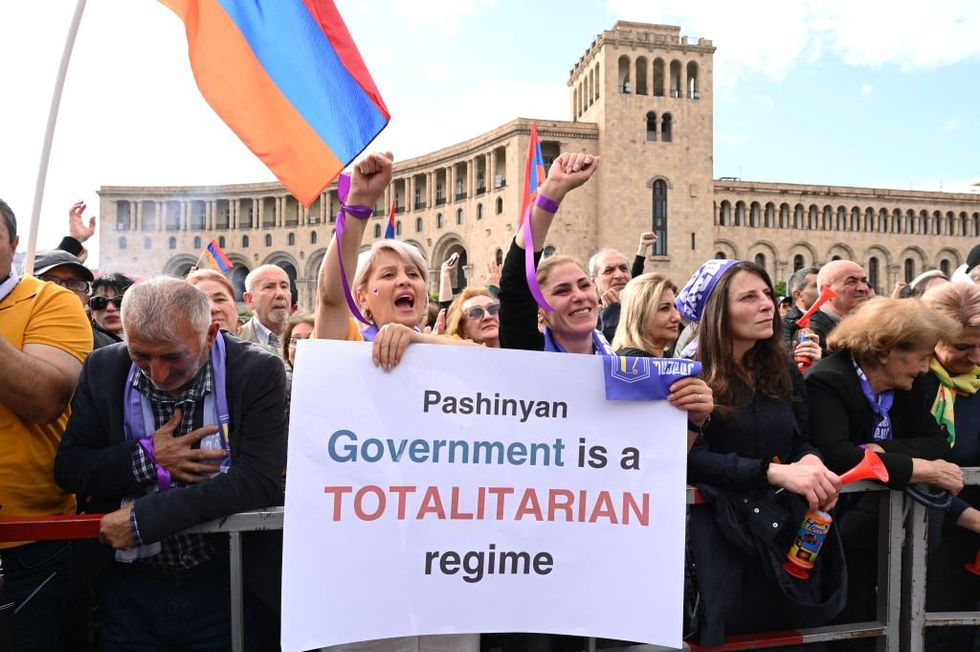
Armenia recently experienced one of its most intense protest movements since the end of the Cold War
|GETTY
Mr Karapetyan’s Strong Armenia currently polls second behind Mr Pashinyan’s Civil Contract, according to a February survey by the International Republican Institute. But yesterday, anti-corruption authorities detained a further 14 suspects connected to Strong Armenia on suspicion of electoral bribery, less than two months before voters cast their ballots.
It was not immediately clear if all those taken into custody were parliamentary candidates.
In an interview with GB News a fortnight before the raid, Mr Vardevanyan said, win or lose, Strong Armenia will continue to defend the Church and campaign for stronger international relations “from the perspective of Armenia's interests”.
He said: “Throughout our history, there were times when we were deprived of our independence (and) sovereignty, and the Armenian Apostolic Church was the anchor (and) protector of Armenian lives.
“I believe the government cannot intervene in the actions of the Church, because this is what religious freedom requires… zero tolerance towards the Government's intervention in the internal affairs of the Church.
“We want strong peace, but for that you have to have the political will and the means for ensuring it, and the last few years have shown the ruling party doesn't have the necessary tools for this.”
Earlier this month, Mr Pashinyan published Civil Contract’s draft pre-election programme, which states the ideological basis of his party is one of “Real Armenia” that saw his administration and Azerbaijan drop mutual territorial claims.
In spite of Mr Pashinyan’s self-declared achievements, increasing attention is being paid to his pre-emptive catalyst against conservative opposition: “We returned the state to the people,” Mr Pashinyan said.
“Now we must return the Church to the people."
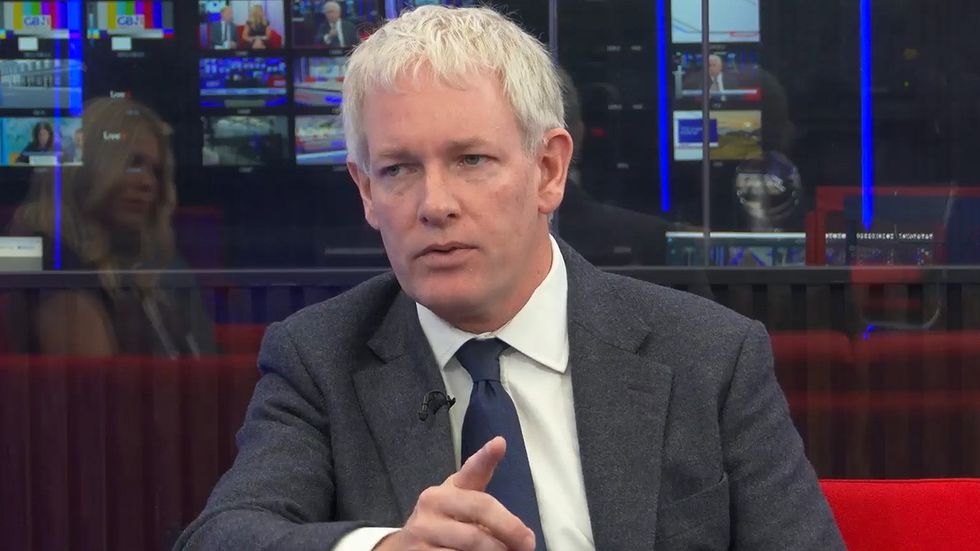
Reform UK Danny Kruger said: 'I can only pray Nikol Pashinyan decides to change his mind and reconciles with the Church'
| GB NEWSThe events unfolding in the South Caucasus have not gone unnoticed in the West: the Lemkin Institute for Genocide Prevention has urged Mr Pashinyan to stop his “suppression” of the Church, while Human Rights Watch has highlighted “serious human rights concerns” involving activists and journalists in Armenia.
The UK Government recently announced it “is monitoring the situation” in Armenia and Reform UK Danny Kruger told The Times: “I can only pray that (Mr) Pashinyan decides to change his mind and reconciles with the Armenian Church.”
Defending his actions against the Church, Mr Pashinyan told the European Parliament: “Some clergymen, who cynically violated all the rules of spiritual good conduct, have assumed leadership of the war party. Some are using the altar of Christ to preach conflict, war and intra-Armenian violence — this cannot be tolerated in any democratic country.”
Allies of Karekin II told GB News the supreme head has no intention of leaving his pontifical residence because Mr Pashinyan has no jurisdiction over the Church under Armenia’s constitution.
One senior bishop told the People’s Channel: “The Catholicos is happy to work with the Government… (but) the only person he fears is Him (God); people have continuously laid their lives for the Church, and so will he.”
A spokesman for the Church’s governing Supreme Spiritual Council added. “Emphasising the imperative of respecting and protecting the Church’s rights and autonomy, as well as the principles of justice and democracy, we condemn these arbitrary and discriminatory actions.”