








New data sourced has revealed UK fire services attended more than 15,000 bariatric incidents between 2020 and 2025, equivalent to one bariatric rescue every 3.3 hours.
Experts at Zava sent freedom of information requests to all 49 fire and rescue services in the UK to determine the areas with the most bariatric rescues, as well as the average time spent on scene.
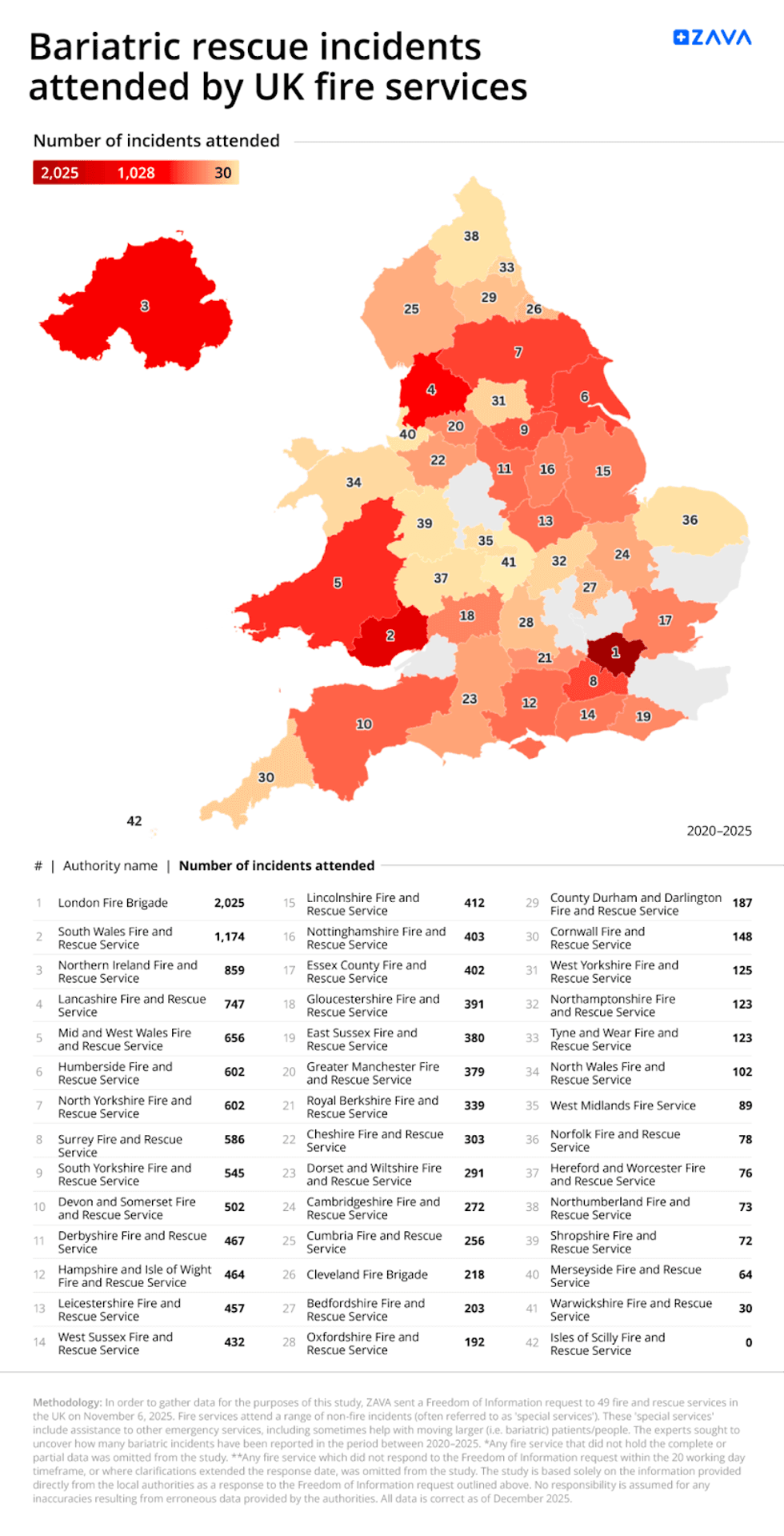
They found fire services have spent over a full year of continuous time rescuing obese patients, with London Fire Brigade responding to the most overall, more than 2,000, costing the service over £1million in resources.
Fire services attended 15,849 incidents overall across the five year period, soaring by 76 per cent, equivalent to almost nine incidents per day.
TRENDING
Stories
Videos
Your Say
Bariatric rescues by fire service
|ZAVA
Approximately 1.88 million UK adults are living with Class III obesity, formerly known as morbid obesity, a condition often associated with significantly reduced mobility.
This surge in obesity rates has raised ongoing questions around public spending, capacity and long-term planning for emergency response.
Obesity levels aren’t just impacting individual health outcomes, but also placing increasing pressure on emergency services nationwide.
Crystal Wyllie, doctor at Zava, said: “Obesity is an epidemic across the world, but within the UK, we can see a natural impact that bariatric care has not only on the NHS, but also on other public services such as fire and rescue.
“First responders have to deal with a tremendous amount of stress on a day-to-day basis, but adding difficult callouts for bariatric patients risks their health and safety when manual handling pushes the physical limits of responders.”
South Wales Fire and Rescue Service reported the second-highest number of incidents involving bariatric patients, with 1,174 reports since 2020, a 56 per cent increase in incidents.
Northern Ireland Fire and Rescue Service reported the third-highest number, with 859 since 2020, increasing by a whopping 146 per cent.
Tom, 30, a firefighter with London Fire Brigade, said: “Jobs that would be straightforward with a casualty of a healthier weight become physically damaging and exhausting.
“Removing a severely overweight casualty from a fire would mean working harder, using more air, and staying longer in a dangerous environment. This significantly increases the risks of heat exhaustion, collapse, and fire spread.
LATEST DEVELOPMENTS
“These incidents often involve removing windows, doors, balconies, or working at height, all of which increase risk and duration.”
He highlighted an experience of a 10-hour rescue of a bariatric patient, requiring five fire engines, a command unit, senior officers, police, four ambulances, a specialist bariatric ambulance, and a London Ambulance Service Incident Response Unit.
“This was an enormous mobilisation for a single patient,” he said.
Crews had to remove a ground-floor balcony, take out three French doors, build a ramp capable of supporting his weight, and set up a line system to lower him down the verge to the road gently.
It took nine firefighters just to lift him from the chair onto an upright stretcher, with one crew member injuring his back during this job.
The sheer number of resources tied up on this one job reduced emergency cover across London and came at a huge cost to the taxpayer, involving a 45-minute blue-light run.
Dr Wyllie added: “Tackling obesity is key to reducing strain on our public services, and with the millions of Britons choosing weight loss management techniques, including weight loss injections, we can expect to see a further decrease in these risky rescues in the years to come.”
More From GB News