










Chancellor Rachel Reeves's rumoured tax on ISAs looks set to fail due to a little-known 1p looplole, experts claim.
A flaw in Ms Reeves's flagship cash Isa reforms will enable savers to circumvent the new restrictions by investing as little as one penny in stocks.
From next April, individuals under 65 will see their annual cash Isa allowance reduced to £12,000, though the overall £20,000 Isa limit remains accessible through stocks and shares accounts.
The Labour Government's new framework would render portfolios consisting entirely of cash-like assets, including money market funds, subject to taxation.
Analysts suggest the Chancellor's ISA reforms could fail
|GETTY
However, investors who place just 1p into equities while maintaining 99.9 per cent of their holdings in money market funds would face no penalties whatsoever.
One industry source said: "This would add even more complexity and would fail to help investors or the aim of these reforms."
HM Revenue and Customs (HMRC) and the Treasury have devised anti-circumvention measures aimed at stopping savers from exploiting investment accounts to dodge the reduced cash ISA threshold.
These provisions will prohibit investors from allocating their entire portfolio to cash-like instruments such as money market funds, which typically deliver marginally better returns than traditional savings with minimal risk.
 The ISA limit is currently £20,000 each tax year | PA
LATEST DEVELOPMENTS
 Industry figures have warned the proposed ISA changes could remove one of the few straightforward options available | GETTY
Yet unlike the effective prohibition that existed before 2014, money market funds will not be banned outright from ISAs.
Should a saver place 100 per cent of their investable assets in money market funds, these holdings would be classified as "non-qualifying assets" and must be sold or transferred out of the ISA within 30 days.
The Treasury is also considering imposing a charge on interest or gains generated by non-qualifying cash-like investments.
Additionally, investors will likely face a 22 per cent levy on interest earned from cash held within stocks and shares Isas starting from April 2027.
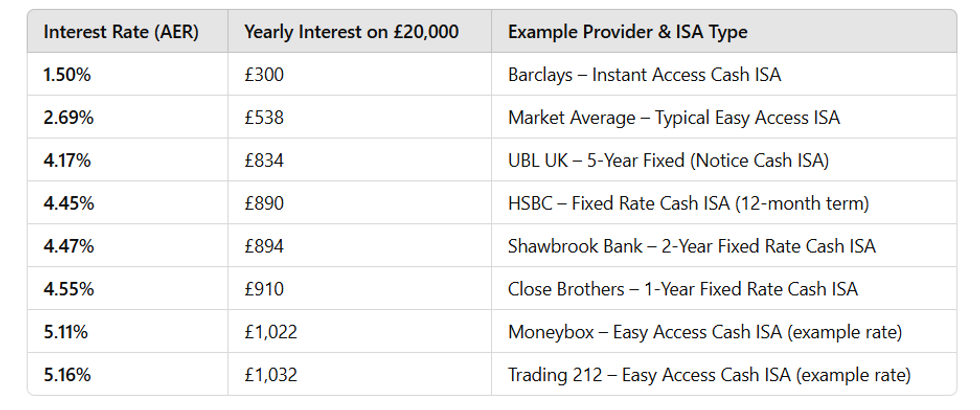 Examples of tax free Isa earnings in the UK if you had £20,000 in the Isa | GBN
This approach echoes the pre-2014 Isa system, when cash interest accrued in stocks and shares accounts attracted a 20 per cent tax. The proposed new charge has been set to match the savings interest tax rate, which is scheduled to rise to 22 per cent in April 2027.
Rachael Griffin, a tax and financial planning expert at wealth manager Quilter, said: "I hope we don't end up in the pre-2014 scenario where we're having to monitor different investments.
"These things take time to deliver. I'm not sure whether HMRC have quite appreciated the potential level of work that's involved to implement these reforms by next April."
A Treasury spokesman said: “We are reforming the cash Isa to encourage more people to invest in stocks and shares, which have historically performed better than cash savings, and we have retained the generous £20,000 tax-free limit."