







As fury over Rachel Reeves' tax hikes mounts, a bombshell new report reveals exactly how the Chancellor is spending the public purse - and there are wide regional disparities.
The exclusive report for the People's Channel from think-tank Facts4EU analysed the latest public spending figures up to the end of March 2025 and has uncovered what all these taxes – to which Rachel Reeves added an extra £20billion in her Budget - are being spent on by the state.
The authors then go further and look at how some regions benefit significantly more than others from the total tax revenues raised each year.
Total government spending reached £1.29trillion in the year ending March.
TRENDING
Stories
Videos
Your Say
Of this sum, £142.7billion went towards capital investment including equipment and upgrades.
Around 18 per cent of overall expenditure served national interests and could not be attributed to specific regions, leaving £957billion in locally-identifiable spending as the focus of the analysis.
Social protection, encompassing benefit payments, emerged as the dominant category of government expenditure by a considerable margin.
The state now allocates 59 per cent more funding to this area than it does to health, which ranks as the second-largest spending category.

Total identifiable public expenditure by household in each region and nation
|FACTS4EU
This breakdown encompasses all everyday spending and capital investment that can be traced to specific locations throughout the UK.
The £957billion in regionally-attributable expenditure represents money raised through taxation or borrowing that is then deployed by government bodies and agencies across different parts of the country.
Facts4EU has indicated it will examine the social protection spending figures in greater detail in a subsequent report.
The geographical distribution of this expenditure reveals marked differences between various parts of the United Kingdom.
LATEST DEVELOPMENTS
- An online petition is circulating. They want to cancel me... and cancel GB News too - Bev Turner
- I've experienced first-hand how IRA whistleblowers pose a massive moral dilemma - Nigel Nelson
- Donald Trump humiliates Keir Starmer with highly effective move to stop UK's small boats - Lee Cohen
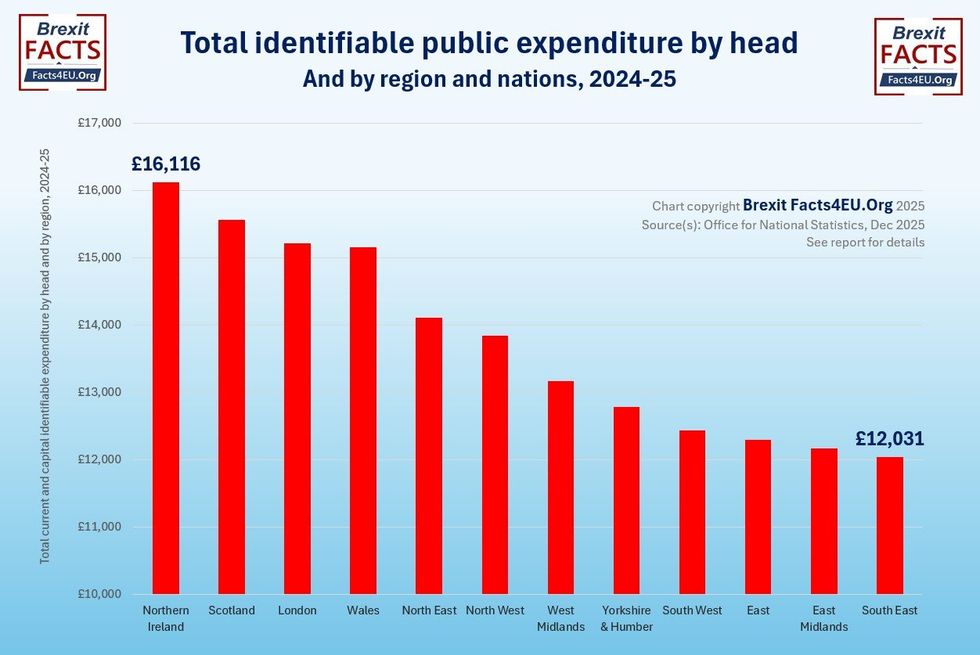
Total identifiable public expenditure per head
|FACTS4EU
When measured per head of population, Northern Ireland receives the highest allocation of public funds in the UK.
Residents there benefit from just over £4,000 more per person than those living in the South East of England, representing a 34 per cent premium.
The traditional explanation for this gap has centred on elevated security and policing costs stemming from the Troubles, but Facts4EU's examination of Office for National Statistics data undermines this argument.
In 2024-25, policing and law enforcement accounted for merely 5.2 per cent of total public spending in Northern Ireland, compared with 4.5 per cent in the South East.
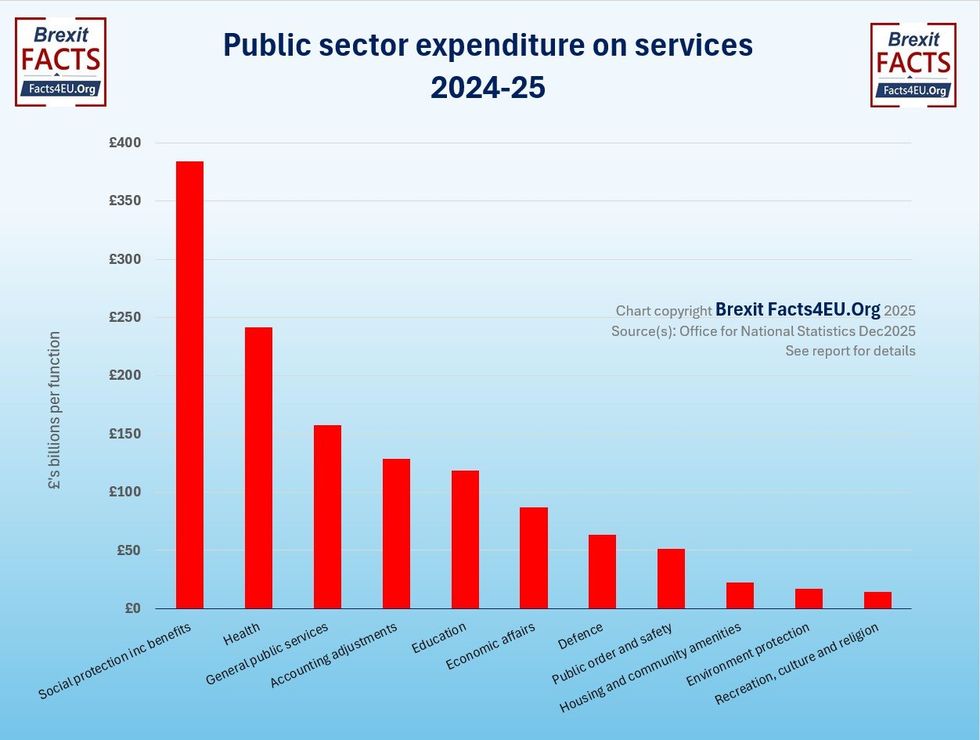
Public sector expenditure on services
|FACTS4EU
This difference is negligible in the broader context of overall expenditure.
Despite being one of the most densely populated areas in Britain, the South East receives the lowest per-capita allocation.
Facts4EU also calculated spending on a household basis, obtaining data on the number and composition of households in each region.
This approach reduces distortions caused by spreading expenditure across all individuals regardless of age, and presents figures in a format more familiar to people accustomed to household bills.
The results proved equally striking, with Northern Ireland again topping the table.
However, under this methodology, the South West of England rather than the South East occupies the bottom position.
The annual gap between a Northern Irish household and one in the South West exceeds £11,000.
This household-level analysis reinforces the pattern identified in the per-capita figures, demonstrating that the spending disparities persist regardless of which measurement approach is applied.
Across both measurement methods, Northern Ireland, Scotland and Wales consistently secure more favourable allocations than any English region.
Whether examining per-capita figures or household-level data, England finds itself at the bottom of the spending charts.
The pattern raises fundamental questions about how total public expenditure is divided between the devolved nations and the English regions.
Facts4EU's analysis demonstrates that this imbalance cannot be attributed to any single factor such as security costs, given the minimal variation in policing expenditure between regions.
The think-tank has posed the question of what explains this persistent disparity between English areas and the three other UK nations, inviting consideration of the underlying reasons for such marked differences in public spending distribution.
More From GB News