








Interest rates in the UK could climb back above four per cent if escalating tensions in the Middle East trigger a fresh inflation shock, economists have warned.
New analysis published today by the National Institute of Economic and Social Research highlights the risk facing policymakers.
The think tank says the Bank of England may be forced to raise borrowing costs again if the ongoing US-Israel conflict with Iran pushes energy prices sharply higher.
A sustained surge in oil and gas costs could quickly feed through to household bills and business expenses, reigniting inflation pressures just as policymakers believed they had begun to bring price growth under control.
Such a move would mark a sharp reversal for the central bank, which has cut rates six times since August 2024, reducing the base rate from 5.25 per cent to its current level of 3.75 per cent.
Financial markets now indicate only a one-in-five probability of another rate reduction this month, a sharp decline from approximately four-in-five just last week.
Energy markets have experienced significant turbulence since hostilities escalated over the weekend.
Brent crude oil prices have climbed approximately 15 per cent since fighting broke out, while European natural gas benchmarks have surged by around three quarters, according to analysts.
 Is the Bank of England cutting interest rates fast enough? | GETTY
 Iran has issued threats to close the Strait of Hormuz, a vital shipping corridor, in retaliation for military strikes against it.
Qatar announced on Monday that it had suspended liquified natural gas production after its facilities came under attack.
Although price movements began to stabilise on Wednesday following the dramatic spikes earlier in the week, concerns about supply disruptions remain acute.
NIESR modelled two potential scenarios based on oil prices rising a further 30 per cent and gas costs increasing by an additional 50 per cent.

Households risk rising energy bills
| GETTYShould the energy price spike prove temporary, normalising within three months, Consumer Prices Index inflation for 2026 would rise by roughly 0.3 percentage points compared to the think tank's February forecasts.
However, if elevated prices persist for a full year before stabilising, CPI inflation could climb by 0.7 percentage points this year and 0.5 percentage points in 2027.
Under this more severe scenario, interest rates could rise approximately 0.8 percentage points above previous projections, pushing them back above four per cent.
The think tank had previously forecast two rate cuts this year, which would have brought borrowing costs down to around 3.25 per cent.
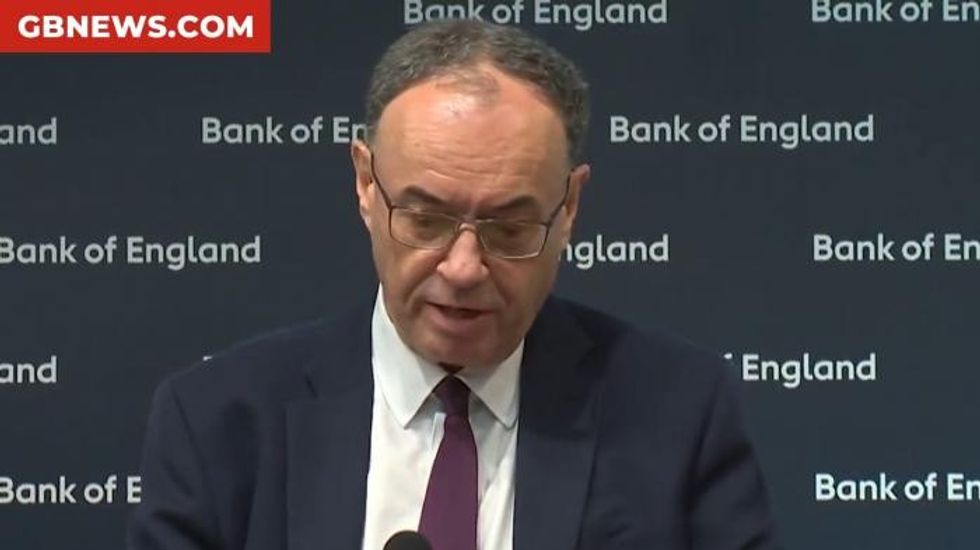
The Bank of England will have to contend with a shock to global energy prices
| Bank of EnglandEd Cornforth, an economist at NIESR, said: "The conflict in the Middle East will have material implications for the economic outlook.
The Bank of England will have to contend with a shock to global energy prices, with the question of persistence hanging over their heads.
"This will cause problems for Rachel Reeves as financing costs increase, putting further pressure on an already precarious fiscal outlook."
Mortgage lenders have already begun suspending planned reductions to home loan rates in response to the conflict and its potential economic consequences.
More From GB News