









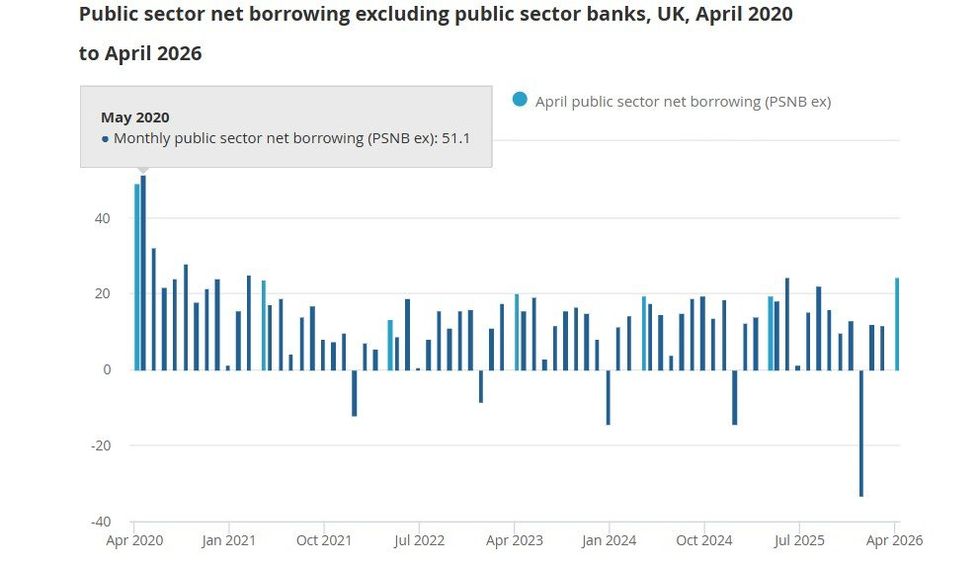
UK borrowing costs surged to a higher-than-expected £24.3billion last month, according to the latest figures from the Office for National Statistics (ONS).
This represents the second-highest April level on record for borrowing, as economists warn Chancellor Rachel Reeves has an uphill battle in improving the economy.
Based on today's ONS figures, borrowing for April 2025 was a quarter higher, or £4.9 billion, than the year before.
Notably, last month's figures were £3.4billion more than the £20billion projected by the the Office for Budget Responsibility (OBR).
Borrowing costs have surged once again
| GB NEWSIn another blow to Chancellor, the ONS revealed that interest costs on Government debt hit £10.3billion.
Grant Fitzner, ONS chief economist, said: “Borrowing this month was substantially higher than in April last year and although receipts increased compared with April 2025, this was more than offset by higher spending on benefits and other costs.
“Borrowing for the latest full financial year was revised down slightly, and on a comparable basis remains the lowest since the year ending March 2020."
Chief Secretary to the Treasury, Lucy Rigby, said: "Earlier this week the International Monetary Fund agreed we had the right economic plan to reduce the deficit.
The ONS has published new borrowing figures for Aprtil 2026
|ONS
LATEST DEVELOPMENTS
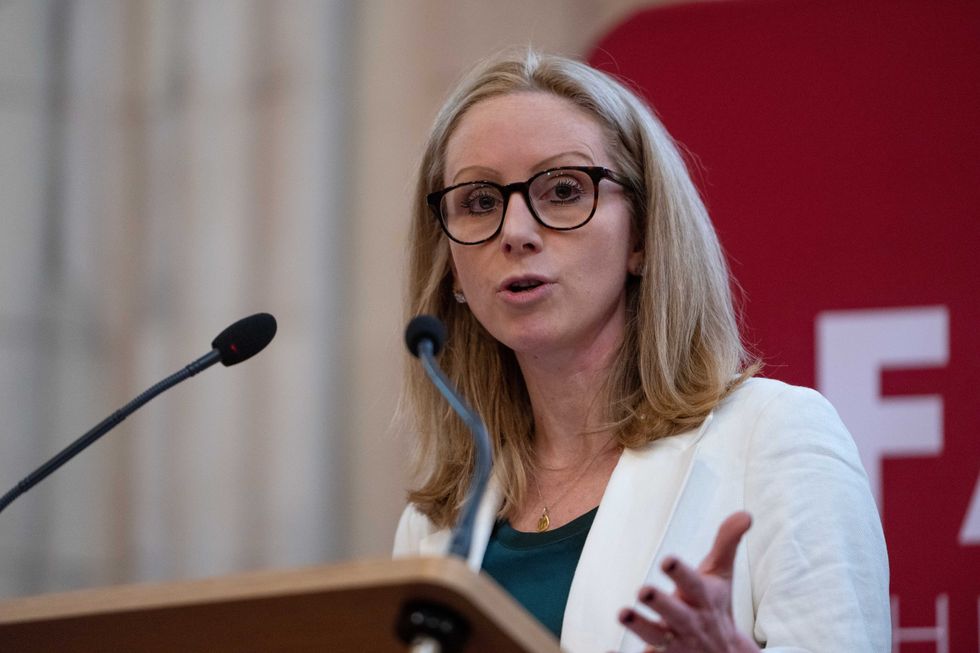
Treasury Minister Lucy Rigby reacted to the figures
| GETTY“We are cutting borrowing and debt, with our actions reducing Government borrowing by over £20billion last year, while driving growth through £120billion of additional capital investment over the Parliament.
“Working families have benefited from falls in inflation and cuts to interest rates, and our non-negotiable fiscal rules will be all the more important to continue to protect them as we face the consequences of the war that we have played no part in."
Professor Joe Nellis, an economic adviser at MHA, added: "The UK Government borrowed £24.3billion in April, as fiscal strain continues to grow as we enter the new financial year. Government spending continues to rise at a relentless pace while tax revenues are not growing at the necessary pace to match it.
"Health and welfare costs are climbing and weaker economic growth is limiting the Treasury’s ability to generate stronger revenues. The result is a fiscal position that looks increasingly stretched.
"Another contributing factor is the persistently high cost of servicing the nation’s debt. Political instability risks unsettling business confidence and financial markets at a delicate moment for the economy. Markets dislike uncertainty, particularly when government borrowing is already elevated and fiscal credibility is under international scrutiny.
"Fears that the Prime Minister and Chancellor could be replaced by a pairing less committed to the current fiscal rules is sending bond yields even higher. What is particularly worrying is that these pressures are emerging at a time when the global economic environment is becoming more unstable again.
"The ongoing tensions in the Middle East is creating fresh risks for government finances. Rising oil and gas prices are feeding into inflation, increasing costs for businesses and households alike. Higher inflation pushes up the cost of servicing inflation-linked government debt, while slower economic activity risks weakening tax receipts.
"None of this points to an immediate economic crisis. But it does reinforce the sense that the UK economy is entering a more fragile phase, in which economic weakness, geopolitical instability and political uncertainty are beginning to feed into each other."