








From indie drummer to industry disruptor, Ryan Edwards has built a business on a problem most artists never even realise exist: until it’s too late.
Long before he was navigating boardrooms and scaling a music-tech company across 14 countries, Mr Edwards was behind a drum kit, touring the UK as part of indie band The Lines.
Speaking to GB News, he shared how it was a formative period that offered a front-row seat to the realities of the music industry: the thrill of live performance, the grind of touring life, and the complex web of contracts and rights that underpin it all.
The band even secured a UK Top 10 hit—an achievement many artists spend entire careers chasing. But it was only years later, after he had left music behind, that Edwards discovered just how opaque that system could be.
Following his departure from the band in 2008, Edwards took a less conventional route into business. He worked in retail, sharpening his understanding of customers and the mechanics of selling, before moving into sales at a fintech startup.
That path eventually led him to Visa Europe, where he rose to a senior leadership role, gaining experience in scaling businesses and navigating complex financial systems.
Each step on the career ladder added another layer to his skill set, but it was not until 2018 that everything clicked into place: "I heard one of my own songs playing in a department store, and I realised I had no visibility on whether I was being paid for it."
It was a moment of clarity and frustration. Digging deeper, he discovered a royalties system still heavily reliant on manual reporting and sampling, leaving significant gaps in data and, crucially, in payments to artists and songwriters.
For an industry built on creativity, it was an outdated infrastructure problem hiding in plain sight. As a result, Mr Edwards decided to do something about it.
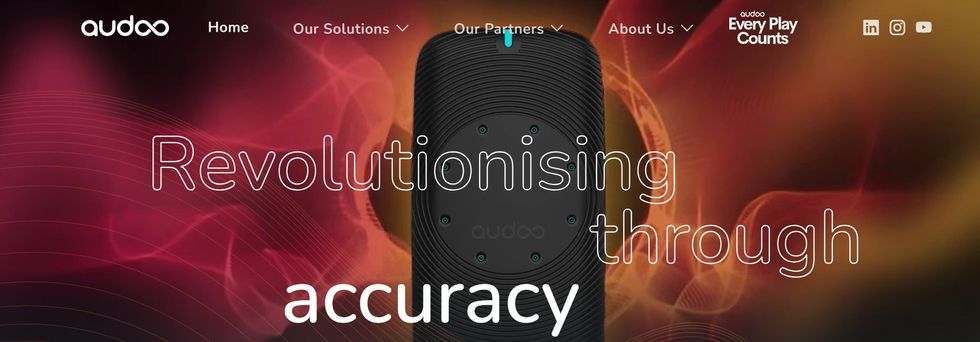
What began as a kitchen-table prototype has since evolved into Audoo’s flagship product: the Audio Meter, a device designed to accurately track music played in public spaces in real time.
Today, the technology operates across 14 countries, providing a level of transparency that has long eluded the industry. The leap from "indie from Wolverhampton" to CEO might seem unlikely, but Mr Edwards is quick to point out that the transition was less dramatic than it appears.
LATEST DEVELOPMENTS
"My time as a musician gave me a first-hand understanding of the industry; working with labels, navigating contracts, and learning how to manage tight budgets as a touring band."
Combined with the commercial grounding he gained in retail and fintech, it created a foundation that proved invaluable when launching Audoo. Still, not everything translated so seamlessly.
"One of the biggest lessons at Audoo has been realising that even when you’re solving a clear problem, which is fairer royalties for artists and better data for venues and PROs, not everyone will see it as progress.
"I think the key thing I learnt here was that solving the problem wasn’t the hardest part; it’s been getting everyone to agree that there is a problem to address in an industry that typically ignores or brushes off its problems.!
That tension sits at the heart of Audoo’s story. While the company’s mission, ensuring fairer royalties for artists and better data for venues and performing rights organisations (PROs, has won widespread support, it has also exposed uncomfortable truths within the industry.
From the outset, Audoo attracted backing from some of music’s most influential figures, including Sir Elton John and ABBA’s Björn Ulvaeus. Their support lent credibility to a solution that, at its core, is highly technical. But Mr Edwards was careful not to lead with the technology itself.
“It was never about convincing creatives to care about the tech. It was about highlighting an issue they already knew existed and demonstrating a credible way to solve it.”

Spotify and other music platforms have changed the music industry
| SPOTIFY PRESS OFFICEThat approach helped Audoo gain traction with PROs in markets such as Ireland, Germany and Australia, where organisations like IMRO, GEMA and APRA recognised the potential value early on. But not everyone has been as receptive.
“The main resistance we’ve faced has been from some organisations that would prefer to turn a blind eye. There have been multiple reports of ‘missing’ royalty allocations—money that should be going to artists and songwriters but currently isn’t being properly tracked or distributed.”
In an industry where legacy systems and long-standing practices often go unchallenged, that resistance is perhaps unsurprising. What is more striking, however, is where Edwards says the pushback has been strongest.
"Sadly, the market we’ve seen the most resistance to is here at home in the UK," he shared, pointing to what he describes as a reluctance to confront systemic issues.
If challenging the status quo was not enough, Audoo also faced launching just before the Covid-19 pandemic brought the world to a standstill. As a business, the impact was immediate.
Expansion plans stalled, and global markets became difficult to access. Yet, in typical startup fashion, constraints forced adaptation. Australia, with its comparatively relaxed restrictions, became an unexpected launchpad.
From there, Audoo expanded into New Zealand and gradually across Europe, building momentum in markets that had not originally been the primary focus. Ultimately, Edwards believes the principle is simple: real artists and songwriters deserve to be recognised and properly compensated for their work.
Looking back, he describes his journey as anything but linear—a series of pivots, challenges, and learning curves that have shaped both him and the business.
His advice to future founders reflects that experience: Set clear goals, but be adaptable. When new technologies or challenges come along, take the time to evolve rather than resisting. Your industry won’t wait for you to catch up."