








Rachel Reeves's statement in the House of Commons on Tuesday sought to reassure the House of Commons, the markets and the public. What resulted was anything but, in the eyes of opposition party members.
Following an exclusive report by the Facts4EU think-tank, in collaboration with Stand for Our Sovereignty and The Campaign for an Independent Britain, GB News highlights the implications of the Chancellor's emergency statement to Parliament and the response of opposition politicians on the looming economic crisis.
In her statement, the Chancellor referred to a subject of great concern to most people: the cost and security of our energy supply. She said: "Since I last addressed the House, the costs of oil and gas have remained high, and last week the Bank of England estimated that inflation could be between three per cent and 3.5 per cent in the next few quarters….
"We must guarantee that our domestic oil and gas industry can also play a role in our energy system for decades to come, so I can confirm that we are encouraging investment in tiebacks to make the most of our existing production facilities."
This second comment will have reassured people the Government is now allowing the exploration and use of large fields of North Sea gas and oil. In fact, Ms Reeves was only referring to licences already granted by the last government, which have been held up. There is no change to policy and no new oil and gas exploration is allowed.
TRENDING
Stories
Videos
Your Say
On food, Ms Reeves said: "On trade, I can confirm to the House that we are aiming to conclude negotiations with the EU this year on the sanitary and phytosanitary (SPS) agreement, which will directly impact food prices in our shops."
It certainly will "directly impact food prices". Catherine McBride OBE, former member of the UK's Trade and Agriculture Commission, told the People's Channel: "Food prices in the EU are higher than those in the UK, so the SPS will not lower UK prices. However aligning with EU regulations will prevent the UK from importing food from other countries, reduce UK animal welfare standards and prevent UK farmers from using new agricultural technologies.
"The EU intends to charge the UK for the privilege of following EU rules. All that the SPS will achieve is to force UK taxpayers to pay for the transaction costs of private food importers even though only these companies will profit from it."
So what is the state of the economy?
On Monday, Sir Keir Starmer convened an emergency Cobra meeting. Not to talk about Iran's attacks on British territory, as might be expected. Instead, the purpose was to discuss the cost of borrowing, with Government bond prices going through the roof. This is something Ms Reeves did not mention on Tuesday.
Over the last week, the UK has seen a raft of basic economic indicators released individually. These are easily overlooked when the news agenda is so full. In addition to sovereign giveaways like the Chagos Islands and Gibraltar, the Iran war continues to dominate. We also have Rachel Reeves and the Government deflecting onto issues like Brexit.
In light of the new figures, we present a snapshot and, unfortunately, none of the news is good. GB News asked the main political parties how bad things are and what ministers should or could be doing to improve our prospects as a country.
So, how is this Government doing on some of the basics which determine how well off Britons all are?
To keep life simple, GB News has chosen five metrics which affect us all, one way or the other (economic growth, inflation, unemployment overall, youth unemployment and cost of borrowing). In each case we present the rate the Government inherited and the latest rate, which we have called "rate now" for convenience, although the date of the latest data varies.
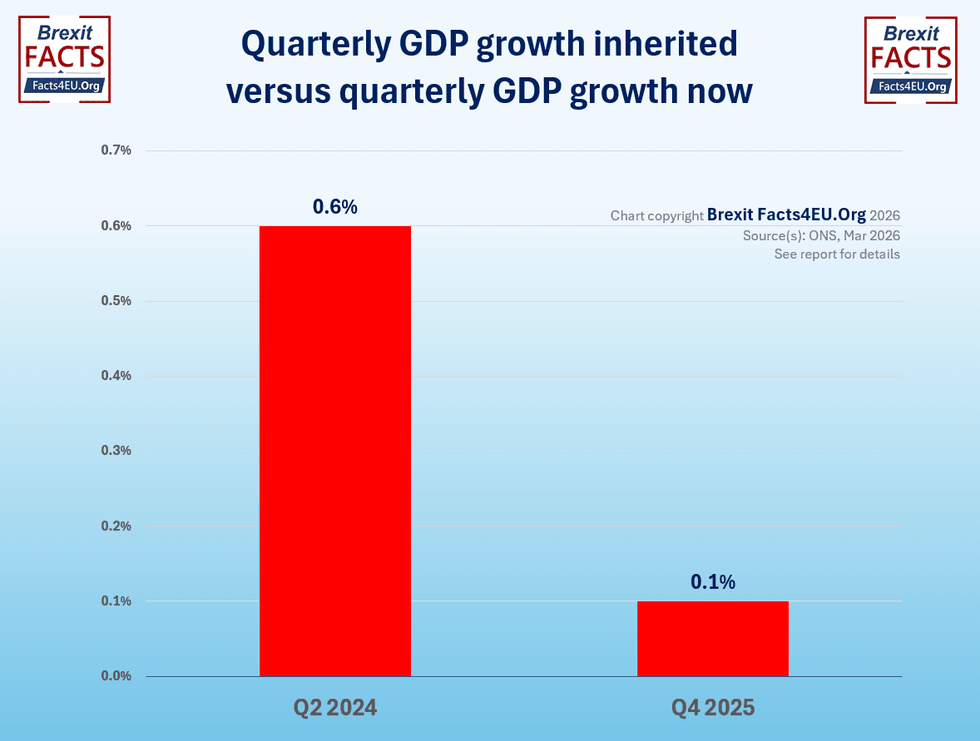
Economic growth - GDP per quarter
Quarterly GDP growth inherited versus quarterly GDP growth now
|BREXIT FACTS4EU.ORG
When the Government came to power, Britain had the fastest growth rate in the G7. It is now amongst the slowest.
There was no growth (0.0 per cent) in January 2026 compared to December 2025. This followed growth of only 0.1 per cent in December. The Treasury’s March 2026 survey of independent forecasts showed an average forecast of 0.9 per cent for the whole of 2026.
Richard Tice, Reform UK's spokesman on Business, Trade and Energy, weighed in with a scathing assessment, saying: "This Government likes its ‘Net Stupid Zero’. Well now its policies have resulted in Net Zero Growth. They managed to scrape 0.1 per cent in December and then zero percent in January.
"They seem to have almost no understanding of the way business works. If we gain the public’s trust and support at the next election, there will be plenty of us with business experience who will put this right and get the country growing again."
Meanwhile, Andrew Griffith, Shadow Secretary of State for Business and Trade, offered an equally biting remark, commenting: "We’ve never had a government with so little understanding of where growth comes from than this one. It’s only business that creates real growth. A ruinous energy policy, driving up the costs of employment, higher taxes and more red tape.
"The Chancellor doesn’t understand business. The cabinet has less business experience than an intern in the House of Commons gift shop! Things need to change."
LATEST DEVELOPMENTS
Inflation - The Consumer Prices Index (CPI)
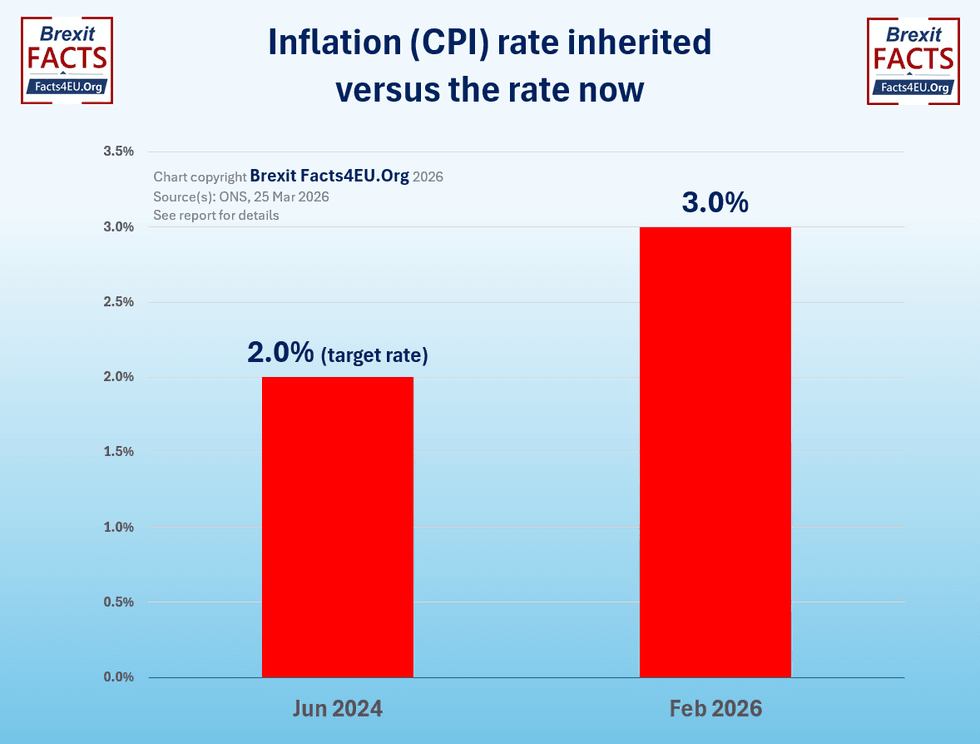
Inflation (CPI) rate inherited versus the rate now
|BREXIT FACTS4EU.ORG
The temptation with inflation is to say the reason it is higher is because of international pressures, such as the oil price. Unfortunately, this does not help the Government.
The inflation rate across the 27 EU countries in January was 2.0 per cent, the same rate the UK Government inherited when it came to power. This also happens to be the Bank of England’s target figure. Yet, it is 50 per cent higher in the UK, at 3.0 per cent. This varies from month to month, of course. In December it was even worse, at 3.4 per cent.
Quite disingenuously, Ms Reeves quotes inflation rates during the previous government of 11 per cent, failing to mention this occurred briefly during the COVID period. The fact remains she inherited an inflation rate at the Bank of England’s target of 2 per cent and under her watch it has consistently been higher.
"When a government puts up the costs of doing business, as this one has consistently done, then of course prices inevitably rise," Mr Tice noted.
"Add to that their flip-flops on protecting our supplies of oil and of goods in tankers and you have the perfect storm. Families have already been feeling the pinch and Labour’s answer is to increase the pressure on prices even more with their ‘EU Re-Set’. Unbelievable."
Mrs Cooper added: "The ballooning cost of living is being egged on by Donald Trump’s war in the Middle East, which is forcing people to make impossible decisions between putting food on the table and filling up their car just to get to work or their kids to school."
Overall unemployment
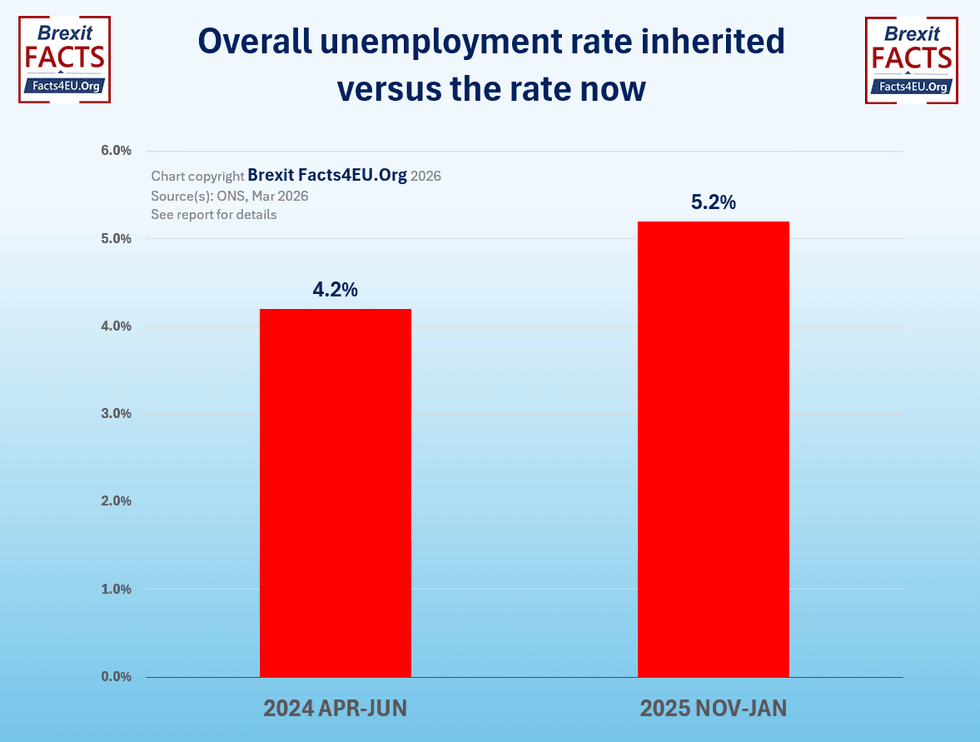
Overall unemployment rate inherited versus the rate now
|BREXIT FACTS4EU.ORG
As of June 2024, the total payrolled employees sat at 30,438,614. By January of this year, that figure was 30,318,796, leaving 119,818 fewer in payrolled employment.
The graph represents an astonishing 24 per cent increase in the rate of unemployment after more than one year-and-a-half of a Labour government. On top of this, the UK has seen a substantial increase in the number of people now on permanent benefits for life, as result of being written off work for what appear in many cases to be very minor reasons.
Mr Tice said: "You would think a Labour government might care about putting people out of work, but not with this one it seems. We warned them the legislation they were so adamant to implement would have these effects, so sadly this comes as no surprise.
"Businesses should be incentivised to employ people but Labour has achieved the precise opposite with their Minimum Wage increases and their Employment Rights Act. Reform UK will tackle all of this if we are elected. We will also ensure that the numbers on welfare get back to normal. No more of this ‘sick notes for life’. The majority in the Alarm Clock generation should not have to carry anyone unless they are genuinely in need."
Lord Redwood, Conservative former Secretary of State, added: "The government has pushed unemployment up by taxing too many businesses into closure or retrenchment. High energy costs, high carbon taxes and business rates have unleashed bankruptcies, shutting refineries, chemical plants, pubs, shops and much else.
"Too many people have been sacked in the name of Net Zero that makes us import instead of producing at home. The UK loses the jobs and tax revenue, madly also putting up world CO2 as we rely on imports."
Youth unemployment
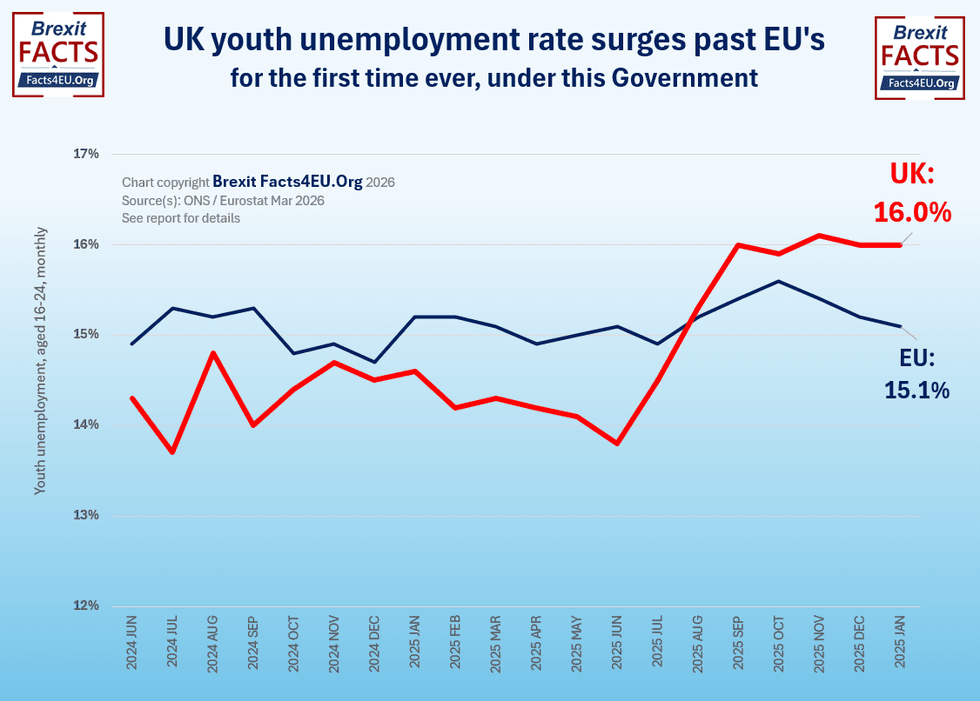
UK youth unemployment rate surges past EU's for the first time ever under this Government
|BREXIT FACTS4EU.ORG
As can be seen in our chart, the UK’s youth unemployment rate always used to be lower than the EU’s. Now, under this government’s policies, particularly on the Minimum Wage and the new Employment Rights Act, employing young people is increasingly less attractive to employers. The Government was warned about this but Ms Reeves dismissed the warnings.
The above excludes all those who are not in education either, but who still are not looking for a job. This is a subject we have reported on several times.
"Labour's infamous tax on jobs with higher National Insurance along with a higher Minimum Wage for young workers has led to mass unemployment of the young," Lord Redwood said.
"Instead of helping them into jobs, government policy makes all young people tense as they scramble to find a first opportunity of work. One in six are tossed onto the unemployment scrap heap before they can begin their working lives."
Ms Cooper stated: "Labour have cemented Britain’s economic doom loop with two anti-growth budgets, putting our public finances on life support. Misguided decisions like the jobs tax have hammered small businesses and made it harder than ever for young people to get a job."
Cost of borrowing - Main 10-year government bond (gilt) rates:
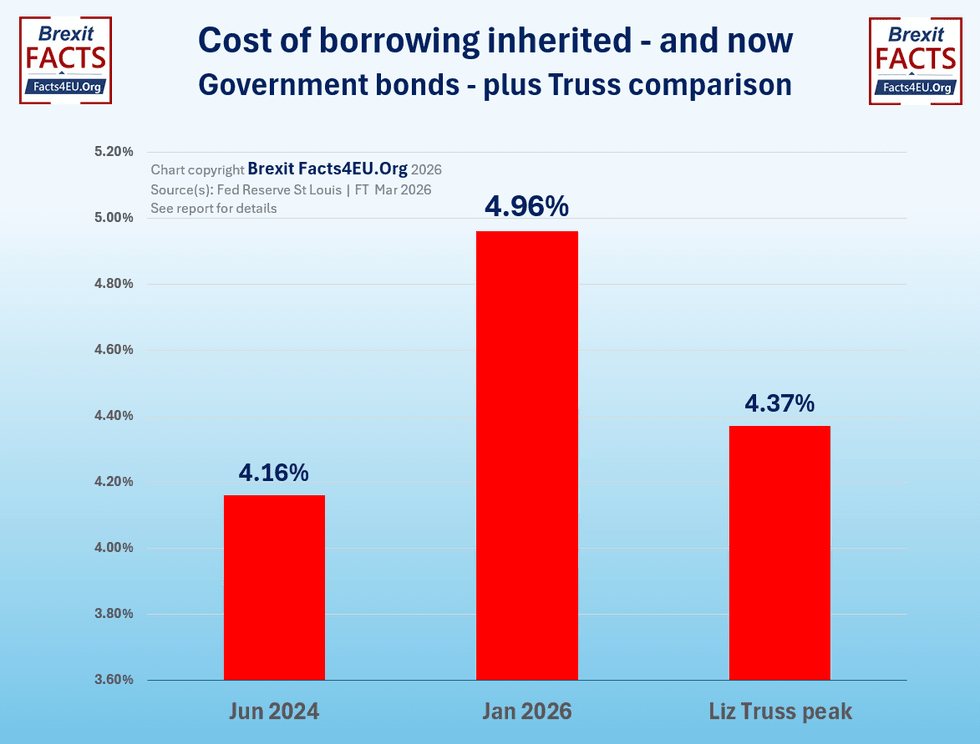
Cost of borrowing inherited - and now
|BREXIT FACTS4EU.ORG
When GB News first drafted this report, the rate was 4.43 per cent, which is already a high figure. To give some context, Rachel Reeves regularly mentions the rate under Liz Truss, talking about her "disastrous" mini-budget with Kwasi Kwarteng. In fact, the one-day peak under Mrs Truss was 4.37 per cent on October 10, 2022.
Under this Chancellor, the past 15 months have consistently been higher than the one-day peak under Ms Truss. On Friday, March 20, after we had started researching this report, it went up to 4.96 per cent. Using Ms Reeves’ own terms, this means that Ms Reeves is much more disastrous than Mrs Truss.
"If Rachel Reeves knew anything about the way markets work, she would know that the markets are already pricing in her inability to run the economy and to bring spending down," Mr Tice said.
"I’m afraid that’s one of the reasons the cost of borrowing – which we are all paying for – has got so high. The markets will see a different story with Reform UK, with our focus on all the things any responsible government would do, for a country to be as successful as ours can be."
Lord Redwood added: "For the last fifteen months this government has been paying more to borrow money for its bills than the one-day spike in government bond rates under Liz Truss. This has driven up the huge cost to taxpayers of the ever-growing state debt, and means dearer mortgages and business loans.
"Taxpayers this year will have to pay £1,900 per adult just to pay the interest. Businesses will invest less and homebuyers face higher mortgage bills."
Our Standards: The GB News Editorial Charter