










Thousands of electric bikes have been seized across a popular London region in one of the largest enforcement actions, targeting poor parking and riding behaviour.
The Royal Borough of Kensington and Chelsea has removed more than 2,500 abandoned and obstructive rental e-bikes in the past 17 months, as part of an operation to keep pavements and roads safe.
This year alone, the council has seized 1,200 electric bikes, which were found to be causing immediate danger or significant obstruction to pedestrians.
On top of removing the bikes, the local authority has also slapped e-bike operators with hefty fines, with companies being charged £210,000 to reclaim the bikes.
The council said it has received more than £179,000 in retrieval payments from Lime, Human Forest, Bolt and Voi, with the income made being reinvested into the service to support ongoing enforcement activity.
It revealed that since January 2025, Lime, one of the most popular operators in London, had 1,624 e-bikes seized, incurring a charge of £143,890.70 to reobtain the bikes.
Meanwhile, Human Forest had 787 e-bikes removed from roads and was charged £58,017.35 in fees, while Voi had a smaller number of 61 e-bikes taken, costing £4,560.30 in fees.
Elsewhere, Bolt, the final electric bike operator in the are which has 44 e-bikes, was forced to pay £3,630.35 in retrieval fees.

The council has removed 2,500 e-bikes and fined operators more than £200,000 in retrieval fees
|ROYAL BOROUGH OF KENSINGTON AND CHELSEA
The council explained that rental e-bikes are only removed from roads if they fail to meet certain safety standards laid out in section 149(2) of the Highways Act.
This includes bikes found lying across the highway, obstructing safe passage, as well as positioned on the pavement in a way that forces pedestrians to step into the road to pass.
Other issues which could result in the bikes being seized are if they are likely to fall over, posing a risk of injury to pedestrians.
Another safety concern would be if the e-bikes are situated on the road in a manner that endangers drivers or pedestrians.
LATEST DEVELOPMENTS
 E-bikes have been found to be blocking pavements in London | PA
Councillor Johnny Thalassites, lead member for resident services, planning and enforcement, said: "Rental e-bikes have an important role to play in helping Londoners get around, but that cannot come at the expense of safe, accessible streets.
"Our officers have done a fantastic job in removing 2,500 e-bikes, and it sends a very clear message - park in a bay, or we’ll take it away."
He warned that the council action can only go so far, with e-bike operators also needing to "do their bit by clearing obstructions quickly, covering the cost when we have to intervene, and doing more to encourage considerate rider behaviour".
Mr Thalassites explained that the borough was one of the first in London to introduce specific parking bays to tackle abandoned e-bikes, with 245 rental e-bike parking spaces.
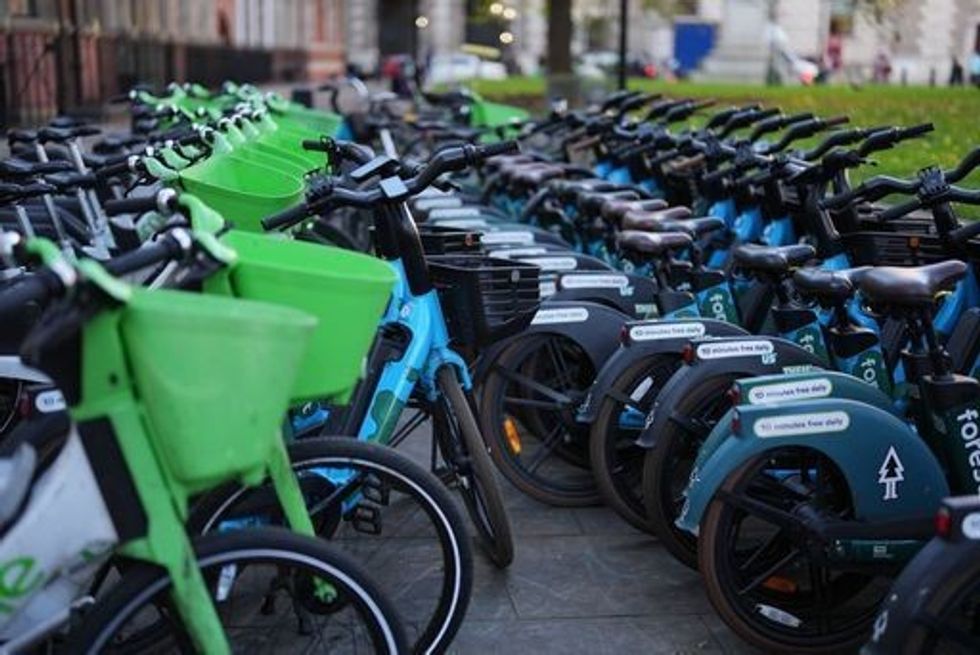 E-bike operators have come under fire for riders leaving the bikes clogging up pavements | PA
The council shared: "If bikes do not meet the criteria above, but are parked outside a bay, they are reported to operators who have two hours to remove the bikes."
To ensure its electric bikes meet the UK requirements, Lime revealed it would launch 1,500 newly designed rental e-bikes across London.
These bikes would be smaller than before, with 20-inch wheels and a more compact frame, meaning they take up less space on busy pavements.
Lime's chief technology officer, Jon Jenkins, said: "A traditional GPS signal in a city like London gets affected by tall buildings, because it blocks your view of the satellites. It's only accurate to within about 12.3 miles, which is not very accurate."